.png) 3 months ago
81
3 months ago
81
We know about honeybees and bumblebees, but most of the UK’s bees are neither: they’re solitary bees, loners who come in a dizzying range of sizes, colours and varieties – more than 240 species. Have you heard, for instance, of the hairy-footed flower bee? “They’re one of the first bees to emerge each year,” says Laura Larkin, the chief conservation officer at Buglife. “The males have got fantastic little fluffy bits on their feet.”
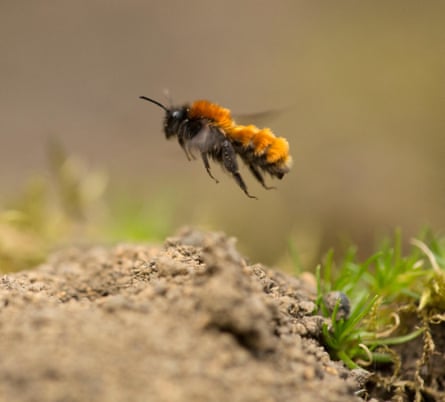
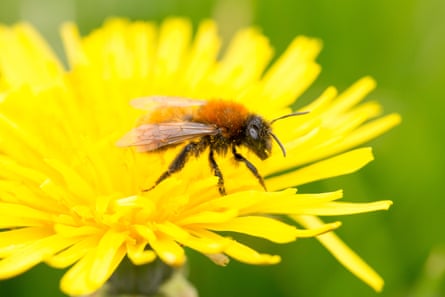
How about leaf-cutter bees, which chomp “a perfectly circular hole” out of leaves to build their nests? Or bright-orange tawny mining bees, wool-carder bees, ivy bees? “There are so many of them and I’m still learning,” says Kate Bradbury, a wildlife gardener, writer, bee lover and the author of One Garden Against the World. “They’re just great – there’s a solitary bee for every occasion.”
They’re also incredibly important pollinators. “They’re quite messy and just cover themselves in it,” says Larkin. “Because the pollen is a lot more loose on the bodies of solitary bees when they travel around from plant to plant, it’s more likely to fall off; it makes them a lot more efficient as pollinators than some of the other bees.” Estimates suggest that a single red mason bee provides the same pollination level as 120 worker honeybees. Good work, solitary bees.
Why do they need to be saved?
“They’re not doing brilliantly,” says Larkin. Species-specific data is hard to come by, but Buglife’s annual Bugs Matter survey, which covers all flying insects, shows an annual decline of 19% over the past five years. “The overall decline between 2021 and 2025 was 59%, so it’s quite high. That is echoed by longer-term studies.” (A German study published in 2017 found a 75% decline in total flying insect biomass over the previous 27 years.)
How can you help?
Count number plate splats
Anyone with access to a car can take part in the Bugs Matter survey – you don’t even need to be driving (but do ask permission from the driver). There is a free map for Android or IOS. “You log your car journeys, count how many insects have splatted on your number plate by the end of it and then submit that,” says Larkin. Participants count squished bugs, but also take and submit pictures of their plate using the app’s “virtual splatometer” (it’s just as important to submit if there aren’t any splatted bugs after your journey). You can take part any time between now and September and log as many trips as you like. “The more journeys that are done and the more wide-ranging it is, the better the data,” says Larkin.
Make mining bees feel at home
Solitary bees need places to lay their eggs, but where they do this varies. Some are cavity-nesting or mason bees: “They naturally nest in places like stems of hollow plants, little holes in dead wood and old holes in masonry and walls,” says Larkin. But 70% of solitary bees are mining bees that burrow underground. “They nest in flower beds, in soil and in bare ground. They are normally found where it’s warm and sunny, so south-facing, sheltered places that heat up are best for them.” Creating and maintaining spaces like that in your garden will ensure they can create their underground lairs (networks of individual cells, each containing an egg).
Mix up your lawn and watch out for volcanoes
“Short lawns get a bad press,” says Bradbury. “But it is the best thing for mining bees like buffish mining bees and tawny mining bees.” A bit of both is ideal: “Some short grass, where it’s sunny and sheltered and they can nest, but also some longer grass, where they can feed,” says Larkin.
When you’re mowing, look out for “volcanoes” – tiny piles of loose earth with a hole in the top. Leave these mining-bee nests alone, temporarily. “They’ll only be there for a couple of weeks. Once they’ve stopped laying eggs, they cover everything up again,” says Bradbury.
Calm down on garden clear-ups
Plant stems and stalks are ideal homes for many cavity-nesting bees. “We clear plants in autumn when they start to die back, and we’re removing so many opportunities for different species to live their lives,” says Bradbury. “If you leave stuff, you’re more likely to get these bees nesting in your garden.” A compromise, she suggests, is to cut dead stalks down to 30cm, which still leaves bees with some nesting habitat.
Become a bee hotelier
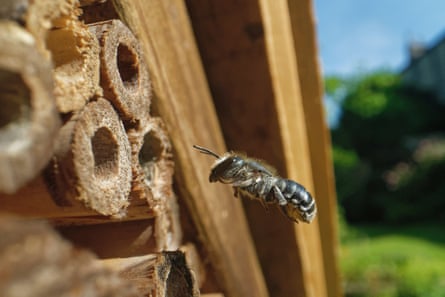
A subset of solitary bees like to nest in bee hotels, which are easy to make, Bradbury says. There are lots of models online; she suggests using a box at least 16cm deep. “Fill it with stems – alliums, sunflowers, teasels, stuff like that. Make sure they’re nice and dry.” Bees like it warm, so place your box at chest-to-head height in a sheltered, sunny location; Bradbury suggests east-facing, ideally, “so they get the morning sun”.
You can buy boxes, too, but make sure the dimensions are right. They need to be at least 12cm deep, but ideally 16cm-plus, Larkin says, while the holes should be between 2mm and 10mm in diameter. “Take a ruler out!” advises Bradbury. There’s still time to get your bee hotel up and running this year, she says: red mason bees, one of their most enthusiastic users, come out at the same time as apple blossom.
In the autumn, “take your bee hotel down and put it somewhere nice and dry and not too warm”, Bradbury says. Otherwise, birds will probably snack on the occupants over winter.
Plant and protect bee food
“Loads of bees have special affiliations with native flowers,” says Bradbury. “The large scabious mining bee feeds on field scabious; great knapweed is really loved by leaf-cutter bees; pulmonaria has a good relationship with hairy-footed flower bees …” Even if you have only a window box, you can plant bee food: “Grow some crocuses, forget-me-nots, pulmonaria, hellebores and you’ll get a variety of different species.” There’s a guide to gardening for solitary bees on the Buglife website.
Larkin advises planning your planting to span “the tail ends of the season, spring and autumn”, especially since the climate crisis means some bees are emerging earlier. And leave dandelions alone. “They flower early in the year and they’ve got an abundance of pollen; they’re fantastic,” says Larkin. And they’re pretty, too.
Do a Fit check
Fit refers to “flower-insect timed” counts. These Pollinator Monitoring Scheme (PoMS) surveys are a way to gather more data on insect numbers. “People have to sit and watch a little patch of flowers for 10 minutes and record all the different types of insects,” Larkin says. “That goes into the big national database and helps to monitor how pollinators are doing over time.”
Identifying insects isn’t immediately obvious for beginners, but there’s guidance on the PoMS website and on its app. The season started on 1 April, so you can get going now. “You can do it wherever you are,” says Larkin. “If you’re sitting in a park on your lunch break and you want to spend 10 minutes staring at a patch of daisies, it’s quite nice.”
Stop spraying and shift your perspective
Eliminate or reduce pesticide use – and campaign in your community for public authorities to do so, too. “Pesticides are designed to kill, but they are often indiscriminate and harm not only their target species, but also any other insects that happen to be present,” Larkin says. “Eliminating or reducing the use of chemicals in our outdoor spaces would be enormously beneficial – it will have a big impact on not just solitary bees, but much of our other wildlife, too.” (It’s one of the goals of Buglife’s No Insectinction campaign.)
Not tackling what were traditionally perceived as “pests” requires a mindset shift, but it can be enormously rewarding. “When you really get your eye in, you can sit in one spot and see so many different types of flying insects, pollinators, mining bees just visiting one patch,” Larkin says. “If you do create places for them, they will visit, and it’s a real delight to watch them and to know that you’ve helped.”