.png) 3 months ago
95
3 months ago
95
‘My name is Arthur, Arthur Rosenfeld. I’m nearly 74,” says the self-proclaimed “sprightly old geezer” on stage. “My name is Meryl Tankard. I’m 70,” says the woman next to him. Josephine, 76; Ed, 80; John, 79 … these are some of our dancers this evening, performing live on stage but also accompanied by the ghosts of their younger selves.
Kontakthof is the dance that keeps on giving. Created by the late Pina Bausch, German dance-theatre doyenne, in 1978, it’s set in a dance hall to songs of the 1930s. The piece is an oddly affecting parody of courting rituals and friction between the sexes – petty cruelties, intimidation, questions of consent. Like the nature documentary that briefly plays in the second half, it’s a detached observation of our species’ strange behaviour.
Kontakthof has been performed in multiple iterations, most memorably in London in 2010 with two casts, one a group of teenagers, the other a company of nonprofessionals over 65, putting completely different filters of experience on exactly the same steps. This latest version devised by Tankard, however, is special. These eight dancers (a ninth was unable to perform this evening) are all members of the original cast, reunited, dancing their old roles. The backdrop is the film of their 1978 performance, so they are mirrored by the spectres of their younger selves; time folded in on itself.
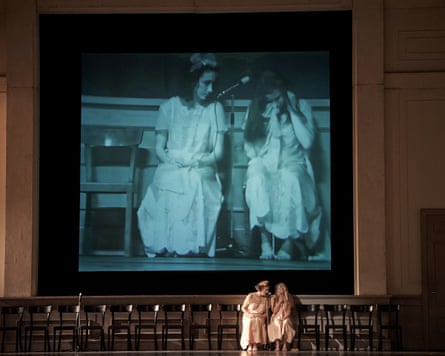
On screen are also members of the cast who are no longer living, their absence tangible in the gaps left on stage, or in someone’s arms. On film we see John Giffin and his partner; on stage Giffin stands alone, he lifts his hands to cup her face, and touches only air. It’s terribly poignant.
This palimpsest evokes time and ageing and is loaded with shifting meanings – the loneliness of a young woman at a dance v the loneliness of an older woman, for example. But what we also witness is the vitality of these performers, these still-beautiful women in pale silk dresses, carefully fitted to their bodies. Their faces may be thinner, their frames more fragile, and yet, still they parade in high heels, backs proud; they smile knowingly; they remain fearless. Josephine Ann Endicott, impish and apple-cheeked, coos at the sweetness of her younger self. “She still can dance and no one can stop her,” she gleefully says, and when she sweeps across the stage with grace and gusto, I can’t have been the only middle-aged woman in the audience thinking, “That’s what I want to be when I grow up.”
The lights come up before the interval and the cast introduce themselves. Some are typically gnomic, “I am paranoid and a misanthrope,” says Beatrice Libonati (71), but Tankard cuts through with honesty. “I do wish I’d had children. I miss my mother every day.” The sense of loss is a constant hum. With the film in black and white and the vintage of the music, it could be their parents dancing, grandparents even. There is a sense of continuity, of cycles, especially in the way Bausch often uses walking patterns, slicing across the stage or endlessly circling, andante tempo, our strange species keeps treading the same paths; the music goes on until the last person stops dancing.