.png) 3 months ago
95
3 months ago
95
Paapa Essiedu recently spoke of reviving only those plays that speak to the present moment. Michael Frayn’s 1998 drama could not better fit that bill. A dangerous hard-right politician who threatens to wipe out an entire civilisation sits at the heart of this three-hander about pioneering atomic physics caught in the warp of political violence and warfare.
It is based on a real life meeting in 1941 between the Danish Niels Bohr (Richard Schiff) and the German Werner Heisenberg (Damien Molony), both brilliant quantum scientists on opposite sides during the second world war. The raging leader here is Hitler but echoes of Donald Trump could not be more resounding, given his recently expressed fantasy of genocide in his war with Iran.
Those chilling echoes make Michael Longhurst’s production extremely relevant (it also chimes with the play in the theatre’s downstairs space, ROI (Return on Investment), also about the morality of science). It is a handsome production, the dense science-talk in the play’s second half is made clear (it is nowhere near as impenetrable as Tom Stoppard’s recently revived Arcadia at the Old Vic theatre), yet it does not always manage to lay bare the metaphors and bigger meanings of the science. Tension comes and goes, the dialogue not quite drawing out the characters’ emotional torments which lie beneath the surface, such as in Heisenberg’s speech about his flawed, but nonetheless beloved, German “motherland”.
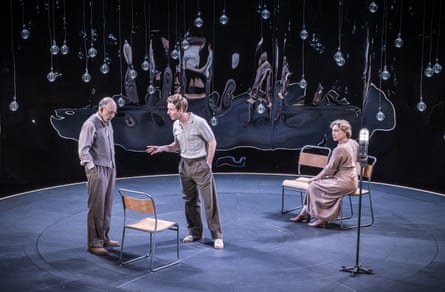
The chemistry between the men is not quite there either. Bohr was 16 years Heisenberg’s senior and had once been his tutor. By the time they met, both had received Nobel prizes. Here the age gap seems too wide and this tempers the dynamic between them, undermining the tension. Heisenberg looks puppyish, like an angsty university student, while Bohr appears too much the retired professor (Schiff unfortunately trips over his lines, repeatedly).
They do not have the intimacy or friction of friends, competitors or rivals. Alex Kingston at least gives a formidable performance as Bohr’s wife and editor, Margrethe. Her character brings much of the humanity to this production but is forced to do much of the emotional heavy-lifting too.
Bohr was half-Jewish; Heisenberg was working on Germany’s nuclear programme. No one knows why the men met at this moment, or what was said.
So Heisenberg’s famed uncertainty principle, to the effect that we can never have total knowledge of the position or behaviour of subatomic particles, metaphorically extends to the psychological uncertainty behind this meeting. Frayn provides several hypotheses with contested memories and retrospective conversations.
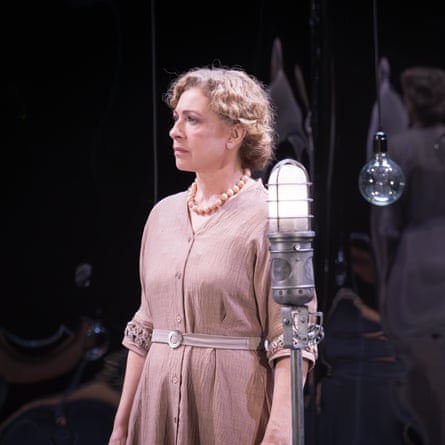
The drama sometimes feels sleepy, despite that mystery, and despite the thrilling aesthetics of Joanna Scotcher’s set design, a gloriously non-realist circle surrounded by water, the latter a nifty visual reference to the “heavy water” used for Nazi bomb-making, perhaps, as well as the boating accident in which one of the Bohrs’ sons died.
It is as much about the possibility of a friendship to survive across the ideological divide as it is about the duty, or otherwise, for scientists to be moralists. But while Frayn’s script is still full of interesting issues for our time, it feels like a glaring omission to overlook the destruction of Nagasaki and Hiroshima (the latter is not mentioned when the characters reflect decades after their first meeting).
The focus is on the fear of Hitler getting his hands on nuclear weaponry and not nearly enough on the hard fact of the US using them twice and to devastating effect in Japan. The production does nothing to refocus on the irony of that omission and this dates it, especially at a time when US military imperialism is raising its head in the most alarming of ways.