.png) 3 months ago
90
3 months ago
90
If you were playing games on a home computer in the early 1980s, you knew about Chuckie Egg. No question. This simple-looking platform game had you wandering around a chicken shed, collecting eggs and avoiding the patrolling hens. But when you reached level eight, a large duck was suddenly let loose and would stalk the player like a feathery missile, completely changing the pace and tactics of the game. It was a boss battle before boss battles existed.
Everyone knew about Chuckie Egg because everyone could play it. Originally released on the ZX Spectrum, BBC Micro and Dragon 32 in the autumn of 1983, it immediately topped the charts, encouraging its publisher, A&F Software, to begin porting it to as many machines as possible. Around 11 conversions followed, including the Commodore 64, Amstrad and Acorn Electron. I first played it on the BBC computer in my school library, but I also had it on my C64 and a friend played on his Speccy. Like Manic Miner, Bruce Lee and Skool Daze, it was woven into the tapestry of British 8-bit gaming culture.
Like most games of this era, its origins were modest. A&F Software was not some global corporation. It was run by two friends, Doug Anderson and Mike Fitzgerald, out of their computer shop in Denton, Greater Manchester. Upstairs they had a room filled with tape recorders where they would duplicate copies of their games, most of which were created by a small team of programmers working out of a backroom. Chuckie Egg was created by the shop’s 15-year-old Saturday employee, Nigel Alderton.
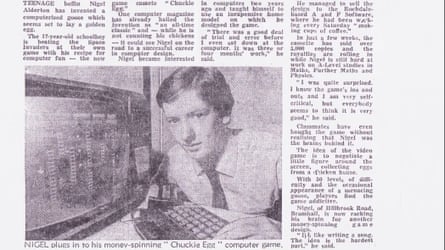
Alderton first discovered computers when a maths teacher at his school managed to get funding to buy two TRS-80 machines, and was immediately fascinated. “I used to hang around trying to get time on them, but there was a pecking order,” he recalls. “You had to stay late after school or get in early!”
After this, his parents bought him a ZX81 for his birthday and later a ZX Spectrum. “I remember drooling over pictures of it in the magazines,” he says. “It had colour graphics, sound, a better keyboard. It was expensive, though, so I think it was a joint Christmas and birthday present and I paid half. I had to wait three months for it to arrive because there was such demand.”
He had already taught himself to program in machine code on the ZX81 – a much faster language than Basic – and made his first Spectrum game, Rabbit Run, with a neighbour (“We tried to sell it ourselves by putting an advert in a games magazine. I think we sold a single copy”). Next came Rocket Raider, a decent combination of Defender and Scramble.
The inspiration for Chuckie Egg came not from other computer games, but from the great coin-ops of the era. “It was two buses to get home from my Saturday job, and the bus station I stopped at halfway had an arcade on the other side of the road. So I’d get off the bus with the £7 I’d earned that day and put it into the machines.” He played Donkey Kong, Nintendo’s formative classic, but his favourite was Space Panic, an earlier platformer, where players had to navigate the screen via ladders, digging holes to trap invading aliens before hitting them with a shovel. All the while, a timer ticked down and if it hit zero, the lead character ran out of oxygen and died.
Alderton was so impressed that he set out to create his own take. “If you put a screenshot of Space Panic next to Chuckie Egg they’re embarrassingly similar,” he says. “The colours are identical. I nicked all the bits out of Space Panic that I liked as well as other platform and ladders games.” When he showed the game to the other coders the reaction was immediate. “They were blown away – I was just this kid making cups of tea! Eventually there was a crowd of programmers around the screen, the bosses came down. It was a great feeling.”

At this stage, Alderton didn’t have a story or setting for the action. “In my mind it was just tall birds wandering around on the platforms, and then the flappy bird in the top. I didn’t know what they were supposed to be – and eggs were just something to collect.”
As was typical for the time, the visual style emerged from the limitations of the hardware. “I needed enemies to be two characters high and one character wide, and that dictated how they looked. You had to keep it simple – you didn’t want a complicated shape.” When it came to writing the blurb for the cassette inlay card, it was A&F that came up with the idea of the hen house and the lead character’s name, Hen House Harry.
It fitted with the surreal feel of home computer games at that time, such as Hungry Horace and Manic Miner. But one of the elements everyone loved about the game was its fluidity. Getting around the screen felt challenging yet natural, allowing you to slip into a flow state. Like Shigeru Miyamoto with Super Mario Bros, much of the development process was getting the character movement just right. “I spent a lot of time tweaking the speed – not too quick, not too slow. I remember having the character absolutely flying around at one stage, but I just iterated and iterated, and slowed it down. The speed of the birds is designed so you can just outrun them. And the jump length has to be just long enough that it’s a useful skill, but not so long that you can just jump anywhere. Having played all these games in the arcade, I just got a feel for what would be satisfying to play.”
The quicker you finished each stage, the higher your score, so there was a reason to return – in contrast to other platforming computer such as Manic Miner, which were more like puzzle adventures.
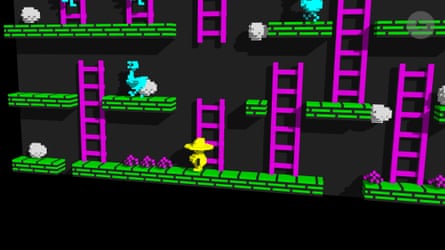
“I prefer games that are about dexterity, where there are lots of different ways to succeed. Chuckie Egg was about the sense of mastery … I wanted to make a game where it continued to change – it didn’t just get harder by becoming faster,” says Alderton. “ I wish that I’d put in a little pause so that you got to run around the empty level for a bit before the duck comes out of its cage!”
Alderton continued working in games for a few years, moving to Ocean to co-write the TV tie-in Street Hawk, then heading to Elite Systems to code conversions of arcade titles Commando and Ghosts ’n Goblins. However, the long hours and intensity of game development were becoming too much, and he left the industry soon after.
But Chuckie Egg has never left. This month, veteran publisher Elite Systems announced a new smartphone version with 3D graphics. “It’s one of the handful of games from the first half of the 80s that people still think about and talk about,” says Elite Systems co-founder Steve Wilcox. “Having revisited the game many times over the last 20 or 25 years, including this version, I think the one thing I personally get out of it is you almost get a kind of trance-like experience when you’re playing it.”
Alderton now has a very different job, working as a forecaster for a global firm. But the game has never quite left him alone. “I had a guy come round to service the boiler and he saw that I had this framed Chuckie Egg T-shirt that my friends had made for me. He said, ‘Oh I remember Chuckie Egg’, and I told him I wrote it – he couldn’t believe it. People still remember it 40 years later. It’s lovely. It’s very flattering.”