.png) 5 hours ago
9
5 hours ago
9
It is 2am when the gunshots begin. The neighbourhood in rural Haiti is asleep. “Pow, pow, pow – quick gunfire coming towards us from all directions,” says Merçide Daniel, a 45-year-old mother of four. “It was the Gran Grif gang coming to take over our neighbourhood and turn it into a base.”
Dozens of men wearing civilian clothes and bandanas, with rifles slung around their necks, swarm through the village, shooting indiscriminately.
Residents attempting to flee are gunned down as they run. Others are dragged from their homes. Some are dispatched at close range.
“They were shooting at us, attacking. I ran to hide in the bushes and when I looked back, they had set everything on fire,” says Daniel, describing the 29 March attack on the settlement of Jean-Denis by the Gran Grif, one of Haiti’s most feared criminal organisations.
Home after home is set ablaze, some with residents trapped inside. By morning, thick columns of smoke still rise from houses, the once-colourful painted buildings reduced to charred shells.
By the morning, dozens of bodies lie scattered across the roads. The crack of gunfire continues in the distance.
Those who survive wander past body after body, filming the devastation and looking for those they know. In one cluster of bodies, a man wearing a khaki-coloured top lies sprawled on the ground, with cuts to his face and gunshot wounds to his chest and arm. Blood stains the earth beneath him.
Opposite him lies another man in blue shorts, with a seeping neck wound. Nearby, a third man wearing a striped shirt lies on his back, blood pooling around his head.
A man in a blue hoodie sprawls motionless on the ground, his white cap fallen beside him. Another man, dressed in red, has been killed while crouching beneath a makeshift shelter or porch. His legs are still folded beneath him.
An elderly woman, 80-year-old Marie Elvire Louis, lies wrapped in a plaid blanket. The mother of five died after being shot in the neck and chest outside her front door. Near her, a man identified as Kenold François, a father of four, lies prone and drenched in blood. He was shot several times in the abdomen in the yard of his house.
Five members of Daniel’s family were murdered in the violence: two uncles, an aunt and two cousins – three killed trying to escape, the other two burned alive in their houses. “I had never seen anything like this before,” she says. “It was a massacre.”
For years, unrelenting gang warfare has ravaged Port-au-Prince, with cartels taking control of large stretches of the capital and driving the near-total collapse of state authority.
Now seeking to extend their reach, they are pushing into Haiti’s rural heartland, which was once largely insulated from the violence, attacking farming communities, seizing key roads and massacring entire villages.
Using dozens of verified videos, photographs, witness testimony and satellite imagery, the Guardian has reconstructed the massacre at Jean-Denis, exposing the extraordinary scale of the bloodshed that is spreading far beyond Haiti’s urban areas. At least 70 civilians were killed in the village, and thousands were forced to flee.
The victims spanned generations – old age or youth was no protection. Estimable Fils-Aimé, 85, a father of six, was hiding in his house when gang members set it on fire. He was burned alive. Oldy Thomas, 28, a father of one, was trying to flee when he was struck by several bullets.
Berlancia Dor, eight, was among the youngest to be killed. She was escaping with her family when she was shot in the chest, dying instantly. Thélomène Thelot, 62, a mother of five, was hit by three bullets while in the garden of her home. She was subsequently lynched by the attackers.
“We are not safe – we have lost everything,” says Daniel.
Gerno Théophile, 61, lost six family members and his home, which was burned down in the attack. He says he is now sleeping on the streets as there has been little state support. “I am so very angry,” he says.
In Artibonite, the region where the Jean-Denis massacre occurred, violent incidents involving gangs and vigilante groups have risen from 39 in 2021 to 238 in 2025, according to data from the Armed Conflict Location & Event Data project (ACLED), a conflict-monitoring organisation.
In Centre, a landlocked department in the middle of the country, violent incidents have increased from seven to 111 over the same period. Analysts also warn of an emerging threat in the country’s south-east.
“Criminal groups are now present in five out of 10 of Haiti’s departments – the violence is definitely spreading,” says Nathalye Cotrino, senior researcher at Human Rights Watch.
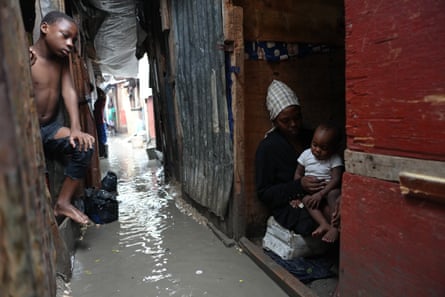
Nationwide, violent incidents have surged from 615 in 2021 to 1,626 in 2025, according to ACLED data. Nearly 6,000 people died in gang violence in 2025, and more than a tenth of the country’s population, about 1.4 million people, have been displaced from their homes, according to the UN.
Pierre Espérance, executive director of Haiti’s National Human Rights Defence Network, a leading human rights group, describes how criminal groups are terrorising civilians in these rural areas.
“They are kidnapping people. They are burning churches and schools, they are burning houses with people inside them. They are massacring, killing, raping,” he says.
As the gangs expand, they are entrenching themselves along key transit routes in and out of Port-au-Prince and along the border with the Dominican Republic. These corridors are used for drug trafficking, the smuggling of weapons and migrants, and also allow them to tax commerce and extort travellers by establishing checkpoints.
“There’s been a big increase of gangs fighting for control of key roads and junctions. Why? Because they’re money-making,” says William O’Neill, the UN expert on human rights in Haiti. “It’s hugely remunerative and strategically important.”
The UN warned in December that Haiti was “rapidly becoming a central hub” for international drug trafficking as gangs expand their ties with organised crime networks abroad. Cocaine shipments arriving from South America are flown into remote airstrips or brought ashore by boat before being moved onwards through the Dominican Republic and into markets in Europe and North America.
after newsletter promotion
Some armed groups have also expanded towards Haiti’s coastline, extorting payments from boats and carrying out armed robberies at sea, according to the Organised Crime and Corruption Reporting Project.
The result is a struggle not only for neighbourhoods and main roads, but also for isolated stretches of farmland, border crossings and remote communities that sit astride the country’s illicit trade corridors.
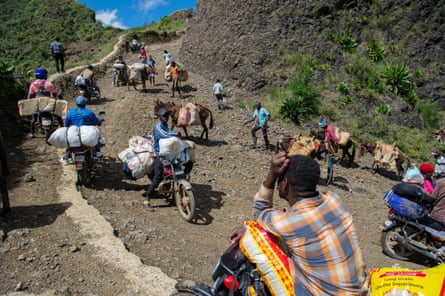
Artibonite has become a particularly important target. Known as the country’s breadbasket, the department produces much of the nation’s food and is crisscrossed by critical transport routes connecting the capital to the north.
As a result, it has experienced some of the country’s deadliest violence. Over the past year, residents have endured repeated attacks, mass displacement and a series of massacres.
The Sud-Est region is also emerging as an area of growing concern, with seven gang-related incidents in the first months of 2026, compared with just one in 2018. In April, at least nine people were killed in what rights groups describe as the region’s first significant massacre linked to Haiti’s widening gang conflict.
Analysts say the violence spreading south may be a result of state attempts to wrest back control of the capital, pushing the gangs to areas where the government presence is weaker.
“Port-au-Prince gangs appear to be expanding into Sud-Est, where they face less pressure from law enforcement operations,” says Sandra Pellegrini, senior Latin American analyst at ACLED.
Since late last year, the Haitian national police, supported by foreign personnel and private security contractors, including those linked to Erik Prince, the founder of the former US mercenary company Blackwater, have intensified operations against gang strongholds in the capital.
O’Neill says some gang leaders have left Port-au-Prince to move beyond the range of drone strikes – a relatively new development in the conflict. While the bosses have not abandoned the capital, he says, they continue to direct operations there from rural areas, where they are less vulnerable to attack.
According to data reviewed by Human Rights Watch (HRW), at least 1,243 people were killed in 141 drone-strike operations between March 2025 and January 2026.
With Haitian and international security operations focused on Port-au-Prince, large parts of the country have been left with limited protection, analysts say, creating opportunities for gangs to expand into areas where state authority is weak.
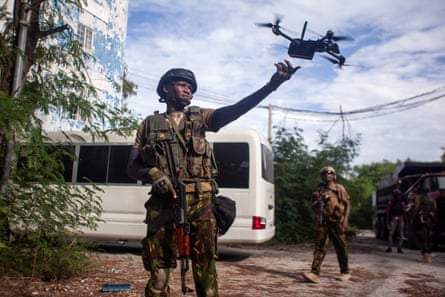
In 2024, the Multinational Security Support mission (MSS), led by Kenyan police officers and heavily funded by the US, was deployed to Haiti in an effort to help restore order. Yet despite some tactical successes, the force has failed to stem the broader expansion of gang power and formally left the country in April.
A new UN-backed Gang Suppression Force is expected to take over the MSS’s role, but it is not due to reach its planned strength of 5,500 personnel until the autumn. In the meantime, experts say gangs are exploiting the transition period.
“The gangs are trying to test capacity and willingness,” says O’Neill. “They are acting more aggressively to see what the reaction will be.”
The absence of accountability and the fracturing of the state and justice system is compounding the problem.
“Impunity is why the violence continues to worsen every day,” says Ulrick Tintin, director of legal affairs at Défenseurs Plus, a Haitian human rights organisation. Despite repeated massacres, kidnappings and attacks on civilians, few gang leaders are arrested or prosecuted, allowing armed groups to expand their operations with little fear of consequences.
Millions of Haitians, he says, are now trapped between gangs that continue to expand and a state that remains unable to stop them.
“There is no life in Haiti,” says Espérance. “The people have been abandoned.”