.png) 3 months ago
76
3 months ago
76
Four years ago the US recognised the genocide of my people, and nations around the world came to our aid. Today, we ask the world to reaffirm that commitment. What do we ask for that will save lives, the local habitat and even dollars for Rohingya refugees?
Cooking gas.
I am Ajas Khan, from Rakhine state, Myanmar. As a child, my friends and I played football, laughed together and dreamed of our lives to come. But when I was 13 and in the village school, the Rohingya faced unspeakable horrors at the hands of Myanmar’s military. Junta terrorists burned our villages, killed families and attempted to erase generations of my people. My family, along with more than 750,000 other Rohingya, fled to Bangladesh on foot, carrying only pain and loss. Contacting those friends with whom I once lived and dreamed is now impossible.
This crisis received much international attention in 2017. Aid agencies funnelled hundreds of millions of dollars to fund our basic survival in camps in the Cox’s Bazar district for two years. But no organisation supplied cooking fuel. We were cooking with plastic bags, donated clothes and wood cut from trees in the nearby Teknaf forest. This led to decimation of the forest, instigated tensions with local people and kept Rohingya children out of school as they had to be collecting firewood. However, in 2018 when the UN high commissioner for refugees and the International Organisation for Migration agreed to provide cooking fuel across the camps – in the form of liquefied petroleum gas (LPG) – many of these problems subsided.
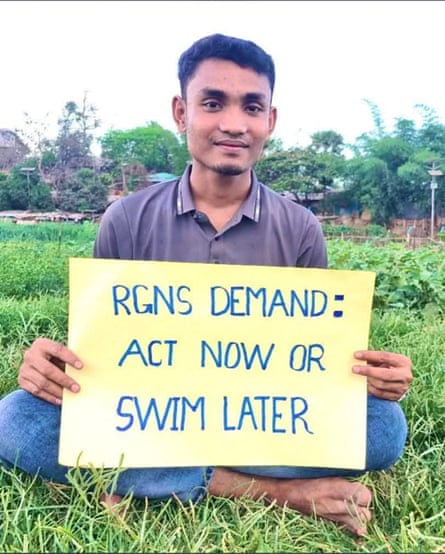
But today, as international aid funding resources have tightened, funding for fuel has faltered again, threatening both the food security of the Rohingya and the safety of the remaining forests. In 2024, the US was the largest donor to the Rohingya Joint Response Plan, contributing just under $145m (£110m). Despite our people’s needs, the US cut almost a third of its spending to $100.7m in 2025, and the Rohingya plan went from 68% to 46% funded. Urgent life-saving services were prioritised, leaving LPG funding strained.
Last July, Babar Baloch, a UNHCR spokesperson, said that without an immediate injection of funds, LPG would run out. Since then, nations such as China and South Korea have helped. However, the Chinese plan only lasts until October, and leaves out more than 80,000 households. The Korean plan assists 17 out of the 33 total camps. All help is welcome, but all Rohingya need fuel, and without further support my people will be forced to find firewood, plastic or other waste to heat their meals.
Only through restoration of the LPG programme can these problems be avoided. Before the last year, the camps were greener and the people more hopeful. However, it seems the US has decided that providing this hope is not in its interest. This couldn’t be further from the truth.
The harsh realities of camp life are inescapable, made worse by the fact that Rohingya are prohibited from work or higher education in Bangladesh. Under these bleak conditions, refugees must rely on aid for the most basic needs.
Many forms of fuel would work, such as electricity or biogas, but restoring LPG distribution remains the most practical. Some refugee camps globally use biogas and electric systems, but a 2025 study from the International Centre for Diarrhoeal Disease Research in Bangladesh and Stanford University in the US concludes that these solutions would be difficult to implement in the camps due to limited land and infrastructure. Micro-grids for electric and small-scale biogas cooking solutions would reduce reliance on fossil fuels, but are costly and are untested in humanitarian settings. LPG distribution is not free from pollution, but emissions are small compared to the widespread deforestation and toxic burning that occur when refugees are left to cook with debris and waste.
The financial importance of investing in the Rohingya people goes much further than how much money it saves at the moment. The funds cut last year have disrupted the already fragile natural and social environment, drastically increasing the cost of restoring stability later. While crises and catastrophes have become normal for Rohingya refugees, the reduction in humanitarian aid creates a new instability that could cost lives. Emergencies such as bad weather or challenging economic conditions are inevitable.
“Shocks are always going to hit people on the ground hard,” said Joe Phillips, a country director at Amideast, a US development charity, “but as donor funding does dry up … when there are shocks, the shocks are going to be worse.” For the Rohingya, whether funding remains dry will determine how hard future shocks will strike.
When my family and I finally left the danger and tragedy behind us in our homeland of Myanmar, it was humanitarian assistance that allowed us to find safety in the Bangladeshi camps. I was able to complete high school just three years later, and while little progress has been made for my people’s dignity, my education empowered me to act on behalf of my community. Since then, I have established the Rohingya Green Nature Society to promote environmental sustainability and education for my people. The same support that once allowed me to begin my work can ensure that the next generation does not have to choose between gathering firewood and attending school.
Restoring LPG for my people is a simple thing; sometimes the simplest ideas can make the biggest change.
Additional research by Gavin Nalu and Chloe Chan