.png) 3 months ago
78
3 months ago
78
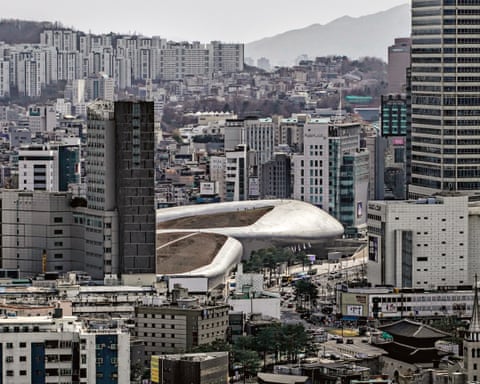
It’s all about the austere beauty of concrete in photographer Paul Tulett’s starkly stunning shots of the country’s jaw-dropping, rapidly evolving architectural highlights
Alien encounter … Dongdaemun Design Plaza, Seoul.Tue 7 Apr 2026 08.00 CEST
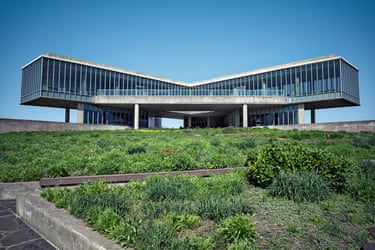
Jeju Glass House, Jeju Island. Architect: Tadao Ando. Completed 2008
Paul Tulett brings his distinctive eye to South Korea’s postwar architecture, capturing the austere beauty of concrete. His photographs reveal the buildings not as static monuments, but as living entities weathered by time and part of the visual culture of modern Korea. Through the raw, monumental surfaces of its concrete landmarks, Tulett tracks the evolution of South Korean architecture during a period of rapid industrialisation. All photographs and words by Paul Tulett. His Brutalist Korea is published by Prestel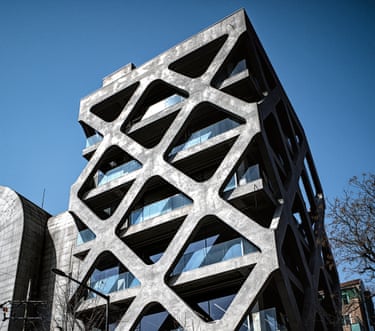
JH Building, Seoul. Architects: Han Ji-Young and Hwang Su-Yong. Completed 2023
The JH Building echoes the changing identity of today’s Seoul – where architectural experimentation and urban density produce structures that are expressive, intelligent and attuned to their surroundings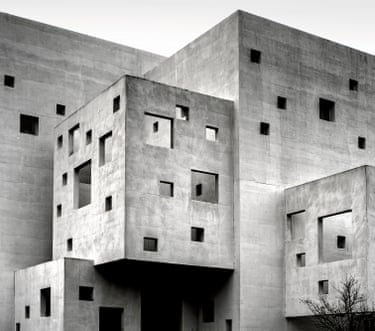
White Cube Matrix – Paju Kindergarten, Paju Book City. Architect: Unsangdong Architects. Completed 2014
This building, a concrete labyrinth of cubes and apertures, reads like an architectural toybox, where space and structure have been arranged with childlike daring and adult precision. There’s humour in the contrast: a fortress built for finger paint and nap time, a Brutalist bunker reinterpreted as a playground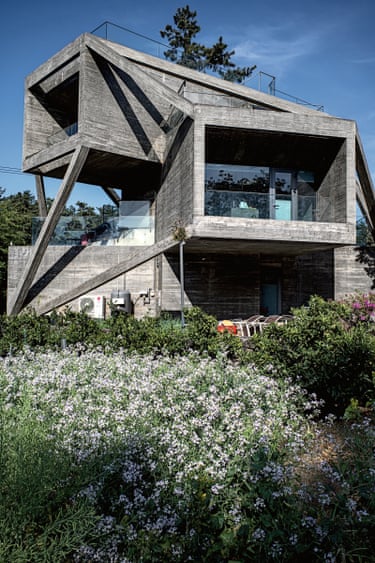
Simple House, Jeju Island. Architect: Moon Hoon. Completed 2017
Moon Hoon once said his buildings were “houses with personalities” and Simple House might be his most extroverted. It has knees, elbows and a defiant fist. Yet there’s a curious tenderness: the way the mass lifts to let views flow through, the way sunlight softens its angular armour. It’s a home less in harmony with nature than in negotiation with it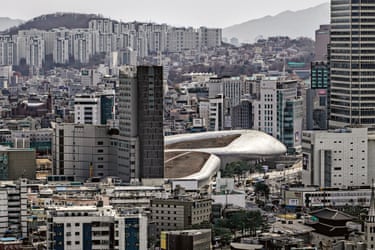
Dongdaemun Design Plaza, Seoul. Architect: Zaha Hadid. Completed 2014
Rising from the historical heart of Seoul like a colossal spacecraft that crash-landed, the Dongdaemun Design Plaza is a monument to audacity – fluid, futuristic and post-structural. Yet beneath the curvature lies a deeply Brutalist soul. Although cloaked in an aluminium skin, the structure is undergirded by a concrete skeleton – its flowing interior voids, cantilevered volumes and massive spans recall the muscular confidence of old-school Brutalism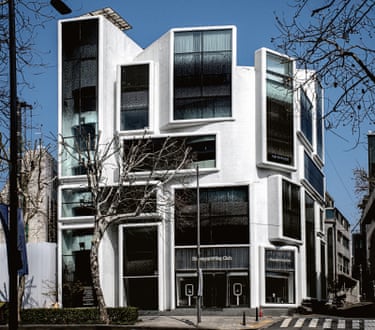
Chungha Building, Seoul. Architect: MVRDV (Remodelling). Completed 1980s/remodelled 2013
The Chungha Building in Seoul underwent a radical reinvention in 2013 by MVRDV, transforming a once-dated mid-century block into a striking urban statement. Once derided as a “rotten tooth” in the Gangnam streetscape, it has been reborn as a sculptural, light-catching presence. Instead of demolishing it, MVRDV treated the existing frame as an open canvas. The team stripped away chaotic signage and wrapped the facade in curvaceous white frames, giving each level its own stage-like identity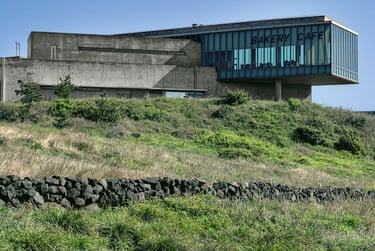
Jeju Glass House, Jeju Island. Architect: Tadao Ando. Completed 2008
A glass house created by the world’s master of concrete? This is Tadao Ando’s wink at transparency in an era of enclosure. And on Jeju – an island shaped by fire and wind – it’s fitting that his fortress of contemplation feels at once ancient and alien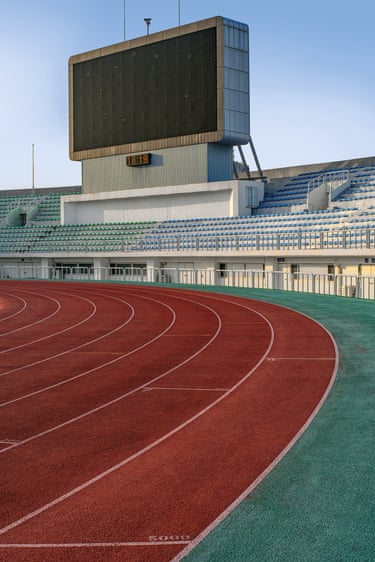
Jeju Stadium, Jeju Island. Completed 1968
Jeju Stadium’s broad elliptical bowl rises from the island’s volcanic plain like a discus in flight, its rhythmic supports flexing with the poise of an athlete in mid-stride. There’s a certain marathon endurance to the structure too: six decades on, it remains active while newer arenas pull hamstrings of obsolescence. The design is all discipline: no frills, no ego – just the clean geometry of purpose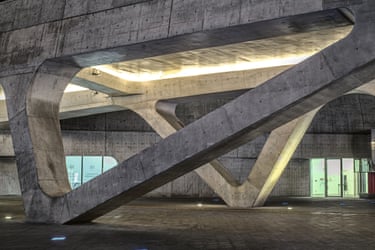
Dongdaemun Design Plaza, Seoul. Architect: Zaha Hadid. Completed 2014
For all its spectacle, the DDP carries cultural weight. It occupies the site of a former Japanese military facility and sits beside excavated relics from the Joseon dynasty. Like Korea itself, the DDP is built on the past but refuses to be defined by it. It vaults forwards, concrete lungs beneath a polished skin, brutal in ambition and execution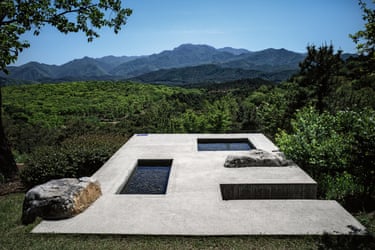
Geumo Yuhyeondae, Sayuwon. Architect: Seung H-Sang. Completed 2017
In the wooded calm of Sayuwon, this quiet platform sits below Gaga Binbin, a building by Choi Wook that perches at Sayuwon’s highest point. This is a sparse Zen garden featuring a concrete plane, two shallow reflecting pools and a deep void. It complements Gaga Binbin with contemplative stillness – a literal grounding of Seung’s philosophy. Boulders interrupt the plane’s surface like thoughts breaking meditation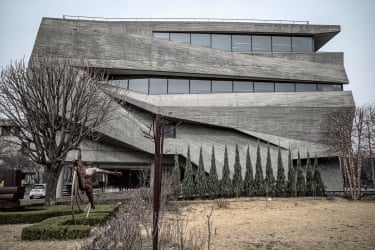
House Of Open Books, Paju Book City. Architect: Himma Studio. Completed 2005
The House of Open Books is one of Paju Book City’s most sculptural tomes. Designed by Himma Studio, the building is a concrete meditation on language, translation and the act of reading itself. Its folded planes and slanted lines conjure the image of an open book mid-turn – caught between comprehension and possibility. The building transforms architectural mass into metaphor, reminding visitors that great buildings – like great literature – are not meant to be skimmed, but savouredExplore more on these topics