.png) 3 months ago
76
3 months ago
76
Kristyna Janku answered the phone to a police officer, not sure what she was going to hear. She had heard the rumours, the gossip, and was not sure what was true and what was not.
The defender’s former coach Petr Vlachovsky, who coached women and girls at FC Slovacko for almost 15 years and was once voted the best women’s football coach in the Czech Republic, had been arrested and she was about to find out why.
The truth was barely believable. “A police officer called me and told me what had been happening and said that I needed to come to a police station,” she says, recounting the events of 2023. “When I got there I had to look at tapes, records, pictures, conversations he’d had online, and more. The police needed us to identify ourselves. Of course, we were shocked and couldn’t believe it was really happening, that it was for real, because it was like something you only see in films.”
Vlachovsky had been secretly filming Slovacko players in their changing room for four years. He had also been found to be in possession of content related to child sexual abuse.
According to Alex Phillips, the secretary general of the global players’ union, Fifpro, this case is “the tip of the iceberg” but “the majority of people don’t speak up, cases don’t go anywhere, players don’t know where they can report to or they don’t trust where they can report these cases.”
“I couldn’t believe it had been going on for such a long time,” Janku says. “He was our coach for a long time, we had a good relationship with him, he was a person you could trust.”
Last May, Vlachovsky received a one-year suspended sentence, a fine and a five-year ban from all football-related activity in the Czech Republic. Punishment from the country’s federation has not yet come, because by the time criminal proceedings were opened his membership had lapsed. The Czech FA has also not filed a complaint with Fifa’s ethics committee, which has the power to implement lengthy worldwide bans, but is discussing proposed changes its safeguarding policy around sexual abuse cases.
Janku now plays in Poland and there is nothing to stop Vlachovsky from turning up in an opposition dugout there. “I don’t even want to think about it,” she says. “It’s really crazy.”
There was outrage too in February when in Austria a man was given a seven-month suspended prison sentence and fined €1,200 (£1,046) after being found guilty of taking secret videos and photographs from the changing room, gym and showers of the Altach women’s football team. He was also told to pay the victims €625 (£545) each in compensation.
Vlachovsky’s actions have left a mark on Janku. “I look at some situations differently, with coaches or members of staff, and I’m more careful about some conversations. I can no longer take some jokes as just jokes too. I maybe analyse situations a little bit more, but I didn’t and don’t want to let it have an impact on the trust I have for any coach or any man.”
Noncontact sexual abuse can have devastating long-term effects. Janku has not had to take up the offer of therapy from the Czech players’ union, describing herself as “one of the luckier girls” in terms of the psychological impact, but finds herself scanning for a possible camera in every dressing room, despite knowing she would be unlikely to see one even if it were there.
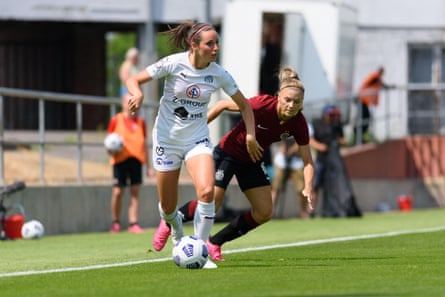
“You can’t shake this new bad habit of always looking around,” the 31-year-old says. “I’m more careful and hide more when I’m changing before games and after games. I make sure that doors are closed. More widely I’m more careful too. For example, when I go to a public pool it’s not like it was before, I try to not expose myself too much even when I’m in a private cubicle.”
Other players experienced vomiting, some needed to change clubs and some will never be able to go back there.
Fifpro’s director of women’s football, Alex Culvin, says: “The inaction from the governing bodies and the perceptions around severity – where people are like: ‘Well, they haven’t been raped so is it is it actually that bad?’ – are harmful. One of the players spoke about having some degree of body dysmorphia now as a result of this case, when a player’s body is their whole economy; that’s how they generate income.”
Janku’s therapy comes from using her voice. “I see the chance for change,” she says, noting that all Vlachovsky’s victims believe his punishment was too lenient. “It’s a joke because that experience will stay with us for a lifetime. A lot of things have changed in our lives or in our careers as a result of this. It was never about money or anything like that – as female footballers it’s never about money for us – but we didn’t and don’t feel OK with the fact that he can come back to coaching. Even now he can coach abroad and he can coach kids, young girls.”
Phillips says education and prevention initiatives around safeguarding are “higher up on the agenda of the football governing bodies” but that “in the case of investigations and sanctions, what is needed is a funded international entity that is independent of the sports governing bodies”.
Part of the issue, he says, is that sexual abuse is in many countries not viewed as a big issue. “They also have no interest in doing much about it because there’s no obvious gain,” he says. “At least that’s how it appears.”
Phillips says that “all the big abuse cases in football – Haiti, Gabon, Afghanistan – only came out because journalists, sometimes with unions, brought the stories into the public eye, even though the federations already had the information”.
Culvin says she is reminded of the start of the Me Too movement. “It was like: believe women. There’s an element of deprioritisation of women’s players, especially the ones who are deemed less valuable, not the top players or the players who’ve got an actual platform. They are vulnerable. They’re not believed.
“Look at Spain and the [Luis] Rubiales kiss. Players were speaking to issues for years, saying: ‘Our coach made us leave our hotel doors unlocked and removed our mobile phones’ – and it’s not treated as a big issue until someone gets sexually abused live on TV. So, just believe players. That is the fundamental backstop of all of these examples. It starts and ends with that.”