.png) 3 months ago
85
3 months ago
85
Within six months of its launch in 2006, the National Theatre of Scotland (NTS) produced a globe-conquering hit. Inspired by tragic events at Camp Dogwood in Iraq, Black Watch was a humane portrayal of young squaddies on the frontline. As a pool table transformed into a tank, the audience were transported from a Fife pub to a war zone where nothing was more heartbreaking than a letter from home.
Vicky Featherstone (founding artistic director): On my first day at NTS in 2004, I bought a Glasgow Herald. On the front page was an article saying Tony Blair was going to get rid of Scotland’s individual regiments and turn them into the Royal Regiment of Scotland. On page three, there was a sad story about three soldiers from the Black Watch regiment who had been blown up by an IED along with an Iraqi translator. In the gap between page one and page three was a story that had to be told. I called up Gregory Burke and said, “Will you follow this story?”
Gregory Burke (playwright): The Black Watch all come from Fife and Tayside and were the people I grew up with. My voice was the voice of the soldiers. I didn’t know any of them personally, but as soon as I went in the room, one of them said, “Oh, you know my sister.” I was at school with her.
VF: It was built on a Scottish tradition. We thought about Bill Bryden’s play The Ship and John McGrath’s The Cheviot, the Stag and the Black, Black Oil. We cry, we laugh, there’s music and singing and the magic of surprise.
John Tiffany (director): I said to Greg, “Don’t write a play – we’re going to revive the big Scottish theatre event show.” But I had no idea how to do it. That became very apparent a couple of weeks into rehearsals.
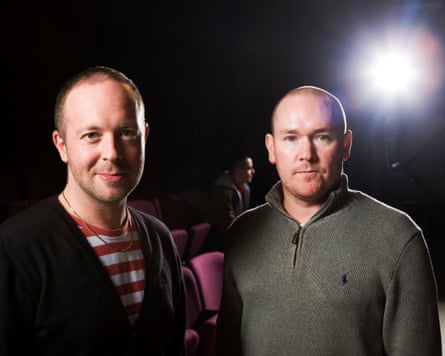
GB: It took a while to find people to interview who were the right age, had been there in Iraq, weren’t too institutionalised to talk about it, and were articulate enough to give you material you could construct something from.
VF: One night, John rang me up. He was with Steven Hoggett [movement director] at John’s flat. He said, “We don’t know what it is yet.” I went round and we drank red wine, and I was just going, “You have to find what it is. It’s really important.” The wine sorted it out.
Brian Ferguson (actor): My character, Cammy, was based on a guy who came and talked to us for an hour. That changed everything because then you’ve got someone whose story you really want to do justice to.
JT: The lads we met were generous, gentle and bright in their analysis. Every one of my suppositions of what drove them to join the army was demolished, and I realised that’s what I needed to do to an audience.
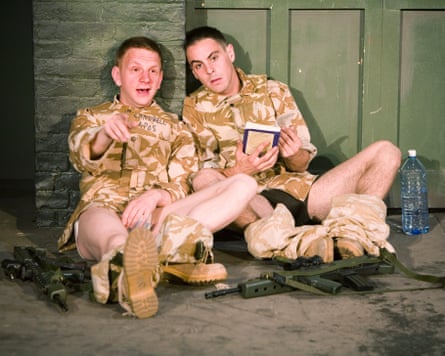
GB: It was billed as verbatim theatre, but I applied author’s prerogative to embellish and dramatise. There was a much bigger canvas than just their story. It was about the history of Scottish soldiering, Scotland’s view of itself as a martial nation and the timeline of the Black Watch in the British state.
Emun Elliott (actor): It was very theatrical but the subject matter was devastating. John rooted us in this reality that allowed us to go off into abstract areas, such as when we would mime receiving letters from home or do the fashion parade at the end.
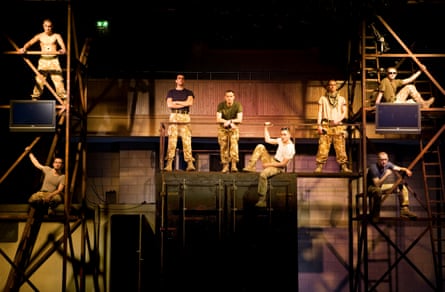
Laura Hopkins (designer): The pool table allowed us to switch between the pub and the other scenes. At one point we were trying to build a tank on top of it, but nothing was working. I was struck that the dimensions of the interior of this tank were the same as the footprint of the table. As soon as we tried the idea of the soldiers emerging from inside the pool table, we thought, “Yes, that’s the way to do it.”
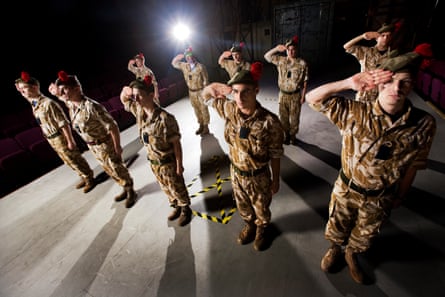
EE: We had to look like soldiers, not actors playing soldiers. Steven would take us through these gruelling three-hour workout sessions. We were all in the best shape of our lives.
JT: We learned how to march from a regimental sergeant major from the Black Watch. It shocked us how brutal he was. Then he took us outside the rehearsal room and made us march up and down in the car park because he said he was proud of us. Our hearts were bursting.
LH: It was designed for the drill hall in Edinburgh, and we wanted it to be unclear what was real and what was our intervention. That meant being light and not imposing too much stuff on it.
EE: The day before the dress rehearsal, I was sitting in the pub with Brian and we had our heads in our hands, thinking, “What have we signed up for? This is going to be a disaster.”
BF: Paul Higgins was there as well and was saying, “I think we’ve got something really special.” There certainly wasn’t a unified feeling.
GB: I don’t think we’d even got through a dress rehearsal all the way to the end. We did the first preview and it all went swimmingly. When the knife came up through the pool table, there was a gasp. John and I were at opposite ends of a row and we leant forward to look at each other as if to say, “We are on to something here.”
JT: The audience were owning it in a way that was incredibly moving. They leapt to their feet.
VF: They had done a run-through in the rehearsal room with makeshift costumes by Jessica Brettle and the show was as perfect as it ever was. It was one of the most amazing theatre moments in my life. Then, watching the first preview, it was everything I believed theatre was.
JT: There were 270 seats yet everyone I’ve ever met claims to have seen it. I’ve been told by more people than could physically have been there. Sean Connery was definitely one of them. King Charles wanted to come, but his security couldn’t be accommodated.
EE: Older actors would come up and say, “Enjoy this, because this sort of response will never happen again.” We would laugh it off. But 20 years later, I realise they were right.
VF: Producers were saying, “We want it! Can it come to us?” The impossible Black Watch that was made never to tour went on tour for seven years.
JT: In Glenrothes, the families of the boys who had died came. Emun looked nothing like the boy he played, but the boy’s mother thanked me for giving him back to her for two hours.
EE: They had lost their son in a horrific way and they were broken. I said hello and the father said, “I’d like to give you this.” He opened his fist and something fell out of his hand. We both scrambled to pick it up. It was a keyring. On one side was a picture of his son in his civvies and on the other, his son in uniform. The fact he wanted to give it to me and that it fell out of his hand was tragic and beautiful at the same time.
GB: In New York, someone told me Lou Reed and Rupert Murdoch were in on the same night. They venerate their armed forces in the US and everybody’s very respectful, so it was difficult for them at that time to criticise the involvement in Iraq, but the play did land there very well. I saw it in Austin, Texas, where the university has a big veterans programme and it really connected with people who’d had those experiences.
VF: Were we used by the SNP government as a tool of soft power? Yes, but I wasn’t cynical about it. We were a national theatre and we were asking difficult questions about what it is to be Scottish and they were not censoring us in any way. It was a platform and it was more than you could ever have expected from a national theatre in its second year. We never felt exploited and it gave us the status to enable us to have other conversations with government. I only ever saw Black Watch as a massive gift.
EE: It opened so many doors for me. It was a hit show and everybody wanted to meet the actors. I gained American management and an agent. Even today, when I’m auditioning, people will mention how much they enjoyed Black Watch.
BF: Years afterwards, I went for an audition for the National Theatre in London and the director said, “It’s so interesting, any time I meet an actor who’s been in Black Watch, you can always tell because they’re really alive and have a confidence in how they deal with a text.”
Jackie Wylie (current artistic director): Black Watch inspired a generation of talent. Jack Lowden, the second Cammy, was clear that his career started with Black Watch – he was 20. It put Scottish theatre on a global map and defined the company.