.png) 7 hours ago
3
7 hours ago
3
It is hard for Yuvelis Morales Blanco to pinpoint when her activism started. Now 25, she recalls getting involved in land rights and environmental issues in Santander, northern Colombia, from a young age. Living near water, she says, has always shaped her connection to nature. “My parents are fishers on the Magdalena, Colombia’s most important river,” says Morales. “For us, the river isn’t just food – it embodies life, identity and culture.”
In April, she received the Goldman environmental prize for her leadership in Puerto Wilches, where she succeeded in halting oil extraction and fracking. Yet, it seems her struggle is only just beginning.
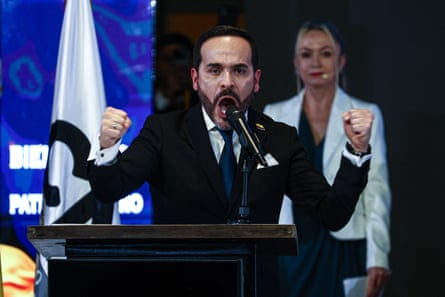
On 21 June, Colombia elected as president, by the narrowest margin in its history – less than 1% – the far-right lawyer Abelardo de la Espriella, who pledged to exploit fossil fuels to the fullest extent possible during his term. The change of government marks a sharp break after four years under the leftist administration of Gustavo Petro, who staked his presidency on the energy transition.
“We were hoping for a government closer to our work, one that respected human rights, but we won’t give up. We’ll keep fighting,” Morales says.
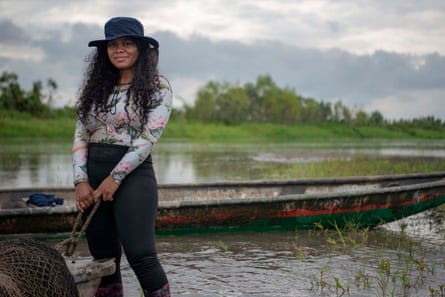
Within Colombia’s environmental movement, campaigners such as Morales, who have endured the world’s highest homicide rates for three consecutive years, see the incoming government as a setback to their progress. “We’re open to dialogue and to finding common ground, but we’re also organised and ready to mobilise to defend our natural resources and our rights,” the activist says.
Just how far the new government is prepared to go remains to be seen. Between the first and second rounds of the election, the president-elect softened his rhetoric on fracking and large-scale extraction. But the environmental agenda still divides Colombians.
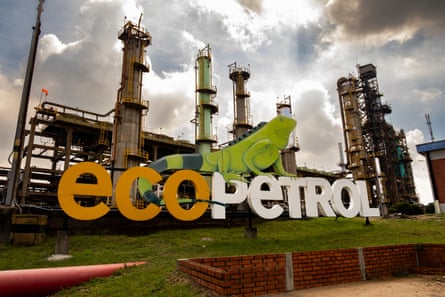
Santander is a case in point: the rightwinger De la Espriella won in nearly every municipality in the department, except Barrancabermeja and Puerto Wilches – the area where Morales lives, and where oil has been extracted and refined for decades. There, results favoured the leftist Iván Cepeda, the candidate backed by President Petro, who took almost 60% of the vote.
“We are the ones who have suffered the consequences of extraction and the pollution of our waters – and we’re precisely the ones who voted against it,” Morales says.
The weight of fossil fuels in Colombia’s economy has shrunk over the past four years. In 2025, non-mining, non-energy exports accounted for 52.6% of the total, overtaking mining and energy exports for the first time in at least a decade.
But critics of the green push argue that a middle-income country such as Colombia cannot simply turn its back on oil, coal and gas, which still make up 5% of GDP – especially with the fiscal deficit hitting 6.4% in 2025, its highest level since the pandemic.
Andrés Gómez, a petroleum engineer and the Latin America coordinator for the Fossil Fuel Non-Proliferation Treaty Initiative, says the right strategy for the country is not to abandon extractive revenues overnight. “It’s about managing the decline,” he says. Colombia benefits from the 750,000 barrels of oil it produces each day, even as exports of coffee, flowers and fruit grow in parallel.
“Colombia is not an oil country,” Gómez says, adding that neighbouring Venezuela is a far more attractive partner for the global energy market. “We have only 0.1% of the world’s proven reserves, while Venezuela has 17%.”
Meanwhile, between 2022 and 2026, Colombia’s renewable energy capacity grew from 200 to 3,600MW. Based on these figures, Gómez believes the Petro government’s environmental bet was the right one.
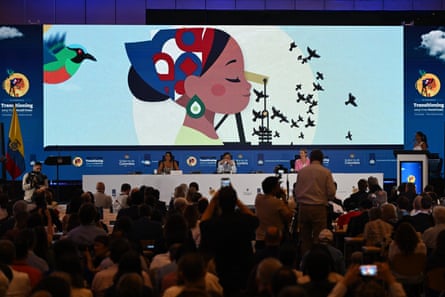
“Colombia has done remarkable diplomatic work in favour of the energy transition and against fossil fuel dependency. That should be a state policy, not just the policy of whichever government happens to be in power,” Gómez says.
Yet change is already under way with the new government. On 7 August, De la Espriella will be sworn in and, as he promised on the campaign trail, will quickly issue dozens of decrees rolling back the policies of the Pacto Histórico, the leftist coalition that has governed the country since 2022.
Susana Muhamad, a political scientist and former environment minister, predicts “a policy of containment” – a raft of environmental rules and initiatives designed to slow the transition begun under the current administration.
In Colombia’s congress, where the left holds significant sway with 68 seats, there is broad consensus that the climate crisis is real. But within that consensus, the right still backs policies favouring the exploitation of non-renewable resources.
“The new government will probably repeat the pattern set by former presidents Álvaro Uribe (2002-2010) and Juan Manuel Santos (2010–2018), who championed the so-called ‘mining locomotive’ as one of the economy’s main engines,” Muhamad says. The future environment minister, Fabio Arjona, has finally ruled out the agency’s abolition, while calling for “greater efficiency” and fewer “obstacles” in the environmental licensing process.
Muhamad expects future environment ministers to act as “notaries of disaster”. “They’ll grant permits for extraction and loosen environmental regulations. During the campaign, they even talked about scrapping the national authority of environmental licences (ANLA), the body that oversees the country’s highest-impact projects,” she says.
This time, though, Muhamad is convinced the fossil fuel push will be more aggressive than ever. “Above all, because of the alliance with the United States, and the pressure Donald Trump will bring to bear,” she says.
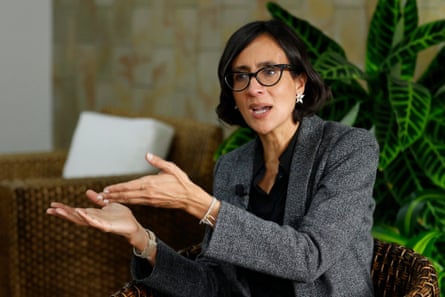
She flags the Cordillera Occidental – a natural corridor linking the Andes to the Pacific and the Amazon – as a particularly vulnerable area: a region with no mining tradition but huge potential for large-scale copper extraction.
Across various parts of Colombia, mineral ambitions will collide with the country’s old obstacle: violence. In these remote areas – some on the borders with Peru, Ecuador, Brazil and Venezuela – a thriving mix of legal and illegal mining has taken root under the sway of various armed groups.
Wresting these economies back under government and private-sector control will require a military offensive, once again putting the country’s most vulnerable rural communities at risk.
This looming scenario might have played out differently. Cepeda, the governing party’s candidate, who promised to continue the energy transition and protect the ecosystems of one of the world’s most biodiverse countries, lost the election by fewer than 250,000 votes out of an electorate of 26 million.
“There wasn’t enough debate. The two governing platforms were never really put head to head so voters could properly compare them,” Muhamad says.
There were attempts during the campaign to bring the candidates together for a presidential debate, but election day arrived without one ever taking place.
Despite the left’s electoral defeat, the incoming far-right government will find Indigenous communities, afro-Colombians and the environmental movement broadly united and organised. Morales points to the contrast in her own region, the Magdalena Medio – a vast, fertile valley rich in natural resources and tourism potential that, so far, has brought too few benefits to local people.
“We have abundant water, yet in Puerto Wilches you can’t drink from the tap. We have a beautiful river, but it has been polluted for years by oil extraction,” she says.

Over the past four years, Colombia has sought to position itself as a laboratory for the energy transition. Much of its diplomacy moved in that direction: in 2024, the country hosted the UN biodiversity conference (Cop16) in Cali; and in early 2026, it held the conference on the transition away from fossil fuels in Santa Marta.
Now, and over the next four years, the country’s role on the world stage will change dramatically, say experts and activists. Despite the risks, Morales remains optimistic and has a message for the international community.
“Countries will need to make sure Colombia honours its fossil fuel treaties,” she says. “They will need to safeguard the wellbeing of local communities and keep watch to ensure the country stays on a roadmap toward a genuine energy transition.”