.png) 2 hours ago
8
2 hours ago
8
Women’s cricket is growing faster than the men’s game in many areas of the world, according to the International Cricket Council chief executive, Sanjog Gupta, who has defended his organisation’s reliance on the Indian market for driving expansion.
The first women’s Test to be played at Lord’s begins on Friday between England and India, five days after the ground staged the final of a record‑breaking T20 World Cup in front of a sellout crowd. Gupta, however, is just as excited by the sport’s potential in new markets.
“Cricket is assuming cultural significance among women in certain countries like Brazil where football is really big,” he says. “Women gravitate towards cricket as a means of finding their own identity, and a platform for belonging.
“The fact it’s a team sport and that it intrinsically entails social connections lends itself to driving a sense of belonging for a community which feels a little cut off from certain facets of their culture.
“In emerging markets, women’s cricket is playing the leading role in driving participation and also the elevation of performance standards. You see that the ranking of the women’s teams in these countries is higher than the ranking of the men’s teams. It’s perhaps easier for a women’s team ranked 25 or 30 in the world to climb quickly, so it’s a virtuous circle.”
After expanding the T20 World Cup to 12 teams for the first time this summer, the competition will grow to 16 in 2030. The first Champions Trophy will take place in Sri Lanka next year, with the women’s game mirroring the men’s four-year global tournament cycle for the first time.
Given the Women’s T20 World Cup was played alongside the men’s competition, with their games serving as curtain-raisers to the main event, as recently as 2016, the pace of change has been remarkable.
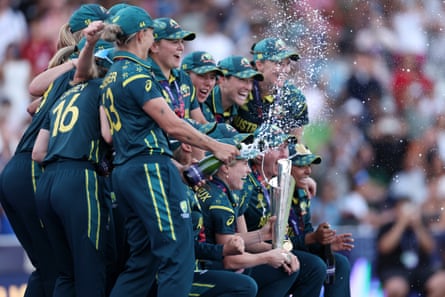
While Australia’s comfortable seven-wicket victory against England in the final last Sunday denied the hosts another seminal moment to match their 50‑over World Cup win against India at Lord’s in 2017, by any metric the tournament can be judged a success, despite clashing with the men’s football World Cup and the Ben Stokes drama that overshadowed the men’s home Test series defeat by New Zealand.
The 245,815 spectators who attended matches smashed the previous tournament attendance record by more than 100,000 while the UK rights holder, Sky Sports, reported more than 15 million viewer hours during the competition. With a record 28,887 at the final paying up to £60 for the privilege, it was the highest‑grossing women’s cricket match, generating more than £1m in ticket sales.
In global terms the growth has been even more dramatic, with viewing figures in India for the group‑stage win against Pakistan in front of 18,000 at Edgbaston larger than the cumulative figure for the entire T20 World Cup two years ago. More than 25 million watched on JioHotstar in India, with the game generating 1.1 billion minutes of watch time.
“We’ve seen every metric track significantly ahead of previous benchmarks,” Gupta says. “There’s been a big shift in mindsets all over the world and it’s era defining. Women’s World Cups now are as big for the Indian market as the 1983 World Cup was at that time for men’s cricket.”
India’s financial might presents challenges, though, most notably that 40% of ICC revenues go to the Board of Control for Cricket in India with just 4% paid to West Indies, whose captain, Hayley Matthews, bemoaned such inequality after her side’s semi-final defeat by Australia.
after newsletter promotion
The power of the Indian TV market also raises integrity concerns. While Harmanpreet Kaur’s side were eliminated at the group stage, a fixed draw had guaranteed India a place in the first semi-final had they progressed, leaving others unable to make plans until the last minute.
As a former chief executive of JioStar, who negotiated its current $3bn Indian rights deal with the ICC and is now seeking an extension from the other side of the table, Gupta insists such accommodations are necessary and will continue.
The numbers bear him out. While impressive on its own terms on a day that also included the men’s World Cup, Wimbledon, the British Grand Prix and the start of the Tour de France, Sky Sports’s peak audience in the UK of 678,000 for the final was a fraction of the millions watching in India.
“We always look to balance the global viewing audience with the audience in countries which are hosting the event,” Gupta says. “That’s why it was pre-decided that one semi-final would be played in a time slot which makes it available in prime time in South Asia. It will be the same for the next tournament in Australia in 2028.
“It’s not to favour India, but to try to help build the market. At our last event, the men’s T20 World Cup this year, the viewership in India was 60% of the global TV audience.
“You could argue that if India had not won the World Cup, the share of viewership may have been 52% to 55%, but you still have half the world. We’re trying to serve two worlds with all of our events – local and global.”