.png) 3 months ago
65
3 months ago
65
US economy adds more jobs than expected in May
Newsflash: the US economy added more jobs than forecast last month.
Total nonfarm payroll employment increased by 172,000 in May, the US Bureau of Labor Statistics has reported, with gains in leisure and hospitality, local government, and health care.
Employment in financial activities declined, though, the BLS reports.
That’s much stronger than the 85,000 new jobs which economists had predicted for May.
Jobs data for the previous two months has been revised higher too, the BLS adds:
The change in total nonfarm payroll employment for March was revised up by 29,000, from +185,000 to +214,000, and the change for April was revised up by 64,000, from +115,000 to +179,000.
Those revisions mean employment in March and April combined was 93,000 higher than previously reported – encouraging news for US workers, and the White House, but something which may make US interest rate cuts less likely…
Key events
Traders fully price in Fed rate hike this year after jobs data
Financial traders are now fully pricing in a Federal Reserve interest-rate hike by the end of this year, after May’s surprisingly strong jobs report, according to Bloomberg.
That will not please president Trump, who repeatedly attacked former Fed chair Jerome Powell for not cutting rates faster.
Isaac Stell, investment manager at Wealth Club, thinks the markets are right, though. With strong job creation, and inflationary pressure from the Iran war, a rise in US interest rates does look more likely….
Stell explains:
The Fed now faces a more complex policy backdrop. Inflation has risen sharply, reaching 3.8% in April from 2.4% at the start of the year, driven in part by the continued disruption in the Strait of Hormuz. With inflation pressures building and the labour market remaining robust, the bar for rate hikes continues to fall, increasing the likelihood of further policy tightening in the near term.”
US government bonds are under pressure as investors conclude that early rate cuts are highly unlikely.
This has pushed up the yield, or interest rate, on US two-year Treasury bills to 4.147%, the highest since February 2025, Reuters reports.
Such strong jobs growth will make it tricky for America’s new top central banker to push for interest rate cuts.
Seema Shah, chief global strategist at Principal Asset Management, says Kevin Warsh may find himself considering raising interest rates later this year, despite Donald Trump’s demands for lower borrowing costs:
“Today’s jobs report reinforces that there is little basis for an easing bias from the Fed. Job creation above 150,000 – very comfortably exceeding the Fed’s estimate of breakeven and also broad-based in nature - comes alongside inflation that remains above target and is expected to trend higher in coming months. In effect, both sides of the Fed’s dual mandate argue against rate cuts at this stage.
“If Chair Warsh pushes for cuts at his first meeting, he will be pushing against the evidence. Our base case remains that the Fed stays on hold through 2026, but if employment data continues to track around May’s pace, rate hikes this year would come firmly into play.”
"This is a hawkish jobs report"
This strong US jobs report makes interest rate cuts less likely, explains Waleed Said, technical analyst from GivTrade:
The US NFP print is clearly hotter than expected — 172k vs 85k forecast, only slightly below the previous 179k, showing the labour market is still resilient and not cooling fast enough for the Fed to relax.
This is a hawkish jobs report: it supports a stronger dollar, higher yields, and pushes back aggressive rate-cut expectations. Gold may come under pressure first as yields and the dollar rise, unless geopolitical fear keeps safe-haven demand alive.
Oil could get a short-term boost because strong jobs suggest solid economic demand, but gains may be capped if the stronger dollar and tighter Fed outlook hit risk sentiment.
Where US jobs were created last month
Here’s a breakdown of the sectors that hired more US workers last month:
-
Leisure and hospitality added 70,000 jobs in May, including 48,000 new roles at food services and drinking places.
-
Employment in local government rose by 55,000.
-
Health care added 35,000 jobs in May, including 26,000 in ambulatory health care.
-
Social assistance employment rose by 12,000 in May
-
Employment in mining, quarrying, and oil and gas extraction increased by 5,000
But…
-
Financial activities employment declined by 22,000 in May and is down by 107,000 since a recent peak in May 2025. Over the month, job losses occurred in insurance carriers and related activities (-11,000) and commercial banking (-3,000).
Employment levels were broadly unchanged in transportation and warehousing, construction, manufacturing, wholesale trade, retail trade, information, professional and business services, and other services.
The US unemployment rate held at 4.3 percent in May.
US economy adds more jobs than expected in May
Newsflash: the US economy added more jobs than forecast last month.
Total nonfarm payroll employment increased by 172,000 in May, the US Bureau of Labor Statistics has reported, with gains in leisure and hospitality, local government, and health care.
Employment in financial activities declined, though, the BLS reports.
That’s much stronger than the 85,000 new jobs which economists had predicted for May.
Jobs data for the previous two months has been revised higher too, the BLS adds:
The change in total nonfarm payroll employment for March was revised up by 29,000, from +185,000 to +214,000, and the change for April was revised up by 64,000, from +115,000 to +179,000.
Those revisions mean employment in March and April combined was 93,000 higher than previously reported – encouraging news for US workers, and the White House, but something which may make US interest rate cuts less likely…
EU's trade deficit with China is 'clearly unsustainable', says Šefčovič

Lisa O’Carroll
The EU trade commissioner has said the growing deficit with China is unsustainable.
Speaking in Brussels, Maroš Šefčovič described the mood among commissioners who met for a China debate last Friday ahead of a leaders summit on 18 June.
Šefčovič told the Brussels and European Policy Centre conference on economy security:
“I would say the underlying and common thought in everyone that the situation where we are accumulating trade deficits with China at the pace of 1 billion euros a day is clearly unsustainable”
“It cannot be in the situation that we could have 360 billion euros deficit.”
But Šefčovič said they would look at re-engaging with China.
“We also have to look how to address not only the deficit, but I would say our overall relationship with China ... [regarding] global over capacities as such.
“So I think that what we are looking at internally is, you know, how to improve the, I would say, diplomatic outreach communications and discussions with our Chinese partners”
Šefčovič also pointed out that “Openness has to be reciprocated by your partner”.
The contraction in the eurozone’s economy in the first quarter of this year is awkward timing for the European Central Bank, which is expected to raise interest rates next week.
Economists predict a rate hike from the ECB, to fight inflationary pressures from the Middle East conflict.
Analysts at Unicredit explain:
The ECB is very likely to start hiking interest rates next week, with a 25bp increase on 11 June.
Several influential members of the Governing Council have already flagged the move, and the new macroeconomic forecasts will provide the background for the decision as the ECB’s inflation projection moves to the 3% area for this year and towards 2.5% for next year.
Despite the inflationary pressures from the Iran war, Kazakhstan’s central bank has cut the country’s key interest rate to 17% from 18%.
The National Bank of Kazakhstan eased monetary policy after its forecast for inflation this year was revised down to 9-11%, from 9.5-11.5%.
Eurozone on brink of technical recession after Ireland's GDP plunges
Newsflash: the eurozone is on the brink of a technical recession, due to a slump in activity among multinationals based in Ireland.
Statistics body eurostat has reported that eurozone GDP fell by 0.2% in the first quarter of this year, following a rise of 0.2% in the fourth quarter of 2025. A technical recession is two quarterly falls in GDP in a row.
The decline was due to a 12.1% slump in Ireland’s GDP, according to official data released yesterday. However, that was caused by a 27.1% slump across Ireland’s multinational-dominated sectors, as a surge of demand for pharmaceutical products during 2025 unwound.
Ireland’s modified domestic demand (MDD), a better measure of its domestic economy rose by 0.6%.
Eurostat, though, uses GDP, so here we are.
It also reports that Denmark (+1.9%) recorded the fastest quarterly, followed by Estonia and Malta (both +1.1%). At the bottom of the growth table, Ireland were followed by Lithuania (-0.3%), Sweden (-0.2%) and France (-0.1%).
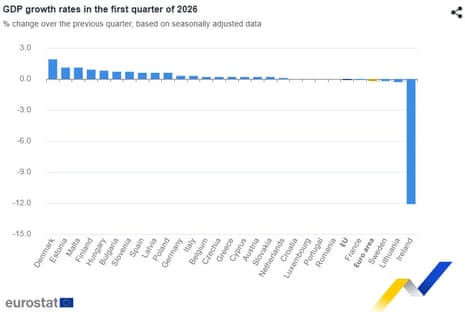
Eurostat had initially estimated last month that eurozone GDP rose by 0.1% in Q1 2026, before Ireland’s GDP slump hit….
India is set to launch a new high-ethanol fuel blend in the market, its latest effort to diversify supplies and reduce the country’s reliance on imported oil, Bloomberg reports.
Oil minister Hardeep Puri is due to introduce the fuel today at an Indian Oil Corp.’s outlet in New Delhi. It will initially sold at 50 pumps in the country.
The South Asian nation currently sells 20% ethanol-blended gasoline, or E20, across its retail fuel network. The new blend, called E85, will contain about 85% ethanol and pollute less than its conventional counterparts. More here.
A majority of UK firms are expecting to hike their prices to pass on the cost of higher energy, but profits are still expected to be squeezed.
The Bank of England’s latest poll of chief financial officers at small, medium and large UK businesses has found that 57% of firms expected to increase their prices, while 68% of firms expected their profit margins to be lower.
The Decision Makers Panel has also found that bosses expect to hand out smaller pay rises this year. They reported that annual wage growth was running at 4.2%, while expected year-ahead wage growth is only forecast to be 3.4%.