.png) 1 hour ago
3
1 hour ago
3
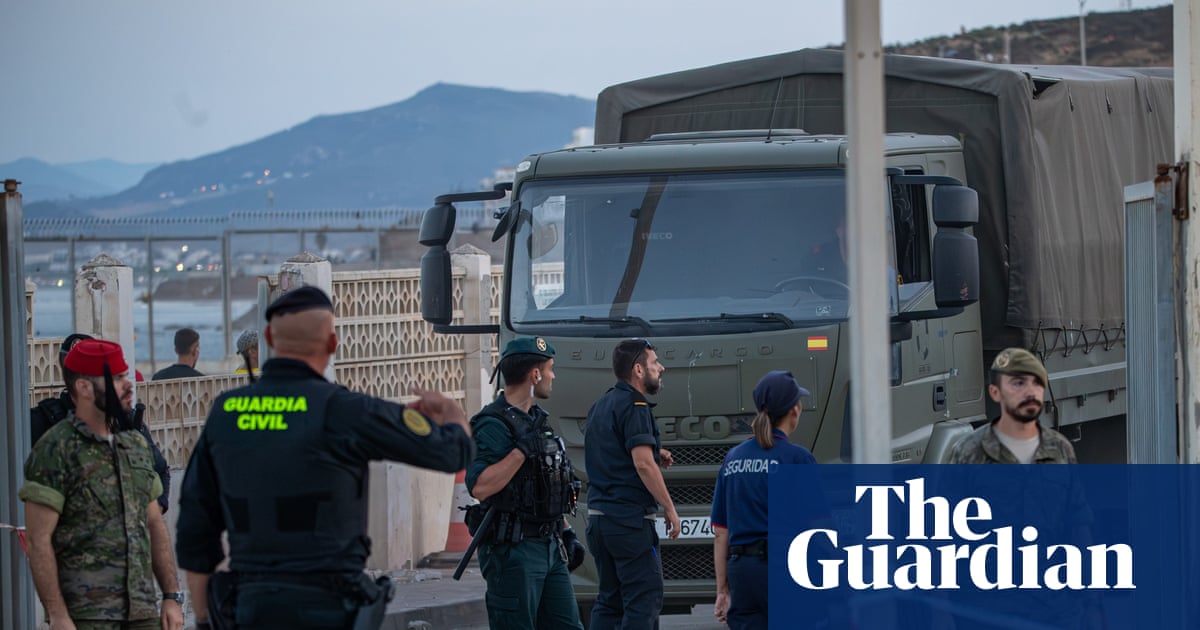
Along the wide avenues and tree-lined plazas of Ceuta’s centre, there were few hints of the recent events that catapulted the Spanish enclave on the north African coast into global headlines.
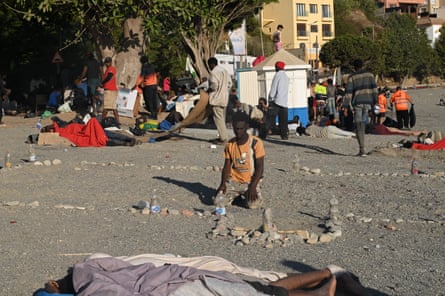
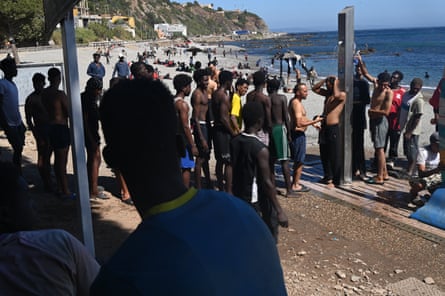
But less than a mile away from the bustling bars and restaurants, at the nearby El Trampolín beach, the lingering impact was impossible to ignore.
“We’re sleeping here on the beach, out in the open, without tents or blankets,” said Imad, 26, one of several thousand people believed to be still in Ceuta after last week’s extraordinary influx of more than 72,000 migrants into the Spanish territory on the edge of Morocco.
“We don’t have bathrooms,” added the Yemen national. “I barely manage two hours of sleep, as it’s incredibly cold by the sea at night, and during the day the heat is unbearable.”
One week on, while questions continue to swirl over what exactly prompted the incident, the city’s shops and markets have reopened and many of the 84,000 residents have resumed their daily routines.
The scenes of normality clashed jarringly with a population left deeply rattled by the crisis, said Ceuta’s long-serving conservative leader. “Ceuta is on edge,” Juan Jesús Vivas told the broadcaster TVE. “Things have yet to return to normal – it’s as if 50 million people had entered Spain in a day.”
One week after tens of thousands of people, referencing posts on TikTok, Instagram and WhatsApp among other platforms, swam or waded into the Spanish territory, there was little consensus on just how many people had arrived and how many had been returned, said Vivas.
The Spanish government estimated that about 72,000 people had crossed into Ceuta and about 2,500 remained, while Vivas believed that about 80,000 had entered, with between 3,000 and 5,000 still in Ceuta.
The precise number of people killed in the crossing also remains murky, with estimates as high as 141. Dozens of people remain missing, suggesting the death toll of the crisis, already one of the worst humanitarian tragedies at Europe’s borders in recent years, will worsen.
Adding to the tension are the fresh online posts that have called for another mass crossing in mid-August, said Vivas. “People in Ceuta are nervous, they are worried. And this is absolutely logical, because the question we keep asking ourselves is: ‘Will this happen again?’”
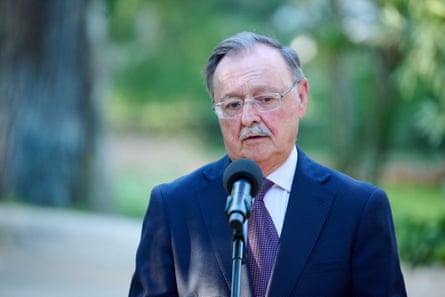
Many had been shaken by migrants’ reports of their crossing being encouraged, at times even facilitated, by Moroccan officials. “It has been demonstrated that our security and border are vulnerable and that both are in the hands of a third country that doesn’t recognise the sovereignty of Ceuta,” said Vivas. “Morocco is not a reliable country.”
As Spain and the EU wrestle with the wider political implications, the migrants who remain in the city have been left struggling to survive.
Immediately after the influx the situation was terrible, said Imad, the 26-year-old from Yemen. “Everything was closed, and we were on the verge of dying of hunger and thirst,” he said. “They used hunger to pressure us into deciding to return on our own. We ate leaves from the trees and drank dirty water.”
Things had improved slightly in recent days, he said, as NGOs such as the Red Cross had begun providing them with food. On Thursday the Spanish government said it was installing toilets and additional showers on the beach, while police said they would open an information point.
When Imad arrived in Spain, making his way across the border in an eight-hour, flipper-powered swimming odyssey, he envisioned it would be the end of an arduous journey that began in 2019 when he fled attempts by the Houthis to recruit him as a fighter.
“I thought that, upon arrival – since I was arriving from a country at war – it would be easier for us to apply for asylum. But we found the reception centre for migrants closed. There were no exceptions for anyone; all the doors were locked.”
He scrambled each day to find food and shelter, while the question of whether he would manage to request asylum loomed. “I have nightmares every day. I dream that my family is being bombed, that they are killed, or that I’m deported to Morocco,” he said. “Psychologically, I’m shattered.”
Those who remain in Ceuta include an estimated 1,300 unaccompanied children, with NGOs expressing concerns that hundreds more – including some as young as 10 – could be wandering the city unprotected.
One 16-year-old told the Guardian that she had made her way to the city’s reception centre for minors on arrival, only to be told it was full. She had instead been sleeping rough on the streets of Ceuta. “I went days without food. When a woman brought food for the migrants, the men got there first, and we didn’t get anything. The same happened with clothing, when we managed to get to the front of the line, there was nothing left.”
She had briefly considered going home. But she decided to stay after realising that this could be a singular opportunity to find a job that could help lift her family in Morocco out of poverty. “I just want to be a normal girl. I want to be able to get dressed, take a shower, eat well, have a place to sleep, study, work, and help my family,” she said.
The situation had prompted neighbours in the Sidi Mbarek neighbourhood on the outskirts of Ceuta to take matters in their own hands.
“We’re particularly concerned about the women and minors,” said Abdullah Abdullah Mustafa, the head of the Sidi Mbarek neighbourhood association. “Many are sleeping hidden in the hills for fear of being found and sent back to Morocco. That means there are minors living with hundreds of men in a situation of extreme vulnerability.”
What they came up with was a makeshift shelter, setting up tents in a courtyard that were watched over each night by residents. “All we can offer them is a place to sleep with some degree of safety. We don’t have bathrooms, beds or any other resources,” he said. “We know that this isn’t a real solution and probably isn’t even legal, but leaving minors unprotected seemed much worse.”
It is one of the many examples of solidarity that have sprung up across Ceuta in recent days, from the dozen volunteers who have been cooking day and night in a local flat to feed up to 400 people a day to the mammoth operation launched by the local NGO Luna Blanca to hand out about 5,000 meals a day.
One resident, Aisha Ahmed Ammar, has taken to stopping by El Trampolín beach each day with her two children, bringing food and clothing, and broadcasting her mobile phone’s wifi signal to allow people to connect with their families back home.
She said she had been moved by the people she had met, many of them asylum seekers from Sudan, Egypt or Yemen, and their readiness to care for those around them even as they had been seemingly abandoned by the international system meant to protect them.
“I’ve been impressed by how respectful and polite they are,” she said. “When you offer them something, they often reply: ‘No, give it to someone who needs it more.’”
But the enormity of the situation and the way in which it leaves residents such as herself on the frontlines, scrambling to do what she could in the face of Europe’s hardening borders, left her constantly fighting back tears. “You want to do more, but you can’t, and that fills me with immense sadness and a profound sense of helplessness,” she said. “It’s never enough.”