.png) 1 hour ago
3
1 hour ago
3
The US president, Donald Trump, asked recently on one of his Truth Social rants: “When are the Iranian people going to rise up and fight?” So frenetic and all-over-the-place are Trump’s statements that one does not know which are actual policies and which are simply noise. But if counting on the “Iranian people” to rise up and fight is indeed US policy then, as far as I can tell from within Iran, it is a failed one. And miserably so. At least for now.
There is no reliable nationwide polling that can tell us what Iranians think about the war in real time. So this is an observation, not a poll. It comes from conversations I have had with many people.
Though a social researcher, I work closely with Iranian startups and the digital ecosystem. Before the war began, my understanding was that this environment was hardly a hotbed of support for the Iranian state. Quite the opposite: being an advocate of the state was generally frowned upon, not least because of the internet blackouts that had repeatedly disrupted the very infrastructure upon which the digital economy depends.
And yet, even in this milieu, one can feel a growing detestation of the US and its war in Iran.
I am talking about some of the loudest voices. Businesspeople with money to spend, large profiles on social media and enough influence to shape conversations. These are the people many young Iranians look up to, and they are becoming increasingly outspoken against the war.
Majid Hosseini Nejad, an entrepreneur and the founder of Alibaba, an Iranian online travel agency, wrote on X on 2 September: “God willing, the day isn’t far off when attacking Iran becomes a terrifying nightmare for them, and they won’t even have the guts for such wishful thinking.” His social media feed is littered with similar anti-US and anti-Israel sentiments.
Many people within these circles share this sentiment. This does not necessarily translate into support for the state, of course. But one can witness the birth of a strong dislike for the US, alongside a growing desire to build Iran back better. There is a wider sense that this war is clarifying something.
That feeling is being nurtured by the images and stories coming out of the war: the shattering tragedy of the school in Minab, the sports complex in Lamerd, demolished homes in Tehran and, most recently, a wedding in a small southern village where people were killed and maimed.
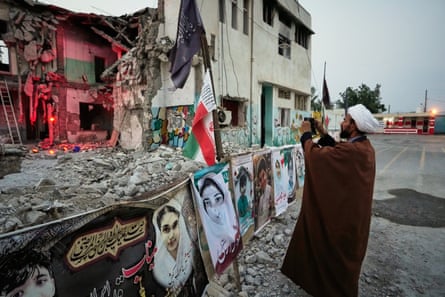
For the most part, these incidents do not inspire people to pour on to the streets in support of the invaders. If anything, they demonstrate how those waging a war from afar can come to see their prey as a faceless, nameless, storyless pile of human bodies. Their deaths are counted as the necessary and negligible cost of one man’s war against Iran.
Tales and images of fellow ordinary citizens slaughtered have a tendency to unify a divided country against foreign invasion. Such incidents rightly bring back memories of Iraq, Libya and Afghanistan. If they are intended to encourage people to “rise up and fight”, they appear to be producing quite the reverse effect.
In meetings, talks and public events, an image that was once assumed widespread – that Iran is a nation kidnapped by our political establishment – is beginning to erode. In its place is another idea: that we are a nation at war with a hostile regional foe and its imperial backer.
More and more people appear to be drawn towards this conclusion. Even if they do not support the state, they cheer it on if it is standing up to the bully.
after newsletter promotion
This is the important distinction that Washington seems to be so naively missing. A person can dislike the Islamic Republic and still dislike an American war against Iran. One can oppose the state and yet not want to see one’s country bombed into submission. One can demand political change and still believe that such change should come from within.
Nationalist and anti-imperialist sentiments are on the rise. If I had been asked in February, I would have said that the chasm between the state and the nation was perhaps unbridgeable. Now I would say it has a chance.
A homegrown uprising is what the US appears to be counting on. But if the intention is to encourage Iranians to turn against their own state, the war may be doing the opposite.
The more Iranian civilians are killed, the harder it becomes to maintain the distinction between the Iranian people and the Iranian state. And the more that distinction disappears, the less likely people are to rise up on behalf of the foreign power attacking them.
From where I stand, people do not look likely to rise up. They may instead be closing ranks.
-
Hossein Hamdieh holds a joint PhD in Geography and Anthropology from Humboldt University of Berlin and King’s College London. He is currently based in Tehran, where he works as a social researcher