.png) 1 month ago
24
1 month ago
24
It’s fair to say I don’t come from a long line of athletes. When I was growing up in the 1990s, sport was something other people did; we were not a family who cycled, much less jogged. In PE I was the wheezing child hiding behind the bins, pretending I’d twisted an ankle. When I contemplated working out – not often – I had the vague idea it was supposed to turn my body into something other people might find attractive.
I evolved from an unsporty child into an unsporty adult. Occasionally, mostly in an attempt to lose weight without having to stop eating croissants, I would attempt something like Couch to 5K, which I’d either abandon after a couple of sessions or see through to the bitter end out of the perverse determination to prove I’d been right all along: exercise was a mug’s game and endorphins an invention of Big Wellness.
Then came children. A large-headed baby delivered two weeks late via C-section was not all that kind on the body. My back, in particular, began to protest; doubly so when, three years on, I did it again, this time while wrestling a toddler. Was this just what age felt like? Things that used to work becoming, overnight, a bit of a letdown?
I tried physio, osteopathy, chiropractic treatment. Eventually, someone suggested strength training. Apparently I had something called a core and it could do with being, well, stronger. I was desperate enough to try. That, and I was becoming increasingly incensed at the decades of internalised misogyny that had shaped the way I thought women ought to look. I didn’t want to be slim; I wanted to be strong.
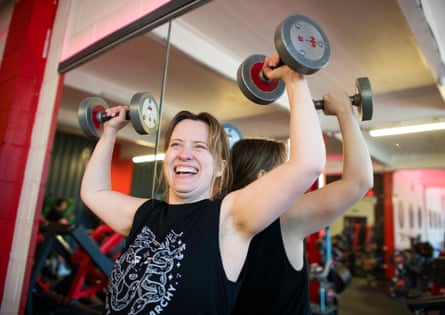
Infuriatingly, it turned out that putting in actual effort did, in fact, work. Within weeks, I wasn’t waking from backache. I could pick up my children without wincing. For the first time in my life, I was beginning to understand my body’s potential in terms not of what it could look like, but of what it could do.
Still, I wasn’t hugely enjoying the exercising, and I didn’t need much of a reason to message my ever-patient personal trainer with a half-arsed excuse. But one day I saw the author Fiona Cummins had tweeted about managing, finally, to reach her goal of deadlifting 100kg. There was something about that number – its sheer, round, solid chutzpah – that made me tell my PT: “I want to do that.”
So we did. A programme of deadlifts, squats and bench presses, supplemented with complementary exercises, and I began to work towards some properly heavy weights. Weights that initially sounded impossible – but with only one hour-long session a week, I found myself getting closer. Within months I was deadlifting 80kg, then 85kg, then 90kg. At first a single rep, but a month later, five, 10. My body was changing, too – not as the byproduct of growing a child or mainlining cake, but as the direct result of what I was pushing it to do. It was a strange and exhilarating feeling.
Even more significantly, something about the measurable, incremental progress made the competitive side of my brain tick in a way no other exercise had. When I eventually hit my 100kg goal, it felt like being handed a trophy – but there were countless other rewarding moments, many of them outside my training sessions. I could swing my toddler over my shoulder and into a back sling. (I tried the move a few weeks ago, now that she’s nearly seven, and yes, I can still do it. Strong-arm emoji.) I could carry my own Ikea order in from the car. Hell, I could carry it up the stairs, and build it singlehandedly as well. I didn’t need a man to move something for me. Quite often I could move something for them.
Now, when I think about fitness, it’s as an end in itself. In the gym or out on my paddleboard – yes, a second form of exercise I genuinely enjoy – sport is no longer somewhere I don’t belong. And I’ve gone from feeling like a passenger in my body to feeling in control of it, C-section scars and all.
Laura Evans’s debut novel, Little Wild, is published on 25 June.