.png) 1 month ago
47
1 month ago
47
In 1945, the violinist Yehudi Menuhin was on a short tour of Germany, offering recitals to survivors of the concentration camps. On Friday 27 July 1945 he reached Bergen-Belsen, liberated three months earlier, and gave two concerts, in the cinema at the camp. The experience had a profound impact. “I shall not forget that afternoon as long as I live,” said Menuhin. “After Belsen, Yehudi was never the same again,” his sister Yaltah Menuhin reported. Anita Lasker, a survivor of Belsen, was present at one of those concerts. Nineteen years old, and a cellist, as a child she had been at Auschwitz, where she played in the women’s orchestra, under the direction of Alma Rosé, the niece of Gustav Mahler.
Lasker wrote to her cousin about the concert. “Who would ever have believed that Belsen Camp would hear Yehudi Menuhin playing? A wonderful evening”, which included “the Bach/Kreisler Prelude and Fugue, the Kreutzer Sonata, Mendelssohn’s Concerto, something by Debussy and several smaller, unfamiliar items”.
Lasker’s eye for detail was unsparing. Menuhin’s attire “bordered on the slovenly, which matched the surroundings perfectly”. He played “faultlessly”, but she sensed he held back. Perhaps he was not inspired by the atmosphere, she wondered (“it was impossible to get complete silence in the hall, and I was thoroughly ashamed of the audience”).
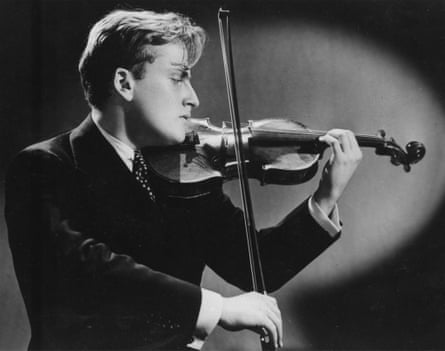
Lasker noted, too, that Menuhin performed with a pianist, whose name she omitted. He left an impression: “As for his accompanist, I can only say that I cannot imagine anything done more beautifully. He was completely unobtrusive and yet I found myself transfixed by him sitting there as if he wouldn’t say boo to a goose – but playing to perfection.”
Lasker’s memory never faded. She later told an interviewer. “I couldn’t take my eyes off that guy who was playing the piano, and that was Benjamin Britten.”
In the 1960s, Lasker-Wallfisch, as she became following her marriage to pianist Peter Wallfisch, would perform with “the guy who played the piano”. She came to Aldeburgh, as a member of the English Chamber Orchestra (which she had helped to establish in 1948, originally as the Goldsbrough Orchestra). On several occasions she was in the cello section when Britten was the piano soloist or conductor. He was “very much a man apart, you didn’t chat to him really”, she recalled. “You accepted Britten as Britten, and that was that!”
In 1969, shortly before the festival opened, Lasker-Wallfisch showed Britten the letter she’d written after the Belsen concert: “I said to Ben, if you’d like to read a letter about your piano playing, by somebody who didn’t know at all who was who, very unbiased criticism. He was fascinated with the letter. He said: ‘Can I borrow it?’ I said: ‘Of course.’” The next day, the Snape Maltings concert hall was destroyed by a fire. The cellist and the composer saw each other the following morning at rehearsal, in the nearby village of Thorpeness.
“He came in and the first thing he said was, ‘Anita, I’ve got your letter.’” Lasker-Wallfisch was stunned: he’d lost his piano, and the Maltings, and still he recognised the significance of the letter.
Menuhin would say that Britten insisted on joining him on the tour. Like the violinist, he was “casting about for some commitment to the human condition whose terrible depths had been so newly revealed”.
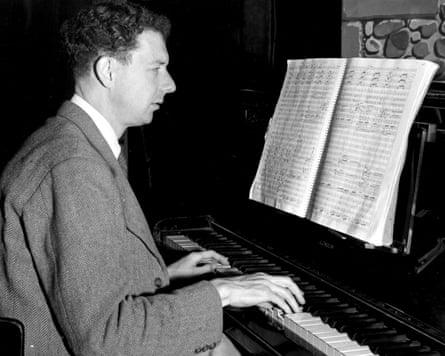
Britten rarely spoke of the experience, which he found, in many ways, to be “terrifying”. Peter Pears would report that he once admitted that the experience “coloured everything he had subsequently written”. The view was shared by a biographer, who concluded that “in each setting, Britten sublimated every word he would never speak about Belsen”.
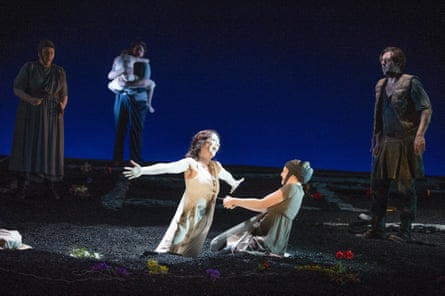
Not long after his return from Belsen, Britten embarked on the composition of The Rape of Lucretia, with a libretto by his friend Ronald Duncan. The opera concludes with an Epilogue (written on a train from London to Bath, according to Duncan, so I am not alone in finding the inspiration to write on such journeys), a lament by a Female Chorus:
Is it all? Is all this suffering and pain
is this in vain?
Does this old world grow old
in sin alone?
Can we attain nothing
but wider oceans of our own tears?’
“It is not all,” the Male Chorus responds, with a note of hope.
The words evoked Robert Jackson’s opening arguments at the famous Nuremberg trial, where new crimes – genocide, crimes against humanity, aggression – were first aired, and which I wrote about in East West Street. “Civilization asks whether law is so laggard as to be utterly helpless to deal with crimes of this magnitude by criminals of this order of importance,” Jackson said to the judges. “It does not expect that you can make war impossible. It does expect that your juridical action will put the forces of international law, its precepts, its prohibitions and, most of all, its sanctions, on the side of peace, so that men and women of good will in all countries may have ‘leave to live by no man’s leave, underneath the law’.”
Still, no one should be starry-eyed about law and legal process.
Six months after being liberated, Anita Lasker was still at Belsen, working as an interpreter. She appeared as a witness at the trial of the Auschwitz commandant, an experience that still seared.
“The trial struck me as a huge farce,” she wrote in her memoir, Inherit the Truth. She came face-to-face with “British justice” and the idea that “you are innocent unless proven guilty”. This was a “commendable principle”, but how could it be applied to crimes that were “incomprehensible to the rest of the world”, in legal proceedings that offered an impression of performance, like “overblown theatre”?
The experience left her sceptical, and we talked about this when I met her, not long after she celebrated her 100th birthday. Of course, the trial allowed “barristers to display their ability”, but for those who’d been on the receiving end of a “murder machine”, the experience was “sick-making” and left “a bitter aftertaste”.
The cellist asked: “Is it possible to apply law in the conventional sense to crimes so far removed from the law as the massacre of millions of people, which were perpetrated in the cause of ‘purifying the human race’?”
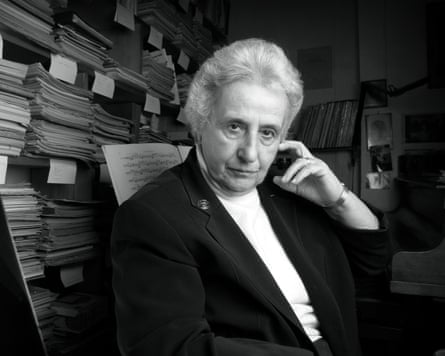
The question is a decent one, and Lasker-Wallfisch is not alone in having raised it. I often ask myself the same question, not least last January in The Hague, where I was appearing in a case on genocide before the International Court of Justice, where we heard searing, terrible accounts from members of the Rohingya community, of killings, rape and the murder of children.
Such themes motivated Britten. In 1968, he decided to set to music Bertolt Brecht’s poem Kinderkreuzzug, written in 1941, about a group of children who become orphans following the outbreak of the war in Poland. Seeking assistance on a translation in English, to mark the 50th anniversary of Save the Children, he turned to his friend Hans Keller (to whom he later dedicated his last completed instrumental work, the Quartet No 3 in G, Op 94).
Brecht’s verses – and Britten’s score – evoke the futility of war, and the limits of legal process, as here in Keller’s translation of Children’s Crusade:
Then there was a war,
War against some other children on the run;
And the war just simply ended:
Sense had it none.
And then there was a trial,
On either side burned a candle.
What an embarrassing affair!
The judge condemned! What a scandal!
Like the lawyer in East West Street, Hersch Lauterpacht, Keller often listened to music at his home in Willow Road, Hampstead, which Britten visited. Curiously, I now live in that house, which Keller shared with Milein Cosman, his wife, an artist whose drawings of musicians, including Britten (and his parrot) and Menuhin, brought renown.
For Menuhin, performing at Belsen with Britten was “like a ray of light in the darkness … because music is liberation”.
For Anita Lasker-Wallfisch, whose life was saved simply because she played the cello, music “cannot be destroyed”, even when appropriated by malign forces.
And for me, when things seem tough, as in The Hague last January, I draw strength listening to Anthem, a song by the Canadian poet Leonard Cohen, who was a student of law: “There is a crack in everything / that’s how the light gets in.”