.png) 1 month ago
46
1 month ago
46
Searing heat has swept the UK with schools, hospitals, transport networks and water companies struggling to cope with the extreme temperatures caused by climate breakdown.
Temperatures hit highs of 34.6C in Wisley in Surrey, the Met Office said, with the UN chief warning that London was “cooking”.
South-east England is expected to record temperatures of 38C on Wednesday and a maximum of 39C on Thursday. Those dizzying thermometer readings would shatter the previous June record of 35.6C, first set in in 1957 and reached again in 1976, and come close to the all-time milestone of 40.3C, reached in July 2022, which marked the first time anywhere in the UK experienced anything above 40C.
The extreme heat came amid urgent warnings that the UK’s infrastructure was “built for a climate that no longer exists”. Coping measures implemented this week include:
-
Reduced rail speeds and services.
-
Hospital patient appointments cancelled.
-
School closures across southern England and Wales.
-
Hosepipe bans in south-east England.
The UK’s Met Office issued a rare red weather warning for Wednesday and Thursday, while a red heat health alert was issued in England indicating “a risk to life for even the healthy population”.
Much of western Europe is sweltering in oppressive heat trapped by an area of high pressure, with temperatures pushed abnormally high by the blanket of carbon pollution smothering the Earth. Climate breakdown has added 2C to 4C to the current heatwave, according to a rapid analysis published by ClimaMeter on Monday.
France experienced its hottest night on record on Monday, followed by its hottest day on record on Tuesday, according to averaged temperature data for the country from Météo-France. Temperatures reached highs of 44.3C as officials said they had recorded 40 deaths from drowning as people sought to escape the heat. Several people also drowned in Germany over the weekend.
In Spain, one in every eight weather stations recorded temperatures above 40C on Monday, with highs of 44C expected on Tuesday. Spain’s weather agency, Aemet, warned of “extraordinary danger”.
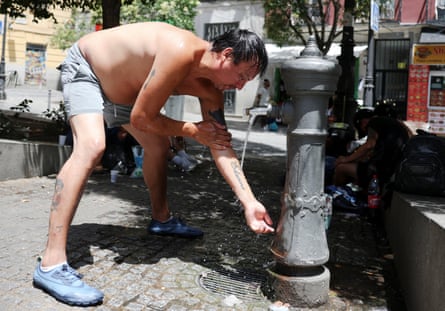
The combination of high heat and humidity has alarmed doctors, who have advised people to drink water, stay in the shade, and check in on vulnerable friends and neighbours.
António Guterres, the UN secretary-general, said in a speech at London Climate Action Week on Tuesday that London was “cooking”. The scorching temperatures led to the cancellation of an event on improving extreme heat governance that had been scheduled in the programme for Wednesday.
Guterres said: “Here in London, the city of Dickens, it is clear our world is facing a tale of two crises: a climate crisis pushing us deeper toward higher temperature and closer to catastrophic tipping points, and an energy crisis exposing the folly of a world hooked on hydrocarbons.”
Rail services across Britain were disrupted on Tuesday and operators urged passengers to travel “only if absolutely necessary”. Trains reduced speeds to exert less force on tracks that are at risk of buckling in the extreme heat.
Some hospitals in England were forced to cancel patient appointments due to high demand for emergency care, amid warnings that the situation could get worse over the coming days.
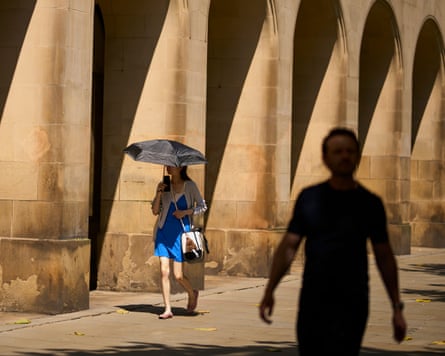
Hundreds of schools across southern England and Wales are expected to close or reduce their hours this week, with many choosing to end the day early to avoid the worst of the heat.
“Our Victorian school buildings have become greenhouses,” said Daniel Kebede, general secretary of the National Education Union.
“The government must step up,” he said. “We need urgent, massive capital investment to retrofit our ageing school estates with proper ventilation, shading and climate-resilient cooling infrastructure.”
South East Water introduced a hosepipe ban as the heatwave caused demand to surge, while other water companies encouraged people to use less water.
Data from retailers suggests people are trying to adapt, with sales of electric fans more than doubling compared with the previous four weeks, according to one retailer, while another predicted sales of ice, ice-cream and ice lollies would rise by about half.
Hot weather kills tens of thousands of Europeans each year – particularly those who are old or have underlying health problems – as it pushes organs into overdrive and hinders recovery.
“Human-induced climate change made this heatwave exceptional,” said Emma Holmberg, an extreme temperature researcher at the Institute of Social and Preventive Medicine at the University of Bern.
“Already in June we are seeing dangerous levels of heat, which places severe stress both on infrastructure and individuals,” she said. “This is especially prominent for the members of our community who are particularly vulnerable to heat, such as the elderly or those with underlying health conditions.”

The striking heat comes weeks after an extreme Spring heatwave in late May that shattered the UK’s historical temperature record for the month by a full 2C. The run of hot weather has evoked memories of an achingly hot summer 50 years ago, in 1976, which caused harvests to fail and taps to run dry.
On Tuesday, the Met Office issued projections of what a similar heatwave might look like in the 2050s against the backdrop of a planet further heated by humans. It said the UK could see a 14-day heatwave event with temperatures of over 40C for nine consecutive days, with heat peaking at 45C in England, 38C in Scotland, 41C in Wales and 30C in Northern Ireland.
Greenpeace UK called on ministers to introduce legal protections for people most exposed to extreme heat. Areeba Hamid, co-executive director of Greenpeace UK, said fossil fuels had turned once-mild British summers into life-threatening heatwaves.
“Ministers are still acting as if extreme heat were an occasional seasonal quirk, when it is fast becoming a regular and serious public health risk,” she said. “When classrooms become ovens, care homes overheat, transport starts to buckle and workers are forced to toil in dangerous temperatures, it’s clear the country isn’t ready.”
Last month, the UK’s Climate Change Committee, the government’s climate advisers, warned: “The UK was built for a climate that no longer exists today and will be increasingly distant in years to come.” It recommended new buildings should be “designed to keep people cool from the outset” with cheap passive cooling measures, such as natural shading. It also recommended increased uptake of air conditioning and maximum temperature rules for workplaces.
Stefán Smith, professor of energy systems and the built environment at the University of Reading, said overheating in buildings required urgent action.
“Air conditioning will be part of the solution, but when used at scale in a city causes extra local warming, further widening the gap between the air conditioning haves and have-nots,” he said. “This points to a clear need for better long-term solutions. Building design and urban planning must adapt to hotter conditions.”