.png) 2 months ago
63
2 months ago
63
Terence Robinson still remembers the Valentine’s Day Massacre – of 2015, not 1929.
For the Cornell University horticulture professor, the term doesn’t conjure up Tommy guns and Al Capone’s Chicago. Instead of a gangster, the culprit in Robinson’s massacre was the weather. And its victims were the apple orchards of the northeastern United States.
“We got a warm-up in February, and then a big cold air mass moved into New York and pushed all the way down into the fruit-growing area of Pennsylvania,” he recalled. “In the spring, we started seeing tree damage.”
Some scientists named the phenomenon “rapid apple decline”. Robinson and his colleagues concluded that the sudden drop in temperature, as much as 65F (18C) in a matter of days, had shocked the orchards, which had started to emerge from dormancy due to the earlier warmth. They also found that the most critical damage wasn’t to the trunks or limbs, but instead to the rootstocks, the very foundations of the trees.
Those foundations are often quite old. The widely planted M9 rootstock, for example, was developed at England’s East Malling Research Station over a century ago. But as extreme weather driven by the climate crisis continues to accelerate, scientists like Robinson are growing concerned that time-tested rootstocks may not hold up against the tests of decades to come.
Damage to rootstocks means damage to a US apple industry that generates roughly $23bn in annual economic activity and yields over 11bn lbs of the country’s most-consumed fruit. That’s because nearly all commercial apple trees are actually a combination of two separate plants.
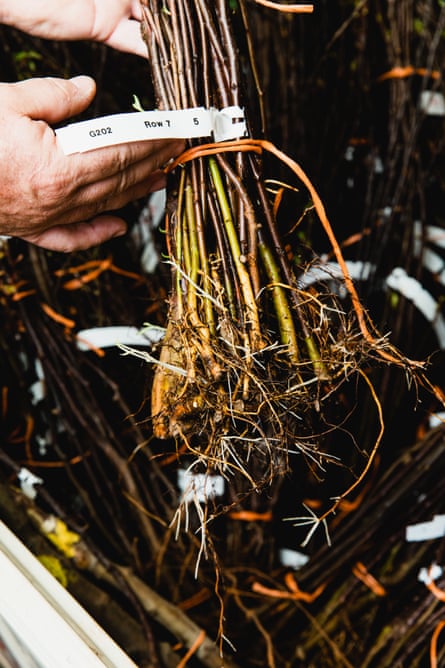
The apple-producing part of the tree, called the scion, starts as a cutting from a variety like Gala or Red Delicious. Nurseries then remove all but a small portion of a different tree, the rootstock, and graft the scion on to that base. The technique combines high-quality fruit with roots that govern commercially important characteristics like dwarf stature (critical for efficient harvesting).
Robinson, together with US Department of Agriculture (USDA) scientist Gennaro Fazio, co-leads North America’s only effort to give commercial growers new foundations for their orchards. Together, Cornell University and the USDA conduct the Geneva Apple Rootstock Breeding Program at a research station in Geneva, New York.
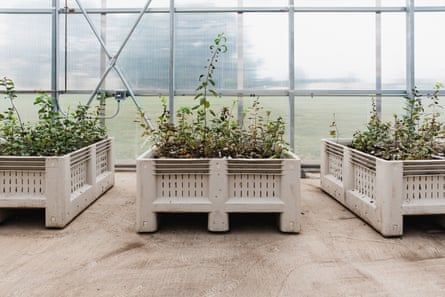
Since 1968, researchers like Robinson and Fazio have been crossing and evaluating apple trees, seeking rootstocks with greater resilience for a changing world. While the program’s initial focus was on disease resistance, particularly to a bacterial infection known as fire blight, its breeders have started putting more emphasis on the traits that apple rootstocks will need to succeed in the future.
“We still continue wanting to have a rootstock that is dwarfing, because dwarf orchards are much more profitable, and that produces early,” Robinson said. “We have broadened our list of goals for this program to include drought resistance, tolerance of high-salt-content soils and the ability to withstand more moderate winters.”
It’s a project that rewards patience. Crossing trees from different rootstock parents, screening their offspring for desired characteristics and making sure the new rootstocks work in real-world settings can take 30 years or more. Cornell didn’t release its first commercial variety until 1997; the initial crosses for three varieties launched in 2023 were made in the 1970s.
Robinson himself has been working on the program since 1991. “It requires long-term commitment to learn to love apple rootstocks,” he said.
The key to success over those long durations, suggests Lee Kalcsits, may involve breeding without a specific climate in mind. A professor of tree fruit physiology at Washington State University, he directs the Strengthening Pear and Apple Resistance to Climate (Sparc) project, a national research effort devoted to protecting fruit trees from extreme weather events. (Fazio and Robinson are also members.)
When growers establish a new apple orchard, Kalcsits explained, they’re making an investment that they expect to bear fruit over 15 to 30 years. While they may be confident in the broad strokes of their region’s climate over time, unexpected events that occur in the years soon after planting can devastate their long-term returns.
Research that Kalcsits and colleagues published in 2024 found that in apple-growing regions across the country, both fall and spring temperatures are getting warmer. That makes it harder for some apples to meet their chilling requirement, a minimum period of cold that a tree must experience before it flowers. Trees also respond by entering dormancy later and coming out of it sooner, creating a longer window of vulnerability to any cold snaps that do occur.
And as the climate crisis weakens the polar jet stream, allowing cold air from the Arctic “polar vortex” to reach more of the US, drastic winter temperature swings are becoming more common. Robinson notes that damaging cold snaps have since hit some of the US’s prime apple-growing areas, including southern Pennsylvania and western Michigan, four times since 2015.
Rootstocks shape how trees respond to the climate. Through their interactions with the scion, rootstocks can push apple trees to stay acclimated to the cold for longer, or to require less chilling to open their buds. Rootstocks can even help apples survive on less water by reducing the scion’s activity under drought. All those traits improve general resilience, rather than optimize for certain conditions.
“We need to be mindful that the rootstocks we select are adaptable. It’s not that they’re adapted to a future climate, but that they’re adaptable,” Kalcsists said.
The Cornell/USDA breeding program is already helping rootstocks resist false springs followed by cold snaps, with newer varieties showing much less damage than the standard M9. By continuing to cross those new rootstocks, scientists hope to combine their strengths and produce superior options for a changing climate. They’re also turning to wild apples collected from Central Asia, where apples were first domesticated, for new reservoirs of genetic diversity.
Once those crosses are made, the most promising offspring are tested across the country as part of a collaboration called NC-140. One of those experimental orchards lies at North Carolina State University’s Mountain Horticultural Crops Research Station, about 20 miles south of Asheville.
On a sunny late-winter day, tree fruit extension specialist Mike Parker strolls between the orderly rows of his rootstock trials. The skinny, leafless apple trees rest on a five-wire trellis anchored by thick wooden posts, a support system to help their small trunks bear their fall crop.
Most of Parker’s trees will grow here for a decade, with scientists collecting details each year on survival rate, trunk size, fruit size and yield. That long-term data helps breeders and horticulturalists gain confidence that new rootstocks will perform as they first thought – or rule out candidates that show unexpected problems.
“When we put the replicated trials in multiple states, there’s things that we find out real quick, like that this rootstock is a dog and ain’t going to fly,” Parker said with a smile. “We would much rather kill trees at our research station than have growers lose trees on their farm.”
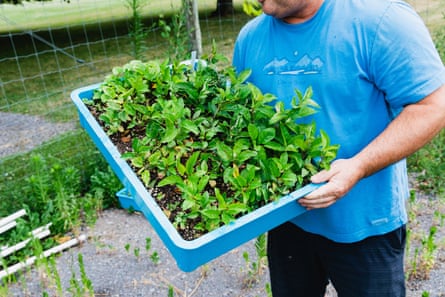
Like Robinson, Parker is a veteran of this work, having taken over North Carolina State University’s rootstock evaluations in 1996. And also like his Cornell colleague, he’s planning to retire within the next year or so.
Robinson is concerned about how rootstock development will fare as his generation of scientists ages out of orchard research. While research funding has so far remained relatively consistent, and his work has the enthusiastic support of trade groups such as the US Apple Association, he says young scientists are more interested in breeding scions than patiently waiting to develop rootstocks.
Long-term perspectives in general, he continues, generally seem less popular with funding agencies in the current scientific climate.
“I fear that they’ll say: ‘We have enough rootstocks, let’s just close down this effort.’ And for things that we’re facing right now, we probably have a good series of rootstocks available. But it’s these emerging problems, that you don’t really think of or didn’t plan for, that you might not be able to respond to if they shut down the program.”