.png) 2 months ago
52
2 months ago
52
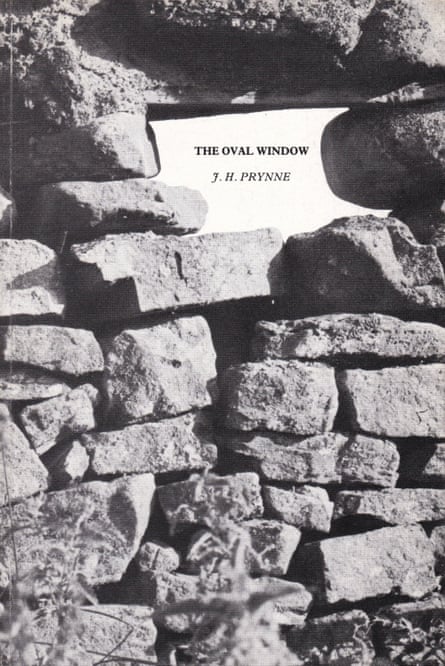
The poetry of JH Prynne, who has died aged 89, has been called opaque, hermetic, impenetrable, forbidding even, and at times it was all of these. But it also sang. To read his Kitchen Poems (1968), The White Stones (1969) or The Oval Window (1983) is to encounter a writer for whom sound and sense were never separable.
As Robert Potts wrote in the Guardian: “Prynne is hard-going, off-putting and much disliked by many more traditional writers; he is also, when one gets into him, so good that he changes the way you think and feel.”
Prynne wrote lines that reward the reader who slows down with them, such as these from Smaller Than the Radius of the Planet, from The White Stones: “I lay out my / unrest like white lines on the slope, so that / something out of broken sleep will land / there.”
That image, of a mind preparing a surface on which something unbidden can arrive, might stand for the whole of his six-decade practice. Described by Neil Astley of Bloodaxe Books as “Britain’s leading late modernist poet”, Prynne first came to prominence in the late 1960s as part of the British poetry revival, and retained a cult following until the end of his life.
The early collections move between the plainly lyrical and the philosophically rigorous, sometimes in a single page. Yet it would be incorrect to assume that Prynne was an abstract formalist, indifferent to history. For example, one of his later poems, Refuse Collection (2004), written in response to the harrowing photographs from Abu Ghraib prison in US-occupied Iraq, is fiercely political in its brutal and jarring military-industrial language:
To a light led sole in pit of, this by slap-up barter
of an arm rest cap, on stirrup trade in
crawled to many bodies, uncounted. Talon up
crude oil-for-food, incarnadine incarcerate, get
foremost a track rocket, rapacious in heavy
investment insert tool this way up.
Astley observed: “His austere yet playful poetry challenges our sense of the world, not by any direct address to the reader but by showing everything in a different light, enacting slips and changes of meaning through shifting language.”
Prynne himself shed precious light on the poet’s own creative method: “If two words are placed together that are not normally associated as from the same field of reference or meaning, a kind of semantic spark or jump may be created that is intensely localised within the continuity of the text process: it may be a kind of ‘hot spot’ that burns very bright but which the reader can quite quickly assimilate within the larger patterns of composition.”
In Smaller Than the Radius of the Planet, technical language from sources such as the scientific journal Nature is juxtaposed with more straightforwardly lyrical language to create, surprisingly, a love poem:
And so, then, the
magnetic influence of Venus sweeps its
shiver into the heart/brain or hypothalamus,
we are still here, I look steadily at nothing.
“The gradient of the decrease may be de-
termined by the spread in intrinsic lumin-
osities” – the ethereal language of love in
brilliant suspense between us and the
hesitant arc. Yet I need it too and keep
one hand in my pocket & one in yours,
waiting for the first snow of the year.
Born in Bromley, Kent, Jeremy Halvard Prynne was the son of Miriam (nee Andrade), a teacher, and Halvard, an engineer. Educated at St Dunstan’s college, Catford, he then went to Jesus College, Cambridge, graduating in English in 1960. Admitted as a fellow of Gonville and Caius College two years later, he became its librarian for 37 years and taught English there for more than four decades. His pupils included the poet and now University of Sussex professor Keston Sutherland.
Prynne’s first collection, Force of Circumstance and Other Poems, was published by Routledge and Kegan Paul in 1962. However, he soon rejected this volume from his canon, suggesting later in a rare interview that it was “uncomfortable, disorderly, imitative, facile, foolish, childish”.
Prynne was also a formidable scholar and literary critic. He produced book-length commentaries on poems by Shakespeare, George Herbert and Wordsworth; a monograph on Ferdinand de Saussure (Stars, Tigers and the Shape of Words, 1993) reflects his fascination with the Swiss semiotician’s research into linguistic theory.
He also enjoyed an engagement with classical Chinese poetry and had a close friendship with Joseph Needham, the historian of Chinese science and technology, leading him to write poems in classical Chinese under the name Pu Ling-en. In 2008 he gave the keynote speech at the First Conference of English-Poetry Studies in China, in Shijiazhuang, on the inherent difficulties of translating “difficult” poetry.
Poets and editors who corresponded with and published Prynne, such as those of us at Broken Sleep Books, came away struck by the same qualities: kindness, thoroughness and an attention to others’ work that put most professional editors to shame. What was also surprising was the sheer range of his taste. Many assumed that the writer of the late sequences must prize only the difficult and obscure, but Prynne read poetry in every register – lyric, narrative, plain-spoken, song – with the same keen attention. The difficulty of his own work was never a position against other kinds, it was a discipline he imposed on himself.
A two-volume Collected Prose of his essays and criticism from Oxford University Press is currently in production.
Prynne is survived by his wife, Suzanne Furmston, whom he married in 1969, and by two daughters.