.png) 5 hours ago
7
5 hours ago
7
At full time, the arithmetic felt wrong. A team from a country of 5.5 million people, back at a World Cup after 28 years away, had just beaten the five-time champions to reach a first quarter-final.
During Norway’s victory over Brazil on Sunday there was little between the fast feet of Vinícius Júnior and the raw power of Erling Haaland. But look at how that pair and others on the two teams were raised and a different story emerges. Neymar, Matheus Cunha and Vinícius grew up in a system that prioritises prodigies – spotting talent early and fast-tracking it through academies built around a single sport. Haaland, Martin Ødegaard and Antonio Nusa grew up inside something altogether different.
That is because in 2007 the Norges idrettsforbund (NIF), Norway’s governing body for sport, revised the eight “rights” it had first adopted in 1987 to protect the participation, safety and joy of every child playing sport. The rules are mandatory for every coach and club registered with the NIF, and they read like heresy to those embedded in the talent-funnel culture found almost everywhere else in world sport.
Under the age of nine, children play only local club matches. There are no results lists, no league tables and no trophies. Regional competition opens at age 11, though scores and rankings stay off limits. Only at 13 can a Norwegian athlete take part in anything resembling a national championship.
Of the eight rights, two buck the trend of the sporting tiger parent culture: mastery and freedom to choose – the idea that a child has a right to try multiple sports rather than being funnelled into a single discipline before they are old enough to have chosen it themselves. For the gifted youngsters, there is the benefit of bringing the skills of each into whichever one they settle on.
Haaland is the framework’s most famous graduate. He was six when the rules were revised and, as his father, Alf-Inge, told Manchester City’s website, spent the next eight years involved in handball, athletics and cross-country skiing as well as football. Norway’s handball setup reportedly wanted him before he chose football at 14.
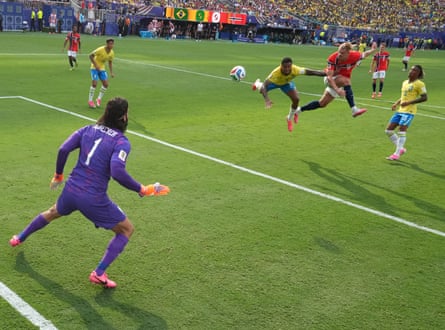
Watch his goals with that in mind: a leap for the header that owes something to a childhood spent jumping to release a shot in the handball goal area and a strike that has the coiled, unhurried power of someone who learned to generate force efficiently, the way a skier does on a mountain that punishes wasted movement. None of it replaces the football training since, but the sports he wasn’t rushed out of are plausibly still in his legs.
Alexander Sørloth, who leads the line alongside Haaland, spent his Trondheim childhood between football, handball and speed skating. He is, like Haaland, the son of athletes: a father who played for Norway at the 1994 World Cup, a mother who competed at handball. Two of Norway’s most physically imposing forwards arrived at football only after years spent learning to move in other ways.
Norway’s goalkeeper, Ørjan Håskjold Nyland, was 17 when the rules arrived and so was not shaped by them, but stands as proof the law did not invent this instinct, but formalise it. Nyland grew up with handball and alpine skiing alongside football, long before he settled in goal.
Against Brazil, that upbringing perhaps showed when it mattered: a penalty saved with the lateral spring of a skier, then, with Norway ahead but not yet safe, a goal-bound deflection off Kristoffer Ajer was clawed away with the kind of contorted, mid-air movement you would expect from a handball player.
after newsletter promotion
This is an argument for what happens when a country builds patience into childhood rather than urgency. Norway have form here. In February, they topped the Winter Olympics medal table for the fourth Games running, with a record 18 golds, outperforming countries 60 times the size.
Most nations run a version of Brazil’s model – spot the gift early, build the pathway around the position a child is presumed to already suit – and it has produced some of the most beautiful football played. But Norway’s success is a prompt to ask whether the alternative, protecting a child’s right to choose, may be the better pathway. It may be rare to legislate patience. It is rarer still to win by doing it.
Rarer because those eight rights were never written to win a World Cup. They were written so a child could play badly without being embarrassed. So a nine-year-old good enough for the first team could still just be a nine-year-old. Winning is what the football world will remember about this squad, but joy, oddly enough, is what the law set out to protect.
“To enjoy football and make it the thing you like to do most in life,” the former Norway and Tottenham goalkeeper Erik Thorstvedt has said. “The most important thing is don’t put too much pressure on the kids.”
After the final whistle against Brazil, the Norway fans broke into their Viking row, that slow, building rhythm that starts almost hesitant and grows into something thunderous. It is easy to hear it as a pure tribal sound. But the hairs stand up on your neck a little more once you know what this team were raised on: less a roar than the sound of a parent at the sideline; the kind who let their child choose their own sport, in their own time, and then turned up every weekend to cheer them on regardless.
Against England, famous for their academy prodigies, Norway will try to make history again on Saturday by reaching the semi-finals. There is a version of their story that is just about football, about a team that beat the odds, and then there’s a better, quieter one. One where a small nation chose to let its children be children – to play, to wander between sports, to enjoy it. It was never meant to produce a team that could beat Brazil. That it did is almost beside the point. What matters is that a whole country got to stand at the touchline and watch its kids fly.