.png) 7 hours ago
10
7 hours ago
10
Astronomers have found evidence that the Milky Way was flipped on its side following a direct hit from a wayward galaxy long before the solar system was born.
The cataclysmic collision took place about 10bn years ago when the Milky Way was struck head-on by an incoming dwarf galaxy known – for purely astronomical reasons – as the Gaia Sausage.
The Milky Way tore the interloper to shreds and absorbed its stars, but the chaos unleashed in the event probably flipped the entire disc of the Milky Way by more than 90 degrees into the position seen today, researchers said.
Astronomers at Durham University used supercomputer simulations to show that Milky Way-like galaxies involved in head-on collisions with the Gaia Sausage were likely to experience a “disc flip” that dramatically, if slowly, reoriented the galaxy. “It probably takes at least a few hundred million years,” said Kirill Batrakov, the lead researcher on the project.
The researchers made the discovery while investigating the curiously slow rotation of stars in the Milky Way’s halo. The halo is the sparse, roughly ball-shaped cloud of stars that surrounds the galaxy. Most of the halo’s stars originally formed in smaller galaxies that strayed too close to the Milky Way and merged over time.
Previous observations from the European Space Agency’s Gaia mission show that stars in the Milky Way’s disc orbit the heart of the galaxy at about 220km (137 miles) a second. But a longstanding mystery has surrounded those in the stellar halo, which rotate far more slowly, circling the galactic centre at about 25km a second.
In search of an explanation for the disparity, the Durham team turned to computer simulations of evolving Milky Way-like galaxies. The simulations showed that galaxies ended up with slow-moving stars in their haloes if they were struck head-on by nearby galaxies the size of the Gaia Sausage and subsequently experienced a disc flip.
Details are being presented this week at the Royal Astronomical Society’s National Astronomy Meeting in Birmingham.
The ancient collision first came to light in 2018, when an international team of astronomers used further observations from the Gaia mission to map the passage of stars through the Milky Way.
Some were found to be on radical, sausage-shaped orbits, which the researchers traced back to a dwarf galaxy breaking up as it ploughed straight into the heart of the Milky Way. The stars’ extreme orbits are a smoking gun for the colossal collision and led to the dwarf galaxy being named the Gaia Sausage.
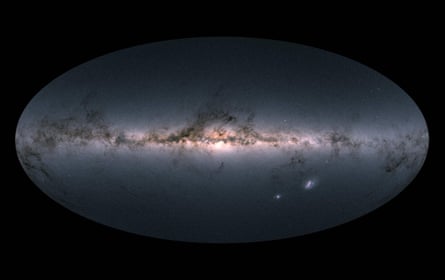
Astronomers now recognise the collision as the galaxy’s last major merger and a defining event in the Milky Way’s history. It fundamentally reshaped the galaxy, creating the bulge at the centre and dominating the stellar halo.
Though classed as a dwarf galaxy, the Gaia Sausage contained stars, gas and dark matter amounting to more than 10bn times the mass of the sun. The next major upheaval might not happen for a few billion years when a nearby dwarf galaxy called the Large Magellanic Cloud merges with the Milky Way.
Another merger is already under way with the far smaller Sagittarius dwarf galaxy. That is expected to have a much less dramatic impact on our cosmic neighbourhood. “It’s not as massive as the Gaia Sausage was, so it is not going to influence the Milky Way as much, and the Milky Way itself is far more massive now than it was back then,” said Batrakov.