.png) 2 months ago
62
2 months ago
62
Iran's foreign minister: 'Iranians never bow to pressure'
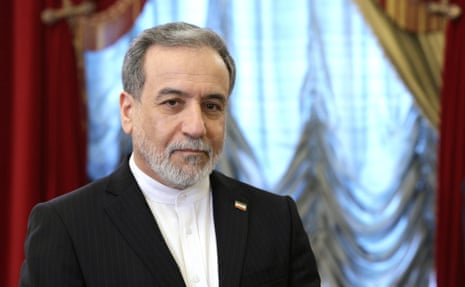
The Iranian foreign minister, Abbas Araghchi, has issued a statement on social media accusing the US of “reckless military adventure” amid diplomatic efforts to end the war.
It is the first comments by the minister after the US and Iran traded attacks over the strait of Hormuz, with both sides blaming each other for breaking the month-old truce.
In his statement, Araghchi said:
Every time a diplomatic solution is on the able, the US opts for a reckless military adventure. Is it a crude pressure tactic? Or the result of a spoiler once again duping [Donald Trump] into another quagmire?
Whatever the causes, the outcome is the same: Iranians never bow to pressure and diplomacy is always the victim.
Also, the CIA is wrong. Our missile inventory and launcher capacity are not at 75% compared to Feb 28 The correct figure is 120%.
As for our readiness to defence our people: 1,000%
He was referring to a report by the Washington Post, citing US intelligence, that Iran retains about 75% of its prewar inventories of mobile launchers and about 70% of its stockpiles of missiles.
Key events Show key events only Please turn on JavaScript to use this feature
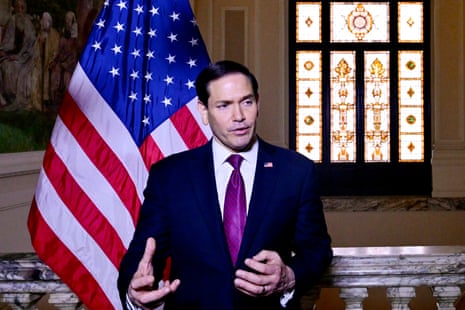
Rubio says Iran asserts it has the right to control an “international waterway”, referring to the strait of Hormuz, which Iran effectively closed in response to the US and Israeli attacks on Tehran in late February.
The US, hit hard by rising gas prices and fertiliser costs, has been pressuring Iran to reopen the strait, enforcing a naval blockade of Iranian ports.
Rubio was asked if he has had conversations with the Italian prime minister, Giorgia Meloni, or Italian foreign minister, Antonio Tajani, about helping the US unblock the strait by providing “escorts” to help commercial ships be guided safely through.
So far, Italy and other European countries have been resistant, not wanting to get dragged into the US war, even though their economies have also suffered as energy prices have surged. Rubio refused to be drawn on specific conversations he has had. But said:
Everybody says Iran is a threat. Everybody says that Iran can’t have a nuclear weapon. Okay. But you have to do something about it. The president is trying to do something about it. I don’t understand why anybody would not be supportive of that.
But here is a more fundamental problem. Iran now claims that they have a right to control an international waterway. They claim that they have a right to control it. What is the world going to do about that? Is the world going to accept that Iran now controls an international waterway.
Because if the world is prepared to accept that, then be ready because there are like ten other countries that are going to start doing the same thing in international waterways near their countries. That is an unacceptable thing they are trying to normalise.
Asked by a reporter if the US has communicated any “red lines” to Iran in their proposal, Marco Rubio replied: “Well the red line is clear, if they threaten Americans they are going to get blown up. How much clearer can you be than that?”
“We are not going to let our ships get sunk by the Iranians with their drones that they are firing,” the secretary of state said.
“They don’t have a Navy anymore but they bring out these little Boston whaler fishing boats and they try to swarm you. We are going to blow those boats up if they are coming towards our boats. I don’t know if that is a red line but I hope they know it is by now.”
The US is now framing any attacks it launches as purely defensive ones that do not constitute a resumption of major combat operations against Iran.
As my colleague notes in this story, the Trump administration is facing increasing pressure over how it frames the US-Israeli war on Iran to Congress because of the war powers resolution, a law that typically requires presidents to seek formal approval from Congress for war activities 60 days after beginning military action.
On the eve of the 60 day war powers deadline expiring last week, a senior official of the Trump administration said the US had “terminated” hostilities with Iran since the shaky 8 April ceasefire.
Rubio says US should get Iran response on Friday
Marco Rubio also told reporters in Rome that the US should get a response on Friday from Iran to its proposal to end the war.
“We’ll see what the response entails. The hope is it’s something that can put us into a serious process of negotiation,” Rubio said.
Axios has been reporting that the US believes it could be getting closer to reaching a 14-point memorandum of understanding with Iran, which could set the basis for more detailed nuclear negotiations at a later date.
US and Iran exchanged fire late on Thursday in the most serious test yet of their month-long ceasefire, raising questions about the likelihood of a lasting agreement being secured.
Hezbollah started firing at Israel shortly after the US and Israel launched its war on Iran by killing the country’s former supreme leader. Israel responded with airstrikes and launched a ground invasion of southern Lebanon.
Despite a US brokered ceasefire agreement, Israel and Hezbollah have continued with their attacks, accusing each other of violations.
Israel has been accused of violating the ceasefire agreement many times, with strikes killing civilians and homes continuing to be demolished despite the military saying it is only targeting Hezbollah sites.
Under the agreement’s terms, Israel was effectively given permission to continue its assault on Lebanon as it retained a “right to take all necessary measures in self-defence, at any time, against planned, imminent, or ongoing attacks”.
The US secretary of state, Marco Rubio, has been speaking to the press after meeting with the Italian prime minister Giorgia Meloni. He said the reasons why Lebanon “faces violence” is because of the Iranian-backed Lebanese militant group Hezbollah.
He said the US wants to empower and “equip” the Lebanese government to confront the “threat” of Hezbollah. He said Italy is among the countries that can play a role in helping “equip” the government and cutting off the financing that supports Hezbollah.
Rubio said Hezbollah is still capable of” “inflicting damage” even though it has been “weakened”. “We are not going to negotiate with Iran over Hezbollah.” “I think our role is with the Lebanese government,” he said.
“Lebanon should be governed by the Lebanese government. It should not have a terrorist group operating within its national territory that poses a threat both to its own people – including the Shia population – and to the government and to Israel and to its other neighbours.”
Israeli and US strikes against Iran’s nuclear sites have set back Tehran’s ability to develop a nuclear weapon, potentially extending the timeline to build one by nine months to two years, according to the Institute for Science and International Security.
In a report published this week, the Washington-based thinktank said it identified at least six nuclear sites that were attacked since the war began on 28 February, including uranium enrichment facilities.
It said before US-Israeli strikes on Iran’s key nuclear sites in June 2025, Tehran could have built a non-missile deliverable nuclear weapon with almost 100% certainty in less than six months.
Describing the situation now, it said:
It [Iran] will face a much more difficult struggle towards success if it tries in the coming months, and the probability of succeeding, whether it be in nine months, one year, or two years, is now much less technically certain, and significantly less than 100 percent.
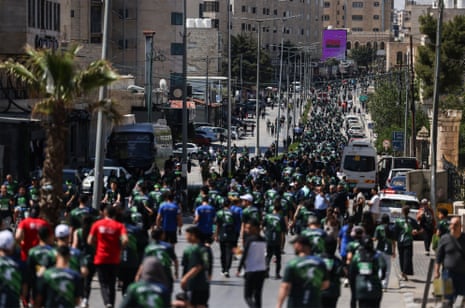
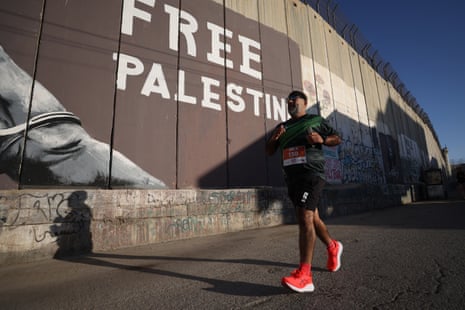
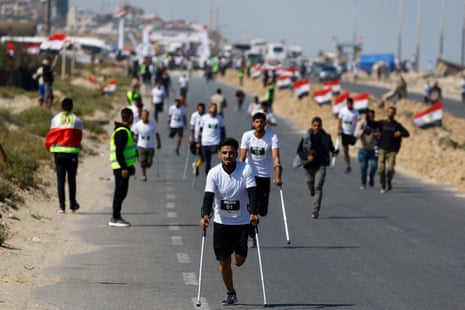
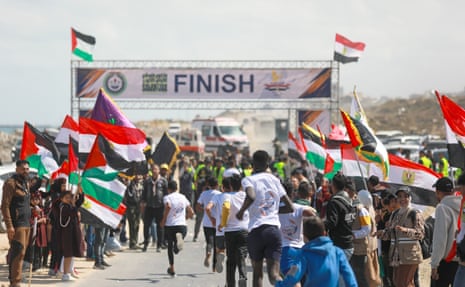
Today is the Palestine Marathon, which has returned after a two-year hiatus due to war.
Hundreds of runners set off from the occupied West Bank city of Bethlehem, the starting point of the race, with a parallel 5km run taking place in the Gaza Strip.
Here are some images from both of those events:
Iran's foreign minister: 'Iranians never bow to pressure'
The Iranian foreign minister, Abbas Araghchi, has issued a statement on social media accusing the US of “reckless military adventure” amid diplomatic efforts to end the war.
It is the first comments by the minister after the US and Iran traded attacks over the strait of Hormuz, with both sides blaming each other for breaking the month-old truce.
In his statement, Araghchi said:
Every time a diplomatic solution is on the able, the US opts for a reckless military adventure. Is it a crude pressure tactic? Or the result of a spoiler once again duping [Donald Trump] into another quagmire?
Whatever the causes, the outcome is the same: Iranians never bow to pressure and diplomacy is always the victim.
Also, the CIA is wrong. Our missile inventory and launcher capacity are not at 75% compared to Feb 28 The correct figure is 120%.
As for our readiness to defence our people: 1,000%
He was referring to a report by the Washington Post, citing US intelligence, that Iran retains about 75% of its prewar inventories of mobile launchers and about 70% of its stockpiles of missiles.
The ship monitor Tanker Trackers has posted the following on X about the Ocean Koi oil tanker:
Her new name is actually JIN LI (9255933), and has been so since 2025-11-30. Examining our data, we can see that she’s transported various Iranian hydrocarbons on at least 16 occasions since 2021; and with full knowledge of Iran because half of her loadings were conducted directly at port in Iran while the other half were conducted via Ship-to-Ship transfer further out.
JIN LI’s ownership is based in Shanghai, China. The vessel was slapped with sanctions by US OFAC on 2026-02-25.
Iran seizes tanker over alleged attempt to disrupt country's oil exports - state media
The Iranian military has seized a tanker over an alleged attempt to disrupt the country’s oil exports, the semi-official Tasnim news agency reported.
Identifying the oil tanker as “Ocean Koi”, the news agency reported that it contained a shipment of Iranian oil and “was attempting to exploit regional conditions to damage and disrupt oil exports and the interests of the Iranian nation”, without elaborating further.
The tanker was seized in the Gulf of Oman and taken to the southern coast of Iran, Tasnim reported.
The Pakistani foreign minister, Ishaq Dar, said he spoke with his Iranian and Singaporean counterparts about repatriating crew members on ships seized by the US.
He asked the Singaporean foreign minister Vivian Balakrishnan for help repatriating “11 Pakistani and 20 Iranian seafarers, aboard vessels seized by US authorities and currently near Singaporean waters”, Dar wrote in a post on X, without specifying which ships the crew were on.
He said he also spoke to Iran’s foreign minister, Abbas Araghchi, and that they “remain in close coordination on the matter”.
“Pakistan also stands ready to facilitate the safe repatriation of Iranian nationals to Iran via Pakistan,” he added.
US special forces boarded a stateless oil tanker in the Indian Ocean last month, which the Pentagon claimed was carrying Iranian crude oil.
A senior Saudi diplomat has reaffirmed efforts “supporting de-escalation and negotiations” as the US and Iran traded fire overnight.
In a post on X, Saudi Arabia’s minister of diplomacy, Rayed Krimly, also cautioned for people to be wary about “media reports attributed to unnamed sources - some of whom claim to be Saudi - suggesting otherwise”.
This may be in reference to a report in the Wall Street Journal that cited unnamed officials saying Saudi Arabia and Kuwait lifted restrictions on the US’s access to their military bases and airspace. US and Saudi officials reportedly told the newspaper that the restrictions were imposed soon after Donald Trump announced his ‘“Project Freedom” military operation on Sunday to reopen the strait of Hormuz. It apparently led to the US president to hit pause on the operation on Tuesday, but he is now looking to restart Project Freedom to guide commercial ships with naval and air support.
You can read more on that story here:
More than three million people in Lebanon are surviving on humanitarian aid, according to the EU commissioner for equality, preparedness and crisis management, Hadja Lahbib.
That equates to more than half of the country’s population, Lahbib told reporters today after meeting the Lebanese president, Joseph Aoun, in Beirut.
She said the EU has provided €100m (£86m) in aid to Lebanon, but this barely scratches the surface in meeting growing humanitarian needs. Last month, the Lebanese minister for social affairs, Hanin Sayyed, said if war and displacement continues, the country will need $1bn (about €849.8m, £734.3m) “to just keep the humanitarian situation afloat”.
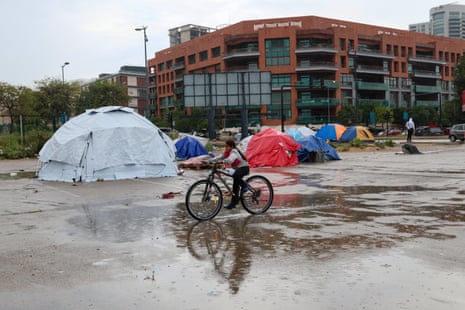
Rescue worker killed in Israeli strike in southern Lebanon, says country's civil defence
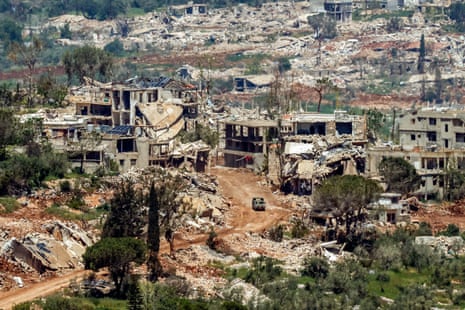
In Lebanon, the country’s civil defence agency said one of its rescue workers was killed in an Israeli strike this morning as he was travelling between two towns in the south.
It is a further sign of a disintegrating ceasefire that took effect on 17 April, with Israel and Hezbollah continuing to trade blows and the Israeli military forcing people out of their homes in dozens of towns and villages in southern Lebanon.
The Lebanese civil defence said their rescuer was killed “as a result of an Israeli strike that targeted him” on a road between Rachaya al-Foukhar and Kfar Shouba in Nabatieh district.
The Israeli military has not commented on the report.
Since the war began in Lebanon on 2 March, the World Health Organization (WHO) had “verified 152 attacks on healthcare that resulted in 103 deaths and 241 injuries”, WHO’s director-general, Tedros Adhanom Ghebreyesus, said on Wednesday.
Also this morning, the Israel Defense Forces (IDF) has issued another warning ordering people in seven towns and villages in Nabatieh and southern Lebanese district of Tyre to flee their homes as the Israeli military prepares to launch further strikes. The IDF has issued such orders almost everyday since the ceasefire began.

Mark Saunokonoko
It has been a week of dizzying, whiplash news in the Iran war.
Seven days ago, the US-Iran ceasefire was holding but negotiations seemed stalled, or inching forward at best. With the strait of Hormuz effectively choked off by Iran, and the US Navy blockading Iranian ports, there was talk of a one-page memorandum being passed between Washington and Tehran to break the stalemate.
In this explainer, we take a look at the key moments of the past week:
Oil back over $100 a barrel as ceasefire comes under pressure

Graeme Wearden
Oil is back over $100 a barrel as the US-Iran ceasefire came under strain, undermining hopes of an early reopening of the strait of Hormuz.
The jump in oil price came two days after hopes of a peace deal breakthrough pushed it down.
Brent, the price barometer for much of the world’s crude oil, is up 1% at $101 a barrel. That’s a fairly modest move, suggesting investors are still hoping that a deal will eventually be reached.
Markets have slipped back thanks to questions about whether the US-Iran ceasefire is holding, reports Jim Reid of Deutsche Bank:
Questions around the ceasefire have already had a market impact in Asia overnight, where all the major equity indices have lost ground. That includes the Nikkei (-0.69%), the KOSPI (-0.73%), Hang Seng (-1.17%), CSI 300 (-0.90%) and the Shanghai Comp (-0.43%).
Moreover, European equity futures are down, with those on the FTSE 100 (-0.70%) and the DAX (-0.87%) both lower, although US futures have picked up a bit after yesterday’s losses, with S&P 500 futures up +0.21%.
Follow our business live blog for more:
UAE says its air defence systems intercepted Iranian drone and missile attacks
The UAE defence ministry said its air defense systems were intercepting missiles and drone attacks from Iran this morning, further straining the tenuous ceasefire.
Iranian state media blamed the UAE for reported strikes in southern Iran yesterday. The semi-official Tasnim news agency, citing sources, reported that there were signs of UAE involvement in attacks on Qeshm, an Iranian island in the strait of Hormuz.
There were no immediate reports of damage in the UAE. The defence ministry advised people not to approach, photograph or touch “any debris or fragments that have fallen as a result of successful air interceptions”.
In a post on X, the ministry said: “The UAE’s air defenses are currently dealing with missile and drone attacks originating from Iran, and the Ministry of Defense confirms that the sounds heard in various parts of the country are the result of the UAE air defense systems intercepting ballistic missiles, cruise missiles, and drones.”
Iran has frequently targeted the UAE and other Gulf nations that hose US military bases in retaliatory attacks since the beginning of the war in late February.
Fragile ceasefire remains intact despite US trading fire with Iran
Morning, and welcome to the Guardian’s Middle East live blog.
The US said it carried out strikes on Iranian military targets after an attack on three American destroyers in the strait of Hormuz, while Tehran accused Washington of striking first. The exchange of fire threatens to unravel a fragile ceasefire in effect since 8 April – but Donald Trump insisted the truce remains intact.
“The ceasefire is going. It’s in effect,” the US president told ABC News, describing the strikes as “just a love tap”.
He repeated this stance when asked during a visit to see renovations of the Lincoln Memorial reflecting pool whether the ceasefire was still on despite the attacks. “Yeah it is,” he said. “They trifled with us today. We blew them away. They trifled. I call that a trifle.”
Writing on his Truth Social platform, he said “there was no damage done” to the US warships “but great damage done to the Iranian attackers”.
He added: “We’ll knock them out a lot harder, and a lot more violently, in the future, if they don’t get their Deal signed, FAST!”
The deal he was referring to is the one-page proposal from the US that would have both sides reach an agreement to reopen the strait of Hormuz and end fighting for 30 days while they work on a longer term truce, the New York Times reported.
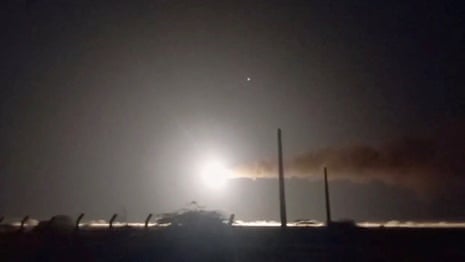
Iran, meanwhile, accused the US of violating the ceasefire by attacking an oil tanker and another ship on Thursday, saying its forces “immediately and in retaliation attacked American military vessels”.
Reacting to the attacks in the Gulf, Ebrahim Azizi, head of the Iranian parliament’s national security committee, wrote on X: “Making the same mistake again and again won’t get you a different answer; only a stronger one. Respect the new maritime regime of Iran.”
The tit-for-tat attacks came as explosions shook the Iranian capital Tehran and coastal city of Bandar Abbas, as well as Qeshm, an island in the strait of Hormuz, according to state media. The reported attacks were blamed on the US and “enemy units”, with the semi-official Tasnim news agency suggesting UAE involvement.