.png) 2 months ago
54
2 months ago
54
Anger mounts after Tennessee Republicans redraw maps to erase last Democratic, Black-majority district
Good morning, and welcome to our live coverage of US politics. Tennessee’s Republican-dominated legislature passed redistricting maps on Thursday, eliminating the state’s one Democratic, Black-majority congressional district as GOP lawmakers scramble to improve their fortunes ahead of the November midterms.
The new map splits Shelby County, the home of Memphis, a majority-Black city that played a critical role in the civil rights movement, into three separate Republican-leaning districts.
The majority-Black district being eliminated in the Memphis area has long been represented by Rep. Steve Cohen, the state’s lone Democratic congressional representative. All nine of Tennessee’s congressional districts are now Republican-leaning.
Republican House Speaker Cameron Sexton claimed that the new districts were drawn based on population and politics, not racial data.
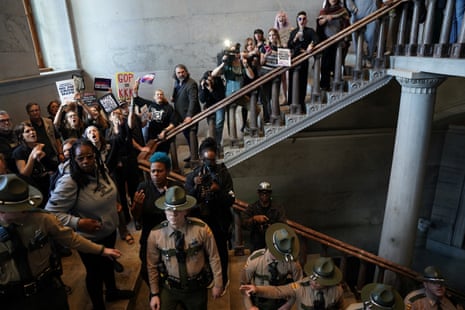
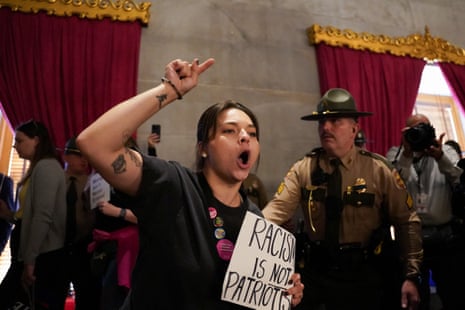
Demonstrators protest inside the Tennessee state Capitol on 7 May 2026. Photograph: Seth Herald/Reuters
But Democrats dismissed these claims and have argued that dividing up Memphis effectively deprives the Black community of representation in Congress.
“These maps are racist tools of white supremacy at the behest of the most powerful white supremacist in the United States of America, Donald J. Trump,” said state Rep. Justin Pearson, a Black Democrat from Memphis who is running for the US House.
Democrats say the redistricting effort, which prompted fierce protests, was a cynical attack on the hard-fought gains for equal representation won in the civil rights movement in a state that was forged by slavery and segregation.
The redraw comes as Republican-led southern states scramble to enact new maps in the wake of last week’s landmark Callais v Landry decision supreme court ruling, which invalidated swaths of the Voting Rights Act which had restrained state governments from drawing congressional districts that left Black voters at a political disadvantage.
Republicans in Louisiana, Alabama and South Carolina also have taken steps toward redistricting. Republican Tennessee Gov. Bill Lee, is reportedly due to sign the map into law imminently.
Key events Show key events only Please turn on JavaScript to use this feature
Gaya Gupta
Economists projected about 55,000 new jobs and a 4.3% unemployment rate. A day earlier, the labor department announced 200,000 people filed for weekly unemployment benefits, a slight increase from the week before.
A series of major changes over the last year – tariffs, government layoffs, changing immigration policies and, now, rising oil prices amid conflict in the Middle East – have rattled the US economy and destabilized the labor market.
The new data from the Bureau of Labor Statistics also included revisions to previous job figures. Last month, employers added 185,000 jobs, first reported as 178,000. This exceeded economists’ expectations of about 70,000. But in February, the US lost 156,000 jobs – initially reported as a drop of 92,000 jobs – an unexpected and major contraction just before the US-Israel war in Iran.
115,000 jobs added in April according to latest data
New data from the Bureau of Labor Statistics (BLS) shows that the US economy added 115,000 jobs in April, down from the 178,000 initially reported in March, which came after a notable contraction the month prior.
Unemployment in April remained unchanged at 4.3%.
Donald Trump will begin his day in Washington. We can expect to hear from the president at 12pm ET, when he delivers remarks in the Rose Garden. We’ll bring you the latest lines as that gets under way.
Later, Trump will travel to Sterling, Virginia for a dinner for the men’s professional golf tour, LIV.
Trump administration arrested the parents of at least 27,000 kids in seven months
A Guardian analysis of government records has found that, during the first seven months of Donald Trump’s presidency, the administration arrested the parents of at least 27,000 children.
During this period in 2025, the US Department of Homeland Security (DHS) was deporting about twice as many parents each month compared with 2024.
The records do not detail how many of these children were detained or deported with their parents, and how many families were split up. But the data provides one of the starkest views yet of how Trump’s mass deportation scheme has affected parents and children.
In thousands of cases, DHS sought to deport parents who had a different citizenship or nationality than their children, creating major legal and logistical barriers to keeping families together. You can read more of the investigation by my colleagues, Maanvi Singh and Will Craft, here:
US to start revoking passports of parents who owe more than $2,500 in child support
The US state department has said it will begin to revoke the passports of Americans who owe more than $2,500 in child support payments.
The revocations would begin on Friday and be focused on those who owe $100,000 or more, or about 2,700 American passport holders, the Associated Press reported.
In a statement, the state department said that the revocation of passports “supports the welfare of American children by exacting real consequences for child support delinquency under existing federal law.” It added:
Any American with significant child support debt should arrange payment to the relevant state or states now to prevent passport revocation. Once a passport is revoked, it may no longer be used for travel. Eligibility for a new passport will only be restored after child support debt is paid to the relevant state child support enforcement agency and the individual is no longer delinquent according to HHS records.
Passport revocations for unpaid child support of over $2,500 is permitted within a rarely used provision in Bill Clinton’s Personal Responsibility and Work Opportunity Act law (1996), which tied benefits to work under reforms that have been criticised for driving up the numbers of people living in deep poverty. When the provision in the law has been applied it is typically focused on preventing people with child support debt from renewing or applying for a new passport.
Meanwhile, Alabama has asked federal judges to lift an order requiring the state to have a second district where Black voters are the majority or close to it. That district gave rise to the election of Rep. Shomari Figures, a Black Democrat, in 2024.
Republicans instead want to put in place a map lawmakers drew in 2023 – which was rejected by a federal court – that could allow them to reclaim Figures’ district.
Black residents currently make up about 48% of the district’s voting-age population, according to the Associated Press.
That would drop to about 39% under the 2023 map. Republicans hope the federal courts will see the case differently in the wake of the supreme court’s Louisiana decision, which found that the Louisiana district represented by Democrat Cleo Fields relied too heavily on race (more on this ruling in the next post)
Here are some details about the seismic impact last week’s US supreme court ruling will have on the voting power of racial minorities going forward, courtesy of my colleague Sam Levine:
The US supreme court ruled that Louisiana will have to redraw its congressional map, in a landmark decision that effectively guts a major section of the Voting Rights Act.
In a 6-3 decision along partisan lines, the court rendered ineffective section 2 of the Voting Rights Act, the last remaining powerful provision of the 1965 civil rights law that prevents racial discrimination in voting. Section 2 has long been used to ensure minority voters are treated fairly in redistricting.
“Allowing race to play any part in government decision-making represents a departure from the constitutional rule that applies in almost every other context,” Justice Samuel Alito, a conservative, wrote for the majority opinion. “Compliance with section 2 thus could not justify the state’s use of race-based redistricting here. The state’s attempt to satisfy the middle district’s ruling, although understandable, was an unconstitutional racial gerrymander.”
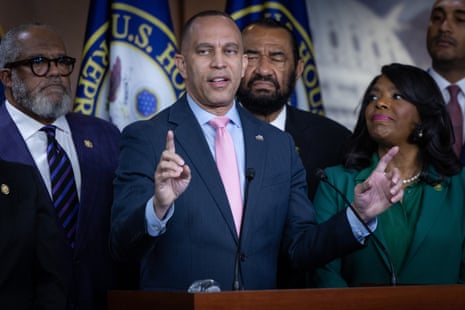
The court’s decision is a major upheaval in US civil rights law and gives lawmakers permission to draw districting plans that weaken the influence of Black and other minority voters.
Asked by reporters on Wednesday whether states should redraw their congressional maps in response to the ruling, Donald Trump said: “I would.” In a dissenting opinion, Justice Elena Kagan wrote the court had now accomplished a “demolition of the Voting Rights Act”. You can read more here:
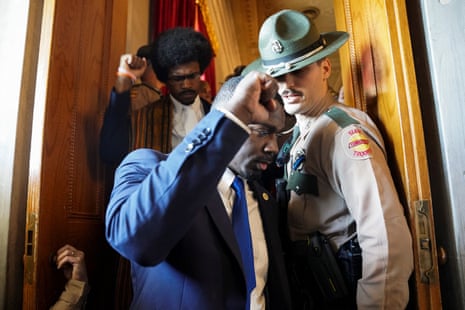
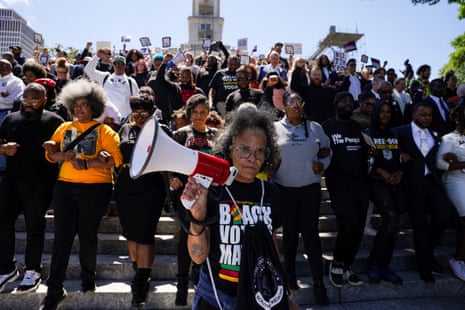
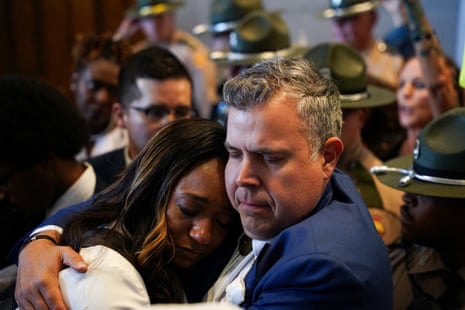
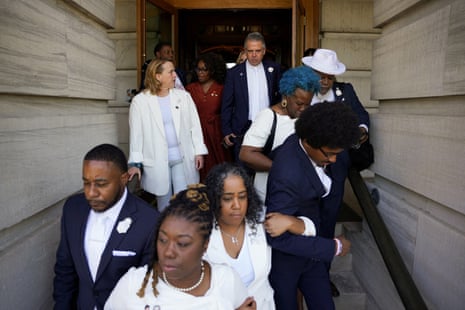
At the Tennessee state capitol, there were a number of protests against the legislature’s move to redraw the state’s congressional map that carved up the state’s majority-Black and sole Democratic district. Here are a selection of pictures that have been sent to us over the newswires:

Anger mounts after Tennessee Republicans redraw maps to erase last Democratic, Black-majority district
Good morning, and welcome to our live coverage of US politics. Tennessee’s Republican-dominated legislature passed redistricting maps on Thursday, eliminating the state’s one Democratic, Black-majority congressional district as GOP lawmakers scramble to improve their fortunes ahead of the November midterms.
The new map splits Shelby County, the home of Memphis, a majority-Black city that played a critical role in the civil rights movement, into three separate Republican-leaning districts.
The majority-Black district being eliminated in the Memphis area has long been represented by Rep. Steve Cohen, the state’s lone Democratic congressional representative. All nine of Tennessee’s congressional districts are now Republican-leaning.
Republican House Speaker Cameron Sexton claimed that the new districts were drawn based on population and politics, not racial data.
Demonstrators protest inside the Tennessee state Capitol on 7 May 2026. Photograph: Seth Herald/Reuters
But Democrats dismissed these claims and have argued that dividing up Memphis effectively deprives the Black community of representation in Congress.
“These maps are racist tools of white supremacy at the behest of the most powerful white supremacist in the United States of America, Donald J. Trump,” said state Rep. Justin Pearson, a Black Democrat from Memphis who is running for the US House.
Democrats say the redistricting effort, which prompted fierce protests, was a cynical attack on the hard-fought gains for equal representation won in the civil rights movement in a state that was forged by slavery and segregation.
The redraw comes as Republican-led southern states scramble to enact new maps in the wake of last week’s landmark Callais v Landry decision supreme court ruling, which invalidated swaths of the Voting Rights Act which had restrained state governments from drawing congressional districts that left Black voters at a political disadvantage.
Republicans in Louisiana, Alabama and South Carolina also have taken steps toward redistricting. Republican Tennessee Gov. Bill Lee, is reportedly due to sign the map into law imminently.