.png) 7 hours ago
7
7 hours ago
7
MI5 has been reprimanded by a watchdog for lying about its relationship with a neo-Nazi informant, who had exploited his role with the spy agency to violently threaten his girlfriend.
The Investigatory Powers Commissioner’s Office (Ipco) criticised MI5’s handling of a man known only as agent X, and said some of its officers had initially misled the courts and the regulator about his true status.
Although MI5 had confirmed to the BBC that agent X was an informant, the spy agency initially told Ipco and the courts that it could “neither confirm nor deny” its relationship with him, a standard form of “no comment” it uses.
That had frustrated the efforts of “Beth”, agent X’s girlfriend, in bringing legal complaints against MI5 after he had attacked her with a machete and tried to rely on his status as an informant to discourage her from speaking out.
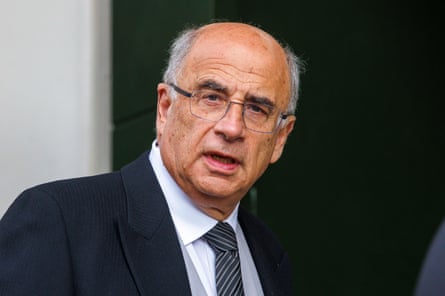
“MI5’s management of agent X fell far below the standards the public, the courts and Ipco have every right to expect,” said Brian Leveson, the investigatory powers commissioner, as he published a review of the case on Thursday.
“What makes this case particularly grave is that Ipco and the courts were misled,” said the watchdog, which reviews the use of covert powers by public bodies. “Failings of candour undermine the entire basis of oversight and accountability.”
The identity of agent X, a foreign national involved in neo-Nazi movements, is unknown and he is understood to have since left the UK. He was recruited by MI5 before 2019, but came under investigation by a BBC reporter, Daniel de Simone.
The journalist contacted agent X, saying he planned to report he was “a dangerous neo-Nazi”. The informant immediately contacted MI5.
Officers handling the case, fearing X’s life could be in danger, tried to suppress a potential BBC report by telling De Simone that X was “not a real extremist, but was pretending to be so at the behest of MI5”, according to the account of events contained in the 211-page Ipco report.
One MI5 official, known only as Officer 2, then responsible for communications, confirmed to the journalist that X was an informant. However, De Simone continued to investigate, believing him in fact to be “a seriously violent and abusive person, with paedophilic tendencies”, based partly on the testimony of Beth.
The BBC eventually published a report in May 2022, after winning a legal battle with the government. Afterwards, Officer 2, told his successor as head of communications, Officer 3, that while he could not entirely remember the conversations, he “thought he had not” confirmed to the BBC that agent X was an informant.
Officer 3 then reported to colleagues that his status “had not been breached”. This underpinned MI5’s position in court proceedings brought by Beth, in which the agency said it could not confirm the status of agent X. When the BBC corrected the record, MI5 was forced to retract and apologise.
This week, the Hillsborough law cleared the Commons following months of delay, after the government made amendments to the bill to ensure its proposed duty of candour for public officials would apply to individual MI5 officers.
A public inquiry into the Manchester Arena terrorist attack, which killed 22 people in May 2017, found that an MI5 corporate witness had at first not given an accurate picture of what it had known about the suicide bomber.
Two junior officers, who had subsequently given evidence to the inquiry, indicated there was intelligence that might have prevented the deadly attack. Previously, MI5 had suggested that was not the case.
The agent X case first became public in 2022, after the BBC won a court battle to allow the case and Beth’s story of her abuse to be reported. Subsequently, MI5 acknowledged that a senior spy had given “false evidence” in three court cases and compensation was paid to Beth earlier this year.
Two versions of the Ipco report were sent to the prime minister, Keir Starmer, earlier this month: a secret, closed version and the open, public version that was released with the permission of Downing Street on Thursday.
Shabana Mahmood, the home secretary, said the Ipco report made for stark reading as it “outlines a series of failings both individually and organisationally within MI5 that led to false evidence being included in its witness statements”.
She added that she would seek to “strengthen current structures” in which the head of MI5, Ken McCallum, is held to account; increase oversight of the spy agency and better understand how it approaches court cases.
McCallum, apologised for MI5’s failings of candour and said he repeated previous apologises to the courts “for the incorrect evidence that was provided and for our slowness in recognising what had happened”.
He also apologised again to Beth, who he acknowledged “suffered additional distress as a consequence of what MI5 got wrong in the course of responding to her serious claims” against the spy agency. The high court and the Investigatory Powers Tribunal will now consider whether to take further action against MI5.