.png) 4 hours ago
6
4 hours ago
6
There is magic in the air at this year’s Buxton festival – and it’s not just the hops from the local brewery. Wizards, sorceresses and fairies curse and charm their way through a trio of operas from three different centuries. Handel and Pauline Viardot take care of the 18th and 19th respectively, but setting the cauldron bubbling is Francesca Caccini’s 1625 La Liberazione di Ruggiero – the earliest surviving opera by a woman.
Premiered at the Medici court – then under the rule of regent Maria Maddalena of Austria – it is no coincidence that the work’s take on Ariosto’s Orlando Furioso is more girl-power than most. Warrior Ruggiero has been reduced to a lovesick captive, while sorceresses Alcina (wicked) and Melissa (good) do battle over him. Add in a chorus of Alcina’s former lovers (now transformed into plants and shrubs) and you have a deliciously semi-serious, mythical romp whose premiere apparently ended with a horse ballet.
Director Eloise Lally is too high-minded for such silliness, and what we get from her and young Buckinghamshire company Vache Baroque is a meditation on power and systems of authority that is at its best when it forgets to be earnest and has as much fun as Jonathan Darbourne’s band.
Supplementing Caccini’s supple, expressive score with instrumental works from Florentine contemporaries, the music bursts with colour and idiomatic energy: three recorders weave and twine in silvery parallel, answered by a trio of belching sackbuts. Violins dance and sway to rhythms from theorbo and guitar, texture now gritty, now gilded, its surface always encrusted with textural interest.
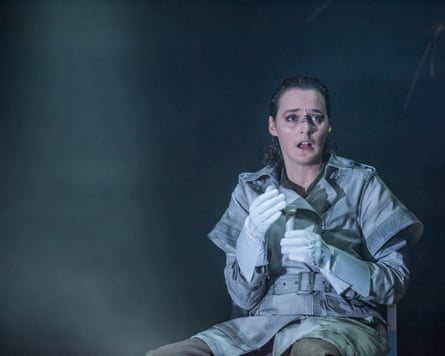
Lally and designer Zahra Mansouri give us pastoral by way of Skid Row. A blindfolded Ruggiero (Jon Stainsby) is bound with a dirty shower-curtain, while Melissa’s henchmen sport fatigues, and Alcina’s potion-making looks a lot like cooking meth. The trouble is that once you up the stakes dramatically the music has to follow suit, and with the exception of Stainsby, whose impassioned confrontation with Alcina swells gloriously, these are smaller voices – full of detail and inflection, but lacking the power to pull off full-scale psychodrama.
Camilla Seale’s Alcina gives little away, her brooding intensity and contained mezzo outgunned by Phoebe Rayner’s bright, prettily sung Melissa. Harriet Burns stands out in a variety of supporting roles – her soprano liquid-lovely in Caccini’s sensual, upper-voices ensembles – and Filippo Turkheimer packs plenty of vocal personality into his cameo as Neptune.
No horse ballet, disappointingly, but this Liberazione still casts a potent musical spell.