.png) 7 hours ago
5
7 hours ago
5
The music festival Menopunkapalooza began with the ceremonial application of an estrogen patch to the backside of Built to Spill and Prism Bitch drummer Teresa Esguerra. It ended with riot grrrl pioneers Calamity Jane tearing the roof off Portland’s Crystal Ballroom as they performed for the first time in 35 years.
What happened in between was 750 festivalgoers, a dozen pillars of the Pacific north-west’s punk rock scene, and a team of medical professionals singing, laughing and occasionally raging about a topic still taboo in 2026: women’s sexual health during menopause and perimenopause, and the promise of hormone replacement therapy (HRT).
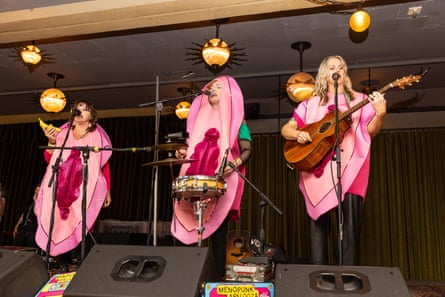
A three-woman band, Ménage àh Twats, dressed in glittery vagina costumes, sang a parody to the tune of Lorde’s Royals: “Night sweats, hot flash, never getting good sleep / Dry puss, moustache, feeling like a crazy / We don’t care …” Gabalanch’s Sara Lund and Rachel Blumberg played a chill drum-and-gong set, before Berzerk’s Joanne Belesiotis propelled herself across the stage in deer antlers while her band melted everyone’s faces. Teenagers and octogenarians cheered, “Hormones are healthcare!” A 10-point hormonal justice Bill of Rights was read aloud as the mascot for the Portland Cherry Bombs FC looked on.
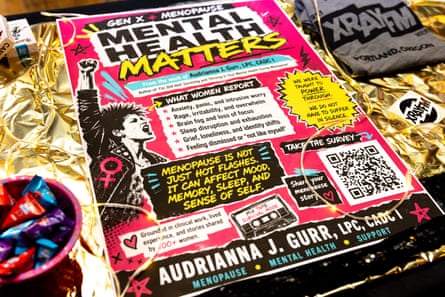
It was the start of a revolution, a movement led by riot grrrl-era musicians and gen X doctors to address how failures of the government and medical establishment have kept middle-aged women in the dark about their medical options, said Alicia J Rose, founder of Menopunkapalooza. It also was a couple of joyous, electric nights of music on the last weekend of June.
Rose, 56, is host of a podcast called Menopunks and director of an upcoming documentary of the same name that features Pat Benatar, Neko Case, Alice Bag and Peaches, as well as many Portland musicians and doctors, talking about their experiences with menopause. “I didn’t know anything about menopause, including when I was going through it,” Bratmobile’s Allison Wolfe says in a trailer. “It affected my confidence in my pussy,” Peaches confesses. The weekend’s events were dreamed up as a way to get funding and footage for the documentary, which Rose hopes to show at film festivals in the fall.
In the 90s, the riot grrrl feminist movement, born in the Pacific north-west, empowered young women to talk about the sexism and abuse they experienced from men. L7 created Rock for Choice, a series of shows to raise money and awareness for reproductive rights. Sleater-Kinney sang out against war and inequality. Bikini Kill started a tradition of shouting “girls to the front” to counter the hostile, male-dominated audiences at punk shows. Many of these bands are still performing. And they are joined by younger punk artists inspired by the era’s sound and political outspokenness, such as Lambrini Girls and the Linda Lindas, and even Olivia Rodrigo, whose upcoming Daisy Chain Fields festival features an all-star, all-women lineup and will raise money for non-profits that help women and girls.
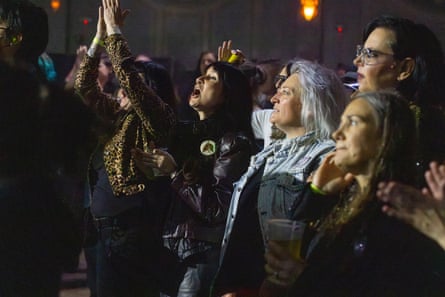
With Menopunks, gen X rockers put to use defiant music, organizing experience, and the “no fucks to give” wisdom that comes with age. “We were all around in riot grrrl and got to experience that wave of activism and community. That primed us for this. Now we’re all in menopause and we’re like, “What the F? This sucks,” Calamity Jane’s Gilly Ann Hanner said. “But we’re also like, ‘Well, no one’s going to do it for us. We got to fight.’”
It started three years ago when Rose, who plays accordion, synth and drums with the band Party Witch, began dealing with crippling fatigue and hot flashes. She was in so much pain that she was not far off from needing hip-replacement surgery, and she worried she would not be able to perform any more.
“It went from decently shitty to holy-fucking-hell-my-life-is-over kind of shitty,” Rose told the audience during the festival. “I was like, I can’t live like this.” Soon, she discovered longtime friends like Hanner and Jen Sbragia of the Softies and All Girl Summer Fun Band were also struggling with symptoms like hers: anxiety, brain fog, joint pain, fatigue, irregular periods, low libido, and other mental and physical horrors.
Hanner, 59, said she was totally caught off guard: “I was doing kung fu. I was jogging. I was just in the best shape of my life. I was in two bands. I was working and just killing it.” But after a bout with Covid in 2021, she started experiencing “a cascade, a waterfall” of symptoms that doctors had trouble diagnosing. “My joints hurt and I couldn’t digest any food and I was just weak,” she said. “I was 53, 54, and felt old and feeble. It really messed me up.”
HRT – a medical treatment to replace estradiol, progesterone and testosterone – is considered the most effective treatment for alleviating myriad symptoms associated with women’s declining hormones. (Research has also shown that HRT may reduce the risk for some women of heart disease, dementia, osteoporosis and other ailments associated with ageing.) Rose, Hanner and most of the speakers and performers at Menopunkapalooza shared stories about hormones tanking in middle age and doctors who were unable to connect the dots. They felt as if they had to fight for care – for physicians trained to recognize and ready to treat menopause symptoms. Even when they found a doctor to prescribe HRT, it took time to calibrate dosages, they said.
Lingering misinformation around hormone therapy is another barrier to treatment, according to Dr Sara Kennedy, president and CEO of Planned Parenthood Columbia Willamette, who spoke at the festival. A lot of the blame for that can be traced back to a 2002 report by the White House Initiative on Women’s Health Research – better known as the Women’s Health Initiative – that linked hormone therapy for post-menopausal women to an increased risk of breast cancer and cardiovascular disease. Women who were being treated with HRT were told to stop immediately. While follow-up research continued to reveal flaws in the study and counter its initial claims, the damage was done: the use of hormone therapy among women nosedived, from nearly 30% in 2002 to less than 5% by 2020, according to a 2024 study published in Jama Health Forum. To this day, many doctors remain reluctant to prescribe HRT, and patients are reluctant to ask about it, citing cancer risks.
Eventually, Hanner found a nurse practitioner who recognized her symptoms and recommended HRT. “Isn’t that bad for you?” Hanner asked the nurse practitioner, who responded: “Well, yeah, that was the story, but new evidence has come to light, and quality of life benefits outweigh the risks.” (Risks of serious side effects are low and depend on age and dosage; women with certain health issues such as breast cancer or cardiovascular disease may not be able to take HRT.)
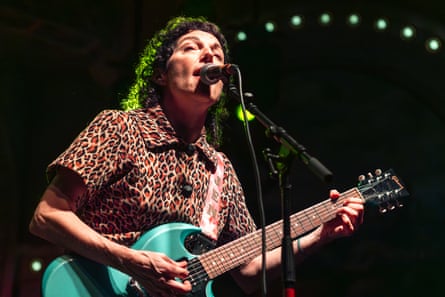
Like many of the artists and attenders at Menopunkapalooza, Hanner said hormone therapy was a gamechanger. In time, her pain subsided and her stomach problems improved. She had the energy to perform gritty, ferocious Calamity Jane anthems such as Magdalena and Hang Up.
Despite the fact that more than 1 million US women begin menopause each year, it remains understudied and not widely taught in medical education, several of the doctors at the festival said. Since western medicine’s earliest days, the male physiology has been treated as the standard, with little attention given to women’s bodies beyond their role in procreation – something the Menopunks want to challenge.
Despite her medical education, Kennedy was completely thrown for a loop when she began experiencing what she now knows was perimenopause.
“When I went through medical school in the early-, mid-2000s, I think I spent one hour learning about perimenopause, menopause care,” Kennedy said on Saturday. “One hour for a condition – not a condition, a time of life – that half the world will experience.”
At the Planned Parenthood clinics she runs (which also sponsored Menopunkapalooza), clinicians undergo expanded training in perimenopause and menopause care so they can learn what type of HRT delivery system – pills, patches, vaginal rings – might be best for a patient and how to adjust prescriptions as needed.
Recently there have been steps toward improvement in care. In November, the FDA announced it was rescinding its 2003 guidance on HRT and removing black-box warnings on medications, and legislation has been introduced in multiple states and Congress to expand insurance coverage, workplace accommodations and medical education for menopause. In pop culture, the time in life once euphemistically called “The Change”, if it was discussed at all, has been tackled in shows like BBC’s Riot Women and CBC’s Small Achievable Goals, and a collection of essays called The Big M featuring writers Roxane Gay and Cheryl Strayed.
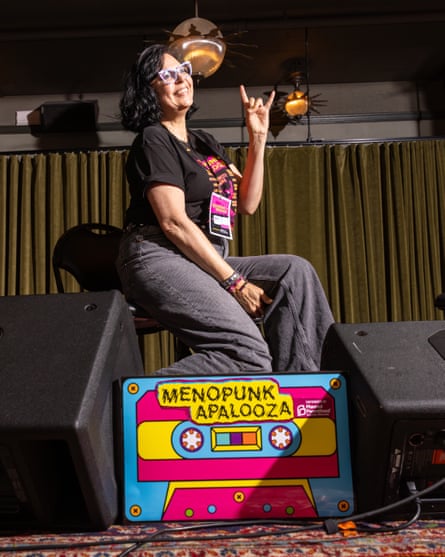
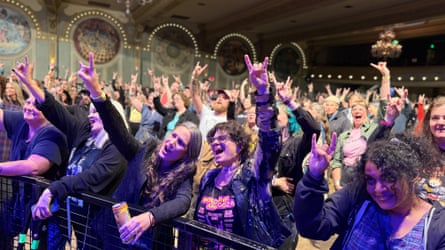
The contagious enthusiasm at a two-day festival dedicated to middle-aged women’s health, happiness and right to hormones also seemed like a pretty big moment. Dressed in Menopunks T-shirts and fashion best described as “chic witch”, the crowd was largely made up of women “of a certain age”, though it also included a good number who were probably closer to their first period than their last. They jumped up and down flashing the “sign of the horns” to ward off bad luck. Sleater-Kinney’s Corin Tucker cheered on the bands from the crowd. Bassist Mandy Morgan had an enormous smile plastered to her face during sets with Berzerk and Calamity Jane, as if she could not believe how much fun she was having. The Crystal Ballroom room erupted when she took the mic for a thrilling cover of Bikini Kill’s Suck My Left One.
Rose, Hanner and the Menopunks hope women in other cities and countries learn something from Menopunkapalooza and host events of their own to get women invigorated about menopause care. Maybe “hormonally optimized” members of more all-women gen X bands will be inspired to reunite for them.
“I think musicians see other people performing [again] and go, ‘OK, I’m not too old,’” said Hanner. “I mean, maybe I am, but who cares? I’m just going to play anyway.”