.png) 3 months ago
66
3 months ago
66
Andy Burnham has signalled he would begin transforming the broken social care system this year if he became prime minister, accusing Westminster of “flinching away” from tackling difficult policy problems.
The Greater Manchester mayor said politicians must be willing to take on “the weight of the system” that stands in the way of radical change, as he began to set out his prospectus for government if he won the Makerfield byelection.
Burnham, who first tried to change the social care system when he was Labour’s health secretary in 2009, said there was an urgent need to fix the crisis. Then, he had planned a levy on estates to pay for universal social care, while in recent years he has talked about replacing inheritance tax with a progressive “care levy” to fund a national care service.
“It is urgent, the need to fix social care, and I personally would look at all of the kind of implications of that in relation to inheritance tax and care charges and everything. I wouldn’t flinch from it,” he said.
He suggested bringing forward the Casey review, which is tasked with drawing up proposals, including on funding, from 2028. He said he would like it published by the end of 2026, focusing on measures that could be implemented quickly.
In an interview with the Guardian while campaigning in Makerfield, where he is fighting to hold Labour’s seat against the threat of Reform UK, Burnham also:
-
Said Labour should be a broad church with more government ministers from the left of the party, but Jeremy Corbyn should not be allowed back in.
-
Signalled there would be no snap election if he replaced Keir Starmer, but defended himself from criticism over a shadow leadership campaign.
-
Defended his comments that politicians should not be “in hock” to the bond markets, and denied he was boxing himself in by sticking to Rachel Reeves’s fiscal rules.
-
Argued it would be a mistake to rerun the Brexit referendum but that he wanted the UK to rejoin the EU in his lifetime.
-
Praised Shabana Mahmood, the home secretary, for “facing up” to the big issues on immigration.
Since his selection for the seat, Burnham has navigated a difficult path between setting out his vision for government, while denying he was using it as a stepping stone to power. He was “100%” focused on winning the byelection, he said, adding it was “weird” being asked who would be in his cabinet.
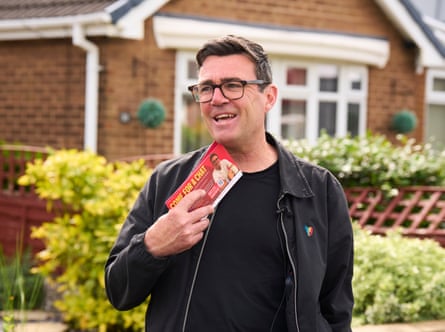
“I’m not making any assumptions about where things go beyond the byelection, because there’s lots of things that then come into play,” he said.
“The public here gave us the clearest of messages in [the local elections in] May. They really are saying loudly now: ‘Politics isn’t working for us’… If it doesn’t change at this moment in time, how many steps away are we from becoming as polarised as the US?”
Burnham said the “shallowness” of Westminster meant too many important issues had gone unresolved, and he had encountered “a sadness” on the doorstep at the lack of radical change.
“I’m not going to say something and then not do it, because this is part of what has dragged politics to this really low-faith position with the public.”
He denied he had left himself little room for manoeuvre by saying he would stick to the fiscal rules.
“Well, actually, the rules have freed up significant resource for public investment, and it’s about using that money as productively as possible. It can be spent in different ways,” he said.
In Manchester, he has taken buses back into public control and halved fares from £4 to £2. Nationally, he said, he would reallocate £39bn earmarked for social and affordable housing to social homes. There should be more fiscal devolution, he said, including allowing councils to levy a tourist tax.
Burham suggested replacing “iniquitous” council tax with a land value tax, and said public sector procurement should prioritise British industry.
He has attempted to cauterise his remarks that politicians were “in hock” to the bond markets, saying they had been misinterpreted for political ends.
“My argument was always that politicians have left the country in hock. If you give up, as we did … the levers of control, you end up losing control of public spending and not able to get a productive, efficient state as a result,” he said. “My argument is about kind of retaking that control, so that you can give yourself some headroom and not be always looking over your shoulder.”
Immigration comes up regularly on the doorstep in Makerfield. Burnham was supportive of Mahmood’s controversial changes. “I applaud the home secretary, actually, for the way in which she’s faced up to some of the issues that need to be gripped.”
He would not “shy away” from concerns over small boat crossings, he said. “We do need to consider further approaches to the issue that are perhaps more robust.”
However, he added there had to be “balance” in the system, with safe routes to the UK for refugees, and a route to work for people already in the country, so they could contribute to the economy rather than being “left in limbo” for long periods.
A Labour government should put factionalism behind it and “draw on all parts” of the movement to create a broad church, Burnham said, raising the prospect of him bringing leftwingers into ministerial jobs should he end up in power.
In an implicit criticism of Starmer’s approach, he highlighted how Labour MPs had been stripped of the whip after voting against the party on policy issues, saying he had always tried to unify people instead.
“This joke that everyone tells about a Corbynite, a Blairite, a Brownite, going to a bar. I can laugh about it to a degree, but this is the point: it says more about the people who tell that joke than me, because it says they are factional.
“I’ve always been a Labour politician that’s about unifying people, trying to be positive and working together. That’s my approach to politics. I think politics needs less division and less factionalism these days.”
Burnham said some leftwingers, including Faiza Shaheen and Jamie Driscoll, should never have been kicked out of Labour but he drew a line at Corbyn, saying it had “gone beyond” the time he could be welcomed back.
Many inside Labour are uncomfortable with the shadow leadership campaign that appears to be taking place. But Burnham said: “I didn’t create what happened in Westminster after the local elections. I can’t be held responsible for what goes on there.
“Obviously, I do have to respond to what goes on, and if the PLP, as it would seem, want a change in direction, I’ve got to respond to that.”
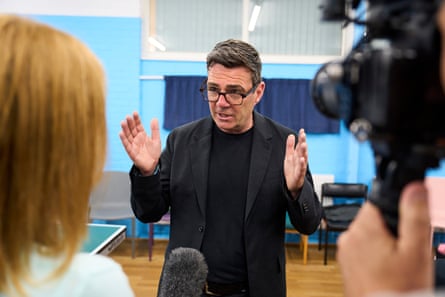
He last spoke to Starmer the Sunday before he was selected to fight Makerfield, adding that their relationship was respectful but they were honest with each other.
And he declined to answer questions from the Guardian about a change in leadership. “What comes beyond the byelection, we’ll face that if and when it comes. I don’t want anyone to think anywhere in this constituency, that I think this is just easy.
“People do want to get ahead of things, but I’m not ahead of things. Sometimes it’s weird, because I get asked about the speculation about general elections, appointments to cabinet … The weird thing for me is my headspace is nowhere near where they are. I’m reading this stuff, my head is 100% on this byelection.”
However, Burnham did appear to rule out holding a snap election should he make it to No 10. “Calling a general election? I’m sorry, I think there’s a limit to how much time people want people to be on their doorsteps, isn’t there?”
He indicated that Josh Simons, the MP for Makerfield who stepped aside to make way for his run, and who is understood to be working on policy for him, could be part of any future team. “There’s no guarantees,” he said, but when asked if he would like to continue working with Simons, added: “Yeah, I would.”
Burnham did not rule out trying to find another seat should he lose the byelection to Reform UK. He also suggested he would stay on as Greater Manchester mayor. “Whichever way people decide to vote, I would obviously work from the assumption that I would continue to see out my mayoral term, if things don’t go as I hope.”
Burnham shrugged off suggestions that Wes Streeting had been trying to corner him on rejoining the EU as a campaign tactic. “That would be to take political machinations too far, maybe,” he said. “I’ve got a really clear position. Some people call it a U-turn. It isn’t. I remain of the view I’d like to see us rejoin in my lifetime. That doesn’t mean you rerun the referendum now.”
He added: “I personally believe, and nothing is new because of the byelection, that rerunning Brexit now would be a mistake, because it would just entrench that feeling of division.
“We’ve got to fix our own fundamentals before we then think about our relationship with other countries. Our focus should be relentlessly domestic in this moment, and then we come to those issues another time.”
Burnham declined to describe the catastrophe on the ground in Gaza as a genocide. “I can’t judge things of that enormity from where I am as mayor of Greater Manchester,” he said. “But I do have concerns about the disproportionate nature of what has happened in terms of the destruction, and there has to be a full process of investigation and accountability.”
He defended Starmer’s approach to Donald Trump. “Normally you would want a good relationship with the US, but if you can’t agree with them, then say that as well. That’s the only way I think to deal with him,” he said.
“Obviously, the relationship is important to the UK, but not to the point where we just go along with anything they say. We’ve got in trouble in the past when that happens, so no, I think the approach that Keir has taken is the right one.”