.png) 4 hours ago
5
4 hours ago
5
As video director to the stars in the golden age of MTV, Tim Pope’s trademark was putting his very famous clients in uncomfortable or dangerous situations. He dressed Freddie Mercury as a “giant Mediterranean prawn”, locked the Cure in a flooded wardrobe then chucked it off a cliff, and almost electrocuted two Psychedelic Furs.
“The core of my work seems to be sadism,” he chuckles. “I have wondered if it was all some sort of revenge for the brutality I suffered away at primary school, but maybe I’m just cruel.”
Whichever, it hasn’t served him badly. Pope’s glittering client list included megastars such as David Bowie and Paul McCartney, most of whom were only too willing to be – almost literally – tortured for their art. In the foreword for I Shoot Rock Stars, Pope’s riotous new memoir, the Cure’s Robert Smith sings the praises of “every moment” in his company “apart from the hours spent drowning in freezing filthy water, being asphyxiated by snakes, slowly being fed into a giant spider’s mouth, cut off at the knees, being chucked off a pier or orally endoscoped”.
“That was for the video for Lullaby,” sniggers Pope, now a youthful 70-year-old with a mischievous grin. “I had to run a camera inside Smithy’s mouth at risk of knocking out his sweet little teeth.”
Bowie, who Pope worked with in the 80s and 90s, was similarly trusting. “I strapped a camera to him and got him to fall forward,” explains the film-maker. “If he’d have fallen in the wrong way it would probably have impaled him.”
In fact, Pope started his memoir after coming across a years-old answerphone message from the singer, who died in 2016. “It was like David was speaking to me from beyond the grave, because I never said goodbye to him,” he says. “I realised I’d been around all these amazing things.”
Pope’s wild ride began at Latymer Grammar School in Enfield, London, where the new film studies class introduced him to directors such as Alfred Hitchcock and Roman Polanski and “the concept of the auteur”. Funding his new hobby by doing a paper round and working in a chip shop, soon enough he smuggled his first 8mm film camera into an Emerson, Lake and Palmer concert: “Down my trousers, at immense pain to myself.”
After film college, he was working at a company training politicians to appear on TV when he started moonlighting for record labels, filming bands playing live for £100 a pop. There were very few video directors then, and the world of David Mallet (Blondie, Bowie, Queen) or Russell Mulcahy (Duran Duran, Elton John) felt like “an impenetrable club”. Then Soft Cell had a global smash with Tainted Love and hurriedly needed a video for the follow-up, Bedsitter. “I’d met this art director, Al McDowell, who went on to work with Spielberg,” explains Pope. “We came up with mad ideas, drew up a storyboard and after the video was shown on Top of the Pops the floodgates opened.”
Pope’s emergence coincided with MTV’s 1981 launch as a global music video platform. However, he rejected what he calls their “thou shalts” – “Thou shalt make your stars wear Spandex”, “Thou shalt include babes with big hair and even bigger boobs”, etc – in favour of what he calls: “Defiant individualism. Rebellion was in my DNA. I wanted to cause trouble.”
He filmed Soft Cell amid chains, raw meat and maggots for Sex Dwarf, after which the police confiscated the film. After the Style Council’s Long Hot Summer video showed Paul Weller playfully stroking bandmate Mick Talbot’s ear, the singer’s father/manager John phoned up asking: “What are you doing with my boy?” “For another video Paul came out wearing lipstick,” Pope remembers. “I think he was rebelling against norms and the image people had of him.”
Rather than adopt the off-the-peg style of many of his peers, Pope saw himself as a “bespoke tailor”, personalising each video to the song and artist. He made 37 of them for the Cure. Because Close to Me drew on Smith’s childhood claustrophobia when he was bedridden with chickenpox, Pope put the band in a wardrobe. For The Lovecats, he came across the ideal location in an estate agent’s window. “They let me view the house and gave me the keys,” he sniggers. “Next thing I know, I’m in there with the crew. Smithy and the boys piling out of the van. The neighbours must have heard The Lovecats coming through the walls.” Pope handed back the keys and the clandestinely shot video went around the world.
Pope’s regular clients were as maverick or uncompromising as he was. He filmed the The videos underneath a steam train and in a Spanish Harlem brothel and blasted Talk Talk’s Mark Hollis with an aircraft engine. Pope drew on Neil Young’s “emotionally raw real-life personality” for a succession of fictional characters – psychotic old drifters or, in Pressure, the guy who punches himself so hard he actually knocks himself out. Once, filming closely, Pope’s camera left the star with a “raging dent in his forehead like a third eye. But I got this amazing shot past his nose on to the keyboard.”
He freely admits a “Spinal Tap period”: a 75ft penis on wheels for Hall and Oates, or Queen’s It’s a Hard Life “prawn” costume video, which led drummer Roger Taylor to comment: “No artist has ever looked as silly in a video.” By the late 80s, Pope was “jetting about on Concorde, hanging out with Iggy Pop …” The chapter Iggy’s “Cock” Moment describes the time his camera captured the rocker’s exposed “schlong” on stage. Pope writes about his adventures like he talks, in mild disbelief: “Lou fucking Reed and David fucking Bowie, and me, a boy from Enfield, trying to play it cool.”
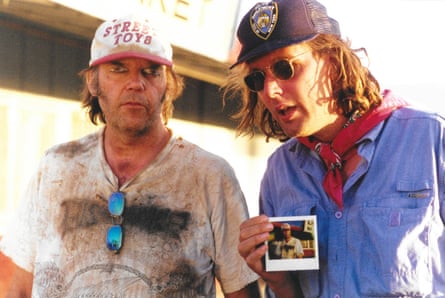
He’d met Bowie when Iggy said he’d invited “a couple of mates” who turned out to be the superstar and Mick Jagger. Then, at Bowie’s Wembley concert, the singer introduced him to Princess Diana. “Sitting behind her while she was hand jiving and singing ‘Time flexes like a whore’ along with Bowie was a brilliant moment,” Pope smiles, “but I got glimpses of the real people. David fretting about his son’s exam results. Freddie making me cups of tea and calling them ‘Matildas’. Behind the gossamer artifice of fame they’re just human beings.” He writes movingly of his friendship with the usually enigmatic Mark Hollis, and their blissful hours spent laid flat, “letting music wash over us. ‘Fancy some fuckin’ Satie, Pope-ay?’ ‘More sherr-ay, Pope-ay?’”
In the 90s, after his short film, Phone, won various awards, Martin Scorsese wrote to him saying he liked it and Pope found himself being “seduced, in a way” by Hollywood. Specifically, he was recruited by the now imprisoned Harvey Weinstein to direct the sequel to The Crow. “A movie which made a lot of money but in which a young man, Brandon Lee, had died. So it was a tricky situation: but I’d loved Reservoir Dogs and Pulp Fiction. This was before we knew about wanking into flowerpots and destroying women’s lives.
“He was still seen as ‘good old Harvey’, the most powerful man in Hollywood, but his other nickname was Harvey Scissorhands. He had a reputation for meddling in the cutting room and I suffered that really badly. I poured everything into that film and ended up with something I loathed, and he said the worst three words anyone ever said to me: ‘We own you.’ Cos they did at that point.” The book doesn’t flinch from what he calls “a brutal experience”, after which Pope returned to London, didn’t make another video for 12 years or a film for 25. He says he carries “mental scars” to this day.
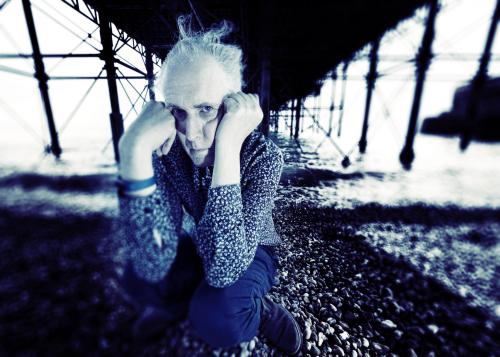
Pope argues that the golden age of video ended when MTV dropped “Music Television” from its logo in 2010, but he still makes videos and is currently casting a film called The Photographer’s Assistant as well as putting together a 50th-anniversary documentary about the Cure.
“I’ve read that my work has been viewed a trillion times, but I’m just a music fanboy from north London who got to work with most of his heroes,” he says. But he does have one more ambition: “I hope Harvey Weinstein reads my book.”