.png) 4 hours ago
5
4 hours ago
5
Last week, 186 passengers had to be evacuated from the cruise ship Viking Ullur, after it ran aground on a sandbank in the Danube. Others have been left stranded, unable to move between Vienna and Budapest. Passengers stood on deck, the Habsburg splendour around them out of reach as the river fell to 41cm in Budapest, within 8cm of its 2018 all-time low. Elsewhere on the Hungarian stretch of the river, new record lows were recorded.
Farther east in Romania, the Danube recorded its lowest water levels since 1996. A river’s flow is measured in cubic metres per second, and at Baziaș, where the river enters the country, it stood at 1,700m³/s, against a July average of 4,700m³/s. Ferry services were suspended, as were grain barges.
While providing the most glamorous images, the Danube is just one of the major rivers veining through Europe that has been suffering through this summer’s drought. Farther north, the Rhine, perhaps the most vital fresh-water transport route in the continent, broke its own records, with levels at Kaub dropping to about 40cm, the level at which shipping runs in emergency mode, with barges loading as little as a fifth of normal capacity.
The extent and frequency of these summer droughts has surprised even the most pessimistic expert observers. In 2018, Germany’s weather service designated that year a Jahrhundertsommer – a once-in-a-century summer – as the Rhine spent 132 days at low water. “The events of 2018 can’t be allowed to be repeated,” said Andreas Scheuer, then the federal transport minister. But they were.
In 2022, EU scientists described the drought gripping the continent as the worst in at least 500 years. Then in 2025, Germany logged its driest March on record and another low-water summer. And this July, the Danube’s water level was at a low it didn’t reach until October during the 2018 drought. The crisis is now happening every year, and it’s arriving earlier.
A study led by Dr Sehrish Usman at the University of Mannheim, working with European Central Bank economists, found that last summer’s heatwaves, droughts and floods hit a quarter of all EU regions, causing short-term losses of at least €43bn, with the total expected to reach €126bn by 2029. On the Rhine alone, the Kiel Institute has shown that a single month of low water cuts German industrial production by about 1%.
The immense wildfires we’re seeing across the continent are not separate from this phenomenon, as the same mechanism is driving both: a hotter atmosphere is soaking up soil moisture faster than the rain can replenish it. That dry soil can’t feed the rivers, or the plants, which end up feeding the fires instead. France has recorded more than three times its annual average number of wildfires already this summer, as soil moisture is the lowest Météo-France has ever recorded this early in the season. The fires, like the river crisis, are arriving ahead of schedule.
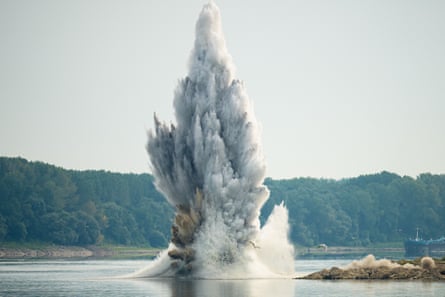
The damage these events inflict on the natural world is harder to put into numbers. In 2018, Swiss authorities pulled about a tonne of dead grayling from the Rhine (about 30% of the annual catch), as water temperatures surpassed 25C. By 2022, the reintroduced Atlantic salmon the river had spent decades nursing back could no longer reach their spawning grounds. Pollutant concentrations rise as water levels fall. On the Danube that year, oxygen levels fell close to the threshold below which trout can’t survive. Dredging was banned, and wastewater plants were placed on standby. Then this month, water levels dropped to the point where Romania was forced to shut down nuclear plants beside the Danube for the first time, as the reactors use river water to cool their cores, and if the river drops too far they can’t run safely. The country declared a nationwide state of emergency and detonated 180kg of explosives on the Bala canal to clear a rock obstructing the flow, buying the remaining reactor a few more days. Meanwhile in Hungary, the Paks nuclear plant, which normally supplies almost half of the country’s electricity, could be fully shut down within days.
About seven years ago, when I first started looking into what’s happening to Europe’s great waterways, I contacted Christina Gruber, a marine biologist and artist based in Vienna, who has been watching this longer than most. I wanted to understand the effects these events have on the societies that have built big parts of their identity and culture around these rivers. She told me about an island her friends used to swim out to in the summer, to get away from the grownups. By 2019, people could walk to it. We’re also seeing the slow disappearance of the Danube’s fishers, all but gone from a river that has fed them since at least 300BC. The people who knew the river best were gone, as the water went with them.
after newsletter promotion
In 1986, the Italian polymath Claudio Magris travelled the Danube from source to delta and wrote a book about what a river means. The Danube was the connecting tissue of Mitteleuropa. Vienna’s concert halls, Budapest’s parliament, the Ottoman and Habsburg and Byzantine sediment accumulated along its banks over centuries, into much that we understand as a shared civilisation. The Rhine is Germany’s industrial spine, the artery that carried the coal and iron ore on which a particular idea of the country was built.
Magris was already writing about a river in cultural decline before the water levels started being a central part of the question. “Century event” has disappeared from the official vocabulary, as seven consecutive years of records made it ridiculous, and replaced by superlatives such as “all-time low”, “historic”, “30-year low”. The problem is that this language still treats each summer as an exceptional incident, with hope for a recovery attached. But this assumption too, that Europe’s great rivers will keep being what they were, regardless of what we do to the climate that feeds them, should also be abandoned.
-
Yiannis Baboulias is a Greek writer based in London. His work focuses on European politics, the environment and the far right