.png) 4 hours ago
3
4 hours ago
3
With its gentle rippling water, tall purple flowers and rustling trees, Earlswood Lakes near Solihull in the West Midlands seems the perfect spot for dogs to paddle. But their owners have been warned that the otherwise idyllic open water could prove perilous to pets.
“We’ve had all this hot weather and millions of families are now spending time around open bodies of water, and it’s easy to not realise the dangers,” said Emma-Jane Thomas, rehoming manager at Dogs Trust Kenilworth during a walk around Earlswood.
“Dogs love water and it’s great exercise and enrichment for them. However, not all dogs are natural swimmers,” she added. “Even strong swimmers can get into difficulties in the water.”
Accompanying Thomas is Bruno the dalmatian who is clearly eager to go for a dip. But he’s been kept on a short lead. Dogs Trust has launched a new campaign with the catchline “If in doubt, keep your dog out”, in an attempt to reduce the injuries and fatalities that can occur among dogs and their owners around lakes, canals, rivers and the sea.
Data from the Royal National Lifeboat Institute obtained by Dogs Trust shows that 308 dog-related incidents in open water in the UK were recorded between 2021 and 2025, almost all taking place on the coast. About a third occurred between June and September of those years.
Separate figures from the National Water Safety Forum show there were 10 accidental deaths due to drowning in England between 2019 and 2025 linked to animal rescue, and 12 linked to dog walking.
Data from the Canal & River Trust shows that dog-related incidents in the UK reached a five-year high in 2025, increasing by 39% compared with the previous year.
Dogs Trust notes that many cases were related to dogs – or people attempting to rescue them – needing help after entering the water. Strong currents and fatigue can pose a risk, too.
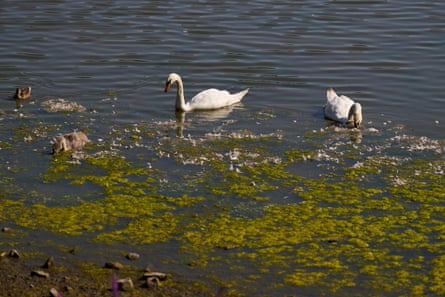
“When you’re thinking about open bodies of water, it’s always stop, check and think about what could be the dangers,” said Thomas, noting many are not clearly visible on first sight. “Steep banks could be an issue if a dog gets in and then swims around, [and] can’t find a way out again,” she said. “Hidden debris under the water – trolleys, broken glass, lots of weeds or branches. Blue-green algae is a danger to dogs.”
Thomas also cautioned against attempting a rescue should a dog get into trouble.
“If your dog’s in difficulty, it could then be two emergencies, not just one,” she said. “If you can see a safe place where your dog can exit the water, call your dog there with their recall. If you can’t do that, call emergency services and they will come and assist with dog emergencies.”
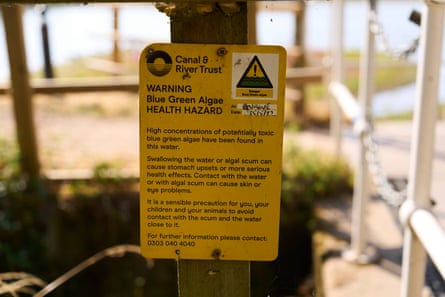
Even on a picturesque summer’s day Earlswood is far from hazard-free, with a small yellow sign alerting walkers to dangers of blue-green algae. Such cyanobacteria thrive in warmer weather, forming blooms and scums – and some release toxins.
“Not all blue-green algae blooms and scums are toxic, but you can’t tell just by looking at them, so it’s best to assume they are,” the Environment Agency notes.
Emily Mills, veterinary projects manager at Dogs Trust, said: “Dogs can become unwell from drinking contaminated water or simply cleaning it from their fur after swimming. Symptoms can be seen as little as 15 minutes after exposure and may progress rapidly to become fatal.”
Walking her rescue border collie Billy, local resident Sally said the blue-green algae was a concern – adding that Billy was always kept on a lead.
“But there’s more dogs off the lead than on the lead when you walk around here. And it is a worry that there isn’t enough signage around,” she said.
An online Dogs Trust survey of 2,000 owners in the UK, conducted in June, revealed that many may be unaware of such risks, with 33% reporting they did not believe blue-green algae posed a serious risk to dogs.
The survey also found 19% of dog owners were unaware calm-looking water can still pose serious risks, and 80% said they’d enter water to rescue their dog, despite the risk to themselves.
“Dogs love the water, we know that, and we absolutely don’t want to stop that,” said Thomas. “The reason that we’ve put the campaign out is so that owners and dogs can continue to enjoy these types of areas safely, so that when they do come here, they are aware of the risks.”