.png) 2 hours ago
3
2 hours ago
3
At a Paris meeting hall this week, hundreds of leftwing voters braved a rainstorm to gather chanting: “Unity! Unity!”
They were celebrating the 90th anniversary of France’s Popular Front, a leftwing alliance that was formed in the 1930s amid fears that the far right could take power. But their concerns were more immediate.
A year before the 2027 French presidential election, Marine Le Pen’s far-right the National Rally (RN) – already the biggest single opposition party in parliament – is high in the polls. The party is closer to power than it has ever been before, and the business community that once shunned it is now openly meeting with senior party figures.
“Voters on the left want unity – so let’s cut the bullshit and build it,” said Danielle Simonnet, a Paris MP for the leftwing party L’Après, who said divisions would allow the far right to cement its gains.
The French president, Emmanuel Macron, cannot constitutionally run again for a third consecutive term next spring, leaving the presidential race more open than it has been for a decade.
But an unprecedented and bewilderingly high number of figures from across the political spectrum – about 30 – have expressed an interest in running, almost all of them focused on attempting to hold back the far right. The political debate is more about tactics, polling and which personalities may have the charisma to face off against Le Pen or her protege Jordan Bardella, than deep policy issues.
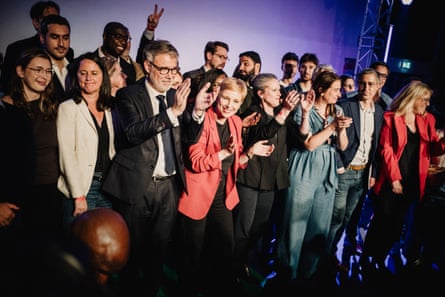
The leftwing parties who gathered in Paris this week – including the Socialist party leadership, the Greens and several smaller groups – vowed to press on with a leftwing primary race for a united candidate in October, seeking to reproduce the New Popular Front, the leftwing alliance that grouped together to hold back the RN in the 2024 snap parliamentary election.
But the initiative is struggling, as the left remains fragmented, with key figures preferring to run alone. Jean-Luc Mélenchon, 74, the veteran radical left leader of La France Insoumise (LFI), announced this week that he would run for president for the fourth time, having come third in 2022. He brushed aside polling that showed a high level of antipathy towards him outside his own party.
Many others on the left are contemplating their own presidential bids, including the centre-left member of the European parliament Raphaël Glucksmann. Even the former Socialist president François Hollande is seeing a potential opportunity for a comeback – despite the fact that in 2016 he renounced running for a second term because he was the least popular French president since the second world war, with a satisfaction rating that had dropped to just 4%. Hollande said in a recent magazine interview that he felt he had crucial international experience.
On the far right, Le Pen is awaiting an appeal trial verdict scheduled for 7 July to see if her conviction for the embezzlement of European parliament funds and the ban stopping her from running for public office will be upheld. If so, Bardella, 30, would run in her place. Both are polling high.
On the right and centre, there are a multitude of personalities vying for space. Edouard Philippe, Macron’s first prime minister, will stand on a centre-right ticket. Another former prime minister, Gabriel Attal, wants to represent Macron’s centrist party, Renaissance, but faces rivalry from several others, including the justice minister, Gérald Darmanin. On the right, Bruno Retailleau, a former hardline interior minister who served in government under Macron, wants to be the rightwing candidate for Les Républicains, but faces rivalry inside his party from figures such as the MP Laurent Wauquiez, and from several outside the party, including the mayor of Cannes, David Lisnard.
The former French prime minister Dominique de Villepin, who gained international fame articulating France’s opposition to the 2003 war in Iraq, and has been recently vocal on war in Gaza and the Middle East, is also seeking to run. For him and many candidates, the challenge will be gathering obligatory backing signatures from 500 elected officials.
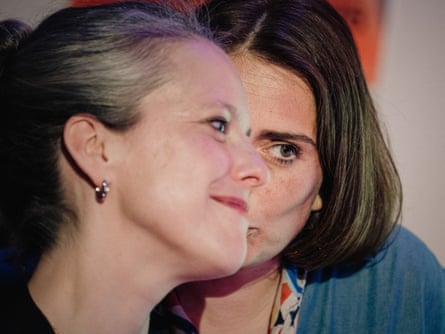
Amid the high number of men seeking to be candidates, some senior women at the left’s meeting this week warned that “testosterone” or “ego” should not be deciding factors.
Antoine Bristielle, the director of opinion at the Fondation Jean-Jaurès thinktank, said it was crucial for candidates to understand the desire among French voters for an in-depth policy debate on social and economic issues. At the last presidential election in 2022, which took place against a backdrop of war in Ukraine, Macron beat Le Pen without an in-depth discussion of his policies. Then a 2024 snap election left parliament without an absolute majority and rudderless.
Bristielle said: “The risk is that this presidential election focuses solely on rejecting the RN, a kind of strategic vote with the message: ‘This person is the most central, the most consensual, maybe they can beat the RN’ – even if that person is proposing nothing concrete and we don’t know where they’re going. That would be dramatic because it means that no in-depth policy issues would be settled.”
Top of French voters’ concerns is healthcare – including difficulties accessing doctors in remote or deprived areas, and cuts to the hospital system – as well as the cost of living and the French social security system. But Bristielle said voters’ main socioeconomic worries were not at the centre of the political debate in France, “reinforcing the idea among French people that politicians are cut off from their concerns”.
Crucially, polling last month by Ipsos showed 74% of French voters wanted either a radical transformation or deep changes in France – a substantial increase in the past three years.
Bristielle said: “There has been a real feeling of immobilism in France, namely since the start of Emmanuel Macron’s second mandate. People want this presidential election to be a real democratic moment which settles the key issues for the future on the basis of tangible facts and clear directions put forward, but we’re still very far from that.”
Christelle Craplet, the director of opinion at Ipsos BVA pollsters, said the election was impossible to predict at this early stage. She said the only key candidates in place right now were Mélenchon on the radical left and either Le Pen or Bardella for the RN.
Craplet said: “Between these, we have a space which is not clear politically, with a large amount of candidates. This shows the fragmentation of the French political landscape and the difficulty of personalities to emerge in a consensual way, through ideas or charisma, or a selection process.”
The prime minister, Sébastien Lecornu, has called for policies to be put forward. “When a real presidential campaign kicks off … with a real debate on ideas, that will create a more dignified atmosphere,” he said.