.png) 2 months ago
53
2 months ago
53
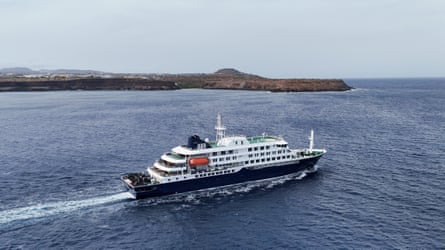
As the MV Hondius sailed out of Ushuaia, the most southerly city on Earth, on 1 April, the grey skies above Tierra del Fuego lifted, lighting up the fresh snow on the mountaintops and the autumnal tree cover closer to shore.
Eighty-eight passengers and 61 crew of 23 nationalities had boarded the small polar-class vessel for its 35-day “Atlantic expedition” from the Argentinian province to Cape Verde, via some of the most remote islands on the planet. As the ship cleared the narrow channel leading to the open sea, those onboard had already been treated to glimpses of humpback whales, dolphins, black-browed albatrosses and South American sea lions.
Jake Rosmarin, a travel blogger from Boston, told his followers the trip would be “something I’ll carry with me forever”. “Off to an incredible start,” he wrote on Instagram.
A little over a month later, things were very different. Three passengers were dead after an outbreak of hantavirus – a disease with a high mortality rate for which there is no cure. The Hondius, having previously stopped at South Georgia, Tristan da Cunha and St Helena, had reached Cape Verde, but the authorities there refused to let passengers disembark.
On Monday, a tearful and distressed Rosmarin posted a video that was swiftly shared around the world.
“We’re not just a story, we’re not just headlines, we are people – people with families, with lives, with people waiting for us at home,” he said. “There’s a lot of uncertainty, and that’s the hardest part. All we want right now is to feel safe, to have clarity and to get home.”
And so, six years after early outbreaks of Covid at sea forced some cruise ships to sail from country to country seeking somewhere to dock, a cruise vessel, its trapped passengers and a little-known virus were once more in the global spotlight.
Unlike Covid-19, however, which was caused by a novel strain of coronavirus, the sickness onboard the Hondius is not thought to be caused by a new kind of hantavirus. Though cases are rare among humans, hantaviruses carried by rodents have long been present in parts of Africa, Asia and South America.
And whereas Covid-19 was easily spread from person to person, the World Health Organization (WHO) and other health authorities have stressed that human-to-human transmission of hantavirus is very rare, and so the risk to public health is low.
But while cases of norovirus, flu and Covid are well known on cruise ships, this is the first recorded onboard outbreak of hantavirus, a disease that kills up to half of those it infects, according to the WHO. It is not only passengers of the Hondius, when they finally disembark, who will be observed closely for symptoms. Public health authorities and the cruise industry will also be watching anxiously to see if this is a one-off outbreak and whether there will be wider repercussions.
Anatomy of an outbreak
The first person to die on the Hondius was a 70-year-old Dutchman. He developed respiratory symptoms on 6 April and died five days later. There seemed no obvious cause for concern beyond sympathy for his loved ones –including his 69-year-old wife, who was onboard – and so the ship’s captain, Jan Dobrogowski, told passengers: “Tragic as it is, it is due to natural causes, we believe.”
The body was removed from the ship on 24 April, when it reached St Helena, where the man’s wife also disembarked. Three days later, as the Hondius reached Ascension Island, the captain was informed that she, too, had become ill after leaving the ship and died. That same day, a British man became seriously ill onboard and was medically evacuated to South Africa.
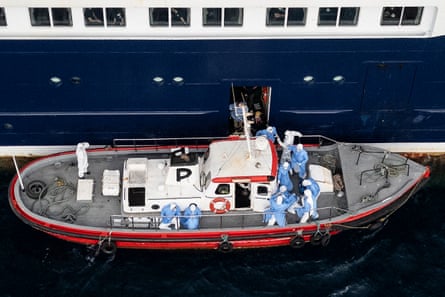
Then, last Saturday, an 80-year-old German woman died onboard and South African specialists identified the pathogen infecting the British man as hantavirus. It was apparent this was not an ordinary shipboard illness.
Outbreaks of disease at sea are common, and Vikram Niranjan, an assistant professor in public health at the University of Limerick, considers this unsurprising. While cruises were not uniquely dangerous, he said: “They do combine several conditions that make transmission easier: close contact, shared dining, enclosed spaces, and shared water and air systems. In outbreak terms, they bring together the right conditions of time, place, person and microorganism for spread to occur.”
Conversely, he added, ships offered advantages for infection control, too. “A ship is a defined setting, so once an outbreak is recognised, public health teams can focus on a known population and a known environment. That makes case-finding, contact-tracing, isolation, cleaning and environmental review more feasible than in an uncontrolled community setting.
“The same features that can help spread infection can also help contain it if action is early: passengers and crew are identifiable, movements can be restricted, and the ship’s medical and operational teams can work with port health authorities.”
This can be unfortunate if you happen to be onboard and uninfected – especially if port authorities won’t let you disembark. Despite mooring offshore for more than three days, the Hondius was not given permission to dock at Praia, the capital of Cape Verde. The island country’s health ministry said this was a precaution to “protect the Cape Verdean population”. A local medical team then boarded the ship to assess other patients who had begun showing symptoms.
The Canary Islands were not keen either. After negotiations with the WHO, Spain agreed to let the ship dock at the autonomous archipelago, but its regional leaders objected. A compromise was reached, with the Canaries agreeing that the vessel could instead remain at anchor off the shore of Tenerife until all passengers had disembarked. The Hondius finally set sail for the Canaries on Thursday, and is due to reach the port of Granadilla in Tenerife on Sunday.
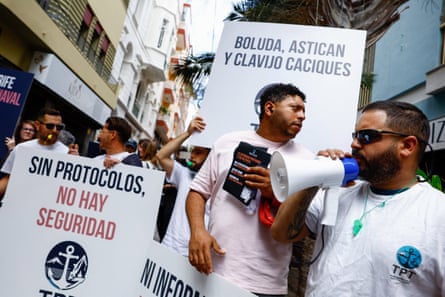
“This is very unusual and I think it reflects how extraordinary this particular situation is,” said Raphael Giacardi, the head of content at the publications World of Cruising and Cruise Trade News. “For a lot of us, the name ‘hantavirus’ is something we discovered only a few days ago, and I think that’s what you’re seeing with the port authorities: the countries are operating in unknown territories and they have to make decisions on the spot. But normally, you would see people evacuated and taken care of as soon as physically possible.”
Cruise operators had long-established protocols for managing outbreaks that had inevitably tightened since Covid, Giacardi added. “Cruise lines are all too aware that being lax on sanitation or hygiene could lead to an issue that would bring negative media coverage. There’s obviously huge care for passengers to make sure that the guests onboard are well looked after and treated well, but [they also] make sure to take care of those reputational risks.”
Leaving the ship
While quarantine precautions remain in place, not everyone on the Hondius has been as distressed as Rosmarin. Kasem Hato, a Jordanian travel influencer who posts online as Ibn Hattuta, said he felt the media had overblown the situation.
“Most of the people on the ship are taking the matter very quietly,” he said in an Instagram post. “This is not a new virus in the world. If it wanted to become an epidemic, it would have been a long time ago.”
Serious concerns do remain, however. Three people were medically evacuated from the ship on Wednesday, including Martin Anstee, a British photographer and expedition guide, who was airlifted to a hospital in the Netherlands where he was being treated in isolation. His wife, Nicola, told the Daily Telegraph it had been “a very traumatic few days”.
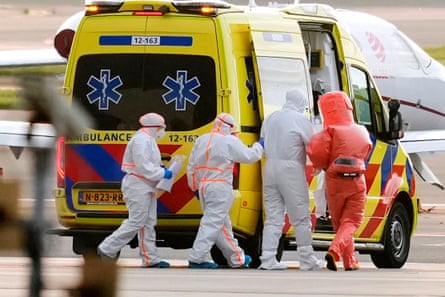
“He’s relieved to be off the ship,” she said. “He had it quite mild then it got a bit more serious and now he’s stable again.”
A female KLM air steward had also been hospitalised after showing symptoms, the Dutch health ministry said. The air steward came into contact with the 69-year-old woman who died after disembarking the Hondius in St Helena when she boarded a flight in Johannesburg, South Africa, before being deemed too sick to fly.
The British man evacuated to South Africa on 27 April remained in intensive care, but was now “doing better”, Dr Maria Van Kerkhove, the WHO’s director for epidemic and pandemic preparedness and prevention said in a press conference on Thursday.
Meanwhile, health authorities around the world are attempting to trace at least 29 passengers of 12 nationalities who disembarked in St Helena, while a third British national was reported as being diagnosed with suspected hantavirus in Tristan da Cunha on Friday.
Prof Robin May, the chief scientific officer at the UK Health Security Agency, has suggested that the 23 Britons who were onboard – 19 passengers and four crew – will be asked to self-isolate for 45 days on their return to the UK.
Health authorities continue to stress that the overall risks to wider global populations are low. “This is not the start of an epidemic. This is not the start of a pandemic. This is not Covid,” Van Kerkhove told reporters on Thursday.
“We completely understand why these questions are coming … but this is not the same situation we were in six years ago.”
As for those onboard, morale had “improved significantly since the ship started moving again”, the WHO’s director general, Tedros Adhanom Ghebreyesus, said in the same press conference.
That is not to suggest passengers can expect a warm welcome in the Canaries, however. According to Spain’s head of civil protection, those being evacuated to their home countries “will not leave the boat until the plane is there to take them to their countries. Once they leave the boat, they will be taken by road.
“They will be taken to an isolated fenced-off place, they will be in isolated vehicles, they will reach an area of the airport that will be completely isolated.
“There is no possibility of contact.”