.png) 2 months ago
48
2 months ago
48
The evacuation of the hantavirus-stricken MV Hondius cruise ship must be completed within 24 hours of the vessel reaching Tenerife on Sunday or face days or even weeks of delay because of bad weather, authorities in the Canary Islands warned on Friday.
The Dutch-flagged vessel, which was sailing from Argentina to Cape Verde, is due to arrive in the Spanish archipelago this weekend, triggering what Spain’s health minister has termed an “unprecedented operation” to receive, assess and repatriate the 149 passengers and crew members onboard.
But the operation now faces the additional complication of changing weather.
“The only window of opportunity we have to carry out this operation is around 12 o’clock on Sunday morning and until conditions change from Monday,” Alfonso Cabello, a regional government spokesperson, told reporters on Friday.
“Otherwise, the ship must leave and no operation could be carried out again in theory … until the end of May,” he said, citing wind and swell.
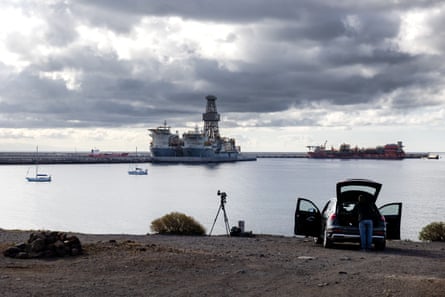
The MV Hondius is estimated to arrive at the port of Granadilla, Tenerife, in the early hours of Sunday. After negotiations between the Spanish government and the archipelago’s regional authorities, it will not dock but will instead remain at anchor in the south-eastern port of Granadilla.
Passengers will be evaluated on the ship and will not have any contact with the local population when they are taken from the ship to be repatriated or, in the case of the 14 Spanish nationals onboard, transported to a military hospital in Madrid for compulsory quarantine.
“This is an unprecedented operation in response to an international health alert involving 23 countries,” the Spanish health minister, Mónica García, told Spain’s state radio broadcaster, RNE, on Friday morning.
“We’re coordinating this from Spain and the World Health Organization has entrusted Spain with this operation – which, as I’ve said, is unprecedented. We’re going to do what we have to do, which is work and deliver the necessary health and logistical management.”
García confirmed that non-Spanish citizens who did not need urgent medical attention would be evacuated to their home countries even if they showed symptoms of hantavirus.
“The international protocols will be followed – as will all the strict measures when it comes to health prevention,” she said. “The protocol is based on no one needing urgent medical attention. And we think that won’t be the case because everyone was asymptomatic when they left Cape Verde and they’ve been on the boat for many days now, which makes us think that the risk that they’ve been infected is diminishing each day.”
Three people – a Dutch couple and a German national – have died in the outbreak on the ship. Four others confirmed to be infected – two Britons, a Dutch and a Swiss national – are being treated in hospitals in the Netherlands, South Africa and Switzerland.
On Friday, the British and Spanish authorities said they were investigating two possible new cases. One involves a British national on the South Atlantic island of Tristan da Cunha, where the cruise ship made a stop on 15 April. The other involves a woman who was on the same flight as a Dutch patient who died in Johannesburg after travelling on the MV Hondius and contracting the virus. She is being treated in a hospital in the eastern Spanish region of Alicante.
Also on Friday, authorities in Singapore announced that two men who had been on board the Hondius tested negative for hantavirus but would remain in quarantine for 30 days as a precaution. They would be tested again before release, said Singapore’s Communicable Diseases Agency (CDA).
The men, aged 65 and 67, had been on the same flight as a confirmed hantavirus case from St Helena to Johannesburg on 25 April, the CDA said a day earlier. The confirmed case died in South Africa.
On Saturday, Australian consular officials advised they were travelling to Tenerife to assist and possibly repatriate four Australian citizens and one permanent resident onboard the vessel.
The CDA’s laboratory conducted testing with “multiple samples collected from the individuals” and confirmed that hantavirus, including the Andes virus, was “not detected”.
The WHO said on Friday that the risk the hantavirus strain in question posed to the public was minimal, as it spread only through “very close contact” and was “not spreading anything close” to how Covid had spread.
“This is a dangerous virus, but only to the person who’s really infected, and the risk to the general population remains absolutely low,” the WHO spokesperson Christian Lindmeier told a press briefing in Geneva.
He said that even the people who had stayed in the same cabin as an infected person on the MV Hondius “don’t seem to be both infected in some cases”.
Based on previous outbreaks in Argentina, it is thought the Andes strain of the virus can be spread between people through very close contact.
Exactly how easily it is transmitted is unclear, with experts studying the virus and its transmission carefully given the relatively limited scientific data currently available. Despite these uncertainties, the WHO has stressed the hantavirus outbreak is not the start of a pandemic, and that the public health threat is low.
The Guardian understands experts think transmission primarily occurs when patients have symptoms. However, out of an abundance of caution, public health teams involved in contact tracing are also considering the two days before symptoms develop.
The UK and the US are among the countries that have agreed to send planes to Tenerife to repatriate their citizens. Health authorities across four continents are scrambling to track down and monitor passengers who left the ship before the outbreak was detected. They are also trying to trace others who may have come into contact with them since then.
On 24 April, nearly two weeks after the first passenger had died onboard, more than two dozen people from at least 12 different countries left the ship without contact tracing, the ship’s operator and Dutch officials said on Thursday. According to the WHO, health authorities did not confirm hantavirus in a passenger on the MV Hondius until 2 May.

The looming arrival of the ship has prompted considerable unease in the Canaries. Fernando Clavijo, the regional president, had objected to the ship coming into port at Granadilla and convinced the central government that it should instead remain at anchor. In an interview with the Spanish newspaper ABC on Friday, he said Spain had been under “no legal obligation” to take in the ship and that it should have put into port in Cape Verde, which refused it permission to dock.
Speaking later the same day, Clavijo said a plan had been devised to minimise the time and contacts that the passengers being evacuated would have while on Tenerife, adding: “We know with certainty that no one will get off the ship if their plane is not already waiting on the runway.”
The authorities’ insistence that everything possible was being done to protect people on Tenerife and across the wider archipelago appeared to have reassured locals. Visitors, too, appeared unfazed as they lay on sunloungers, soaking up the sunshine and the 23C heat.
“It’s no problem,” said one local woman, who was selling tourist trinkets by the beach near Los Cristianos, in the south of the island. “The Canarian government has confirmed that the ship will not dock in the port but on the high seas.”
The woman, who did not want to give her name, said her only concern was of the possible effects on Tenerife’s lucrative tourism industry. “People get scared quickly,” she added.
Ima, who runs a shop selling traditional handmade goods, was similarly relaxed: “The news says it’s no problem.”
But the view was not shared by everyone. Joao Decastro, who runs La Siesta Excursions, said he felt Spain was always the country that came to the rescue in international emergencies. He was worried about the possible cost to local people.
“To be honest, I’m not very happy about what they’re doing because I think [the cruise ship passengers] have many places to go, right?” he said. “This is a very touristy area and right now that would make the tourists more afraid.”
He added: “If there are three dead on a boat, imagine a population that reaches a million people here.”
Additional reporting by Nicola Davis