.png) 3 months ago
56
3 months ago
56
There is perhaps no more vivid illustration of the moral nadir Israel has reached than the Knesset’s passage, two days before Passover, of a death penalty law that applies only to Palestinians. The measure, whose approval was greeted with tears of joy and the popping of champagne in the legislative chamber, is a concise legal expression of the core animating idea of modern Israel: that there exists no humane obligation in Jewish tradition with a durable universal ambit. The notion that Jews should have a special concern for the fate of all humanity, regardless of ethnicity or creed, lies dead beneath the rubble in Gaza.
It had to be killed, however, because there was a time when it lived. Cosmopolitanism over nationalism, social democracy over rapacious capitalism, collective liberation over ethno-chauvinist fortress-building – these were the values that animated the Jewish Labour Bund, a revolutionary party founded in 1897 in the Tsarist empire. “For leftist Jews longing for resources within our own past for combating the Zionist death cult,” as author, activist and artist Molly Crabapple puts it, “the Bund is a model.” A model with an audience – Crabapple’s new history of the Bund was already in its second printing the week before it came out.
Crabapple, who speaks in the blunt and artfully profane manner of a born New Yorker, has been participating in and documenting resistance movements – in art, articles and two previous books (one co-authored with Marwan Hisham) – for 15 years. Her new book, Here Where We Live Is Our Country: The Story of the Jewish Bund, she says, is “like a defeated person’s history of the 20th century”. In 380 lush, high-tempo, strikingly poignant pages, interspersed with her own illustrations of its key characters, Crabapple documents the Bund’s extraordinary rise and fall. For half a century, Bundists fought for liberation as Jews and as Marxists – for a time, the Bund was the most popular socialist movement in Russia – before the seismic events of the 20th century spelled their miserable end.
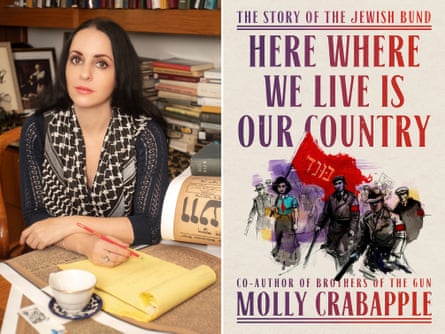
Bundists fought, as Jews, for the liberation of all. “On one hand, they were people who ferociously believed in the value and dignity of eastern European Jewish culture at a time when this was sneered at,” says Crabapple. “But on the other hand, they were internationalists.” They agitated and educated the shtetls. They formed defense squads against pogroms. They championed the Yiddish language. And they fought on the barricades in the revolutions of 1905 and 1917.
After the October Revolution, when Lenin suppressed their ranks, Bundists reconstituted over the border in Poland, building, as Crabapple puts it, “a beautiful alternate world out of little more than love and grit”. The Polish Bund, Crabapple tells me, built “schools, trade unions, a women’s movement, a kids’ movement, summer camps, a sanatorium for tubercular slum kids, and amazing newspapers”, which reported on the fate of workers’ movements from Alabama to China. When the Nazis arrived, they operated an anti-fascist underground and helped lead the Warsaw ghetto uprising.
Their defeat, however, was total and richly tragic: despite their efforts, nationalism grew and festered; the Jews of eastern Europe, proletariat and bourgeoisie alike, were systematically annihilated; the socialism of Soviet Russia turned tyrannical; and their perennial foes, the Zionists, founded a settler colonial nation state in the Levant fueled by the very chauvinism against which they had fought for generations. As global Jewry became increasingly aligned with Israel, the Bund’s memory was largely relegated to obscure scholarship and Yiddish archives.
What endures – if faintly – are the principles on which they organized, and a legacy Crabapple sees today in a growing movement of Jews fighting for Palestinian liberation. “Solidarity across difference,” Crabapple summarizes. “This insistence that you could remain yourself, you didn’t have to change who you were, while also fighting alongside others for a better and more beautiful world: that’s the heart of why the Bund remains so morally inspiring today.”
Crabapple and I are sitting at a wooden table in her Williamsburg apartment, which is large and open – she and her partner, the illustrator and painter Fred Harper, took down the interior walls when they moved in – but the room is so bursting with art, art supplies, textiles and knick-knacks from around the world, that the loftlike space feels cozily cramped.
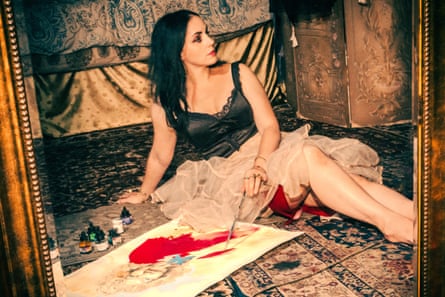
“I read him the whole book five times,” Crabapple says, gesturing to the back of Harper’s head, who sits silently drawing at his desk in the corner of the room during our interview. “More than that,” Harper says, without a hint of chagrin. Above Crabapple’s head hangs a large replica Chateau-Thierry clock, and to her left, a 3ft-by-4ft nude portrait of the author by Harper. Through the window, on the fire escape, a small monoestrellada flutters in the wind; like the neighborhood, Crabapple is part Jewish and part Puerto Rican.
Much of the art adorning the walls is Crabapple’s, Harper’s, or their friends’. But there are also several sculptures and striking impressionist paintings – a young woman in a white peasant’s tunic and vest; a mother and child with a similar, wry look in their eyes – by Samuel Rothbort, Crabapple’s great-grandfather. “I grew up obsessed with my great-grandfather,” Crabapple says. “He taught my mom how to paint, and my mom taught me how to paint. So I always felt this sense that being an artist was something that was essentially like a gift that I inherited from him.”
But that wasn’t all she inherited from great-grandpa Sam. Rothbort was born in 1882 in Volkovysk, a small town in Belarus, where he worked in a tannery. In the summer of 1898 – amid a strike against the bosses for forcing him and his co-workers to work Saturday nights after the sabbath – Rothbort joined the Bund. “So it was that my great-grandfather abandoned his place in a secure if circumscribed community and plunged into a modern insurrection,” Crabapple writes. Five years later, she believes, Rothbort was involved in the shooting of a policeman during a pogrom in Volkovysk; in the aftermath he smuggled himself out of the country, across the border to Germany, onward by train to Antwerp, and from there, by sea, to New York City, where former Bundists, such as the International Ladies’ Garment Workers Union leader, David Dubinsky, were building socialism on the Lower East Side.
Toward the end of his life, Rothbort composed more than 600 watercolors – “memory paintings”, Crabapple calls them – of Volkovysk. They depict every aspect of shtetl life. “He painted rabbis reading the Torah,” Crabapple says, “and then himself setting his rabbi’s shoes on fire in religious school. And then himself spying on the women’s bathhouse. And teaching the other kids how to smoke. People getting into fights on the market day … just this amazing mixture of the sacred, the profane, the funny, the serious, all of that – a 360-degree view of life.”
As a child, Crabapple was obsessed with these painted vignettes. But one stood out above the rest: it shows a young woman on a twilit street throwing a rock through a window, while her boyfriend waits, in the corner of the canvas, to offer her more rocks. “It was called Itka the Bundist Breaking Windows,” says Crabapple. “He wrote that on the bottom. And so I was like, ‘What’s that? What’s the Bund?’ And that was the question that led me to discover the movement for myself.”
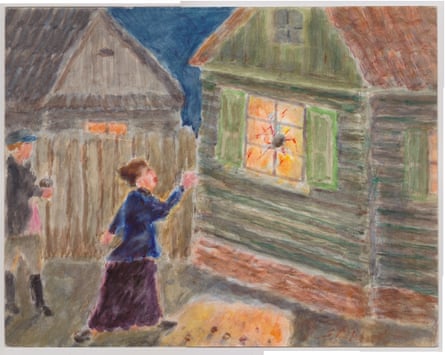
Crabapple threads this personal aspect into the book with admirable grace; it elevates and never distracts from the historical material. “I made a real commitment when I was writing this book,” Crabapple says, “that if I was going to stick through this seven-year-long process, I would in some ways follow my pleasure in it.” The reader feels her kinship with her characters; her own experience as an activist – often wrestling with the same big questions, enduring the same small discomforts and painful deflations – enables a rare empathy. “Despite our century of distance,” she writes, “Itka and I share a few common experiences. We both have taken over a street and mistook it for our country, both grabbed hands with a stranger and mistook it for a vow.”
The relevance of her material for our present moment is impossible to ignore. Bundists saw the truth about the Zionist movement – which was founded, the same year as the Bund, with the aim of establishing a Jewish nation-state in the biblical “Land of Israel” – from the very start. “At first, in 1897, the Bundists just think Zionism is incredibly stupid,” Crabapple says. “They’re just like, ‘OK, so your brilliant idea is that you’re going to take all these millions and millions of people that are living here, that have houses and lives, and they’re going to move to the Levant and become collective farmers?’ It sounds extremely stupid.”
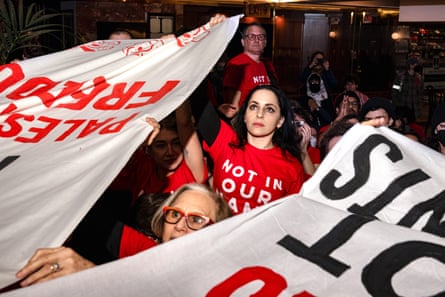
As Zionism grew, Bundists came to see it as inherently dangerous and self-destructive, too. “One of the elements of European racism towards Jews has always been that Jews are swarthy foreigners who come from Palestine and should probably fucking go there,” Crabapple says. “And the Bund says to the Zionists: ‘Are you publicly agreeing with them? What’s wrong with you?’” Zionism stopped being just this “dumbfuck hallucination”, Crabapple says, after the British pledged to support a “Jewish homeland” in Palestine through the 1917 Balfour Declaration. “By that point, the Bund is saying: ‘You’re becoming the handmaids of the British empire. Is that your brilliant idea? And you’re taking people’s land and trying to deny them their political rights.’”
In 1933, the Bundist leader Henryk Ehrlich offered a prophetic censure: “If Jewish nationalism, as a general rule, is not bloodthirsty, this is only out of necessity, not virtue; if an appropriate opportunity arose, Jewish nationalism would show its sharp teeth and nails no less than the nationalisms of other nations.”
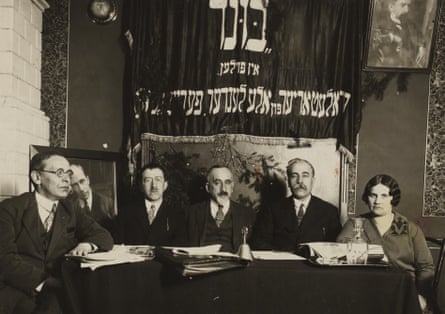
Ehrlich added: “[Ze’ev] Jabotinsky’s brown-shirt soldiers [the Irgun militia in Palestine and Betar in Europe] are nothing more than a tragicomic caricature of Hitler’s [Sturmabteilung paramilitary organization]. But the only thing missing in order for them to become the same beasts is some muscle strength, some territory, and a political opportunity … No, we are not a chosen people. Our nationalism is just as ugly, just as harmful, and has the same inclination to fascist debauchery as a nationalism of other nations.”
Who can deny he was proven right?
The Bundists rejected Zionism because it offended the core principle of their project: that ethnic particularity need not lead to nationalism, that it could be the basis for organizing across difference.
Several times in the book, Crabapple returns to a description of the Bund offered by the Jewish socialist Meyer London, who worked closely with Bundists on the Lower East Side. “Are you aware,” London said, “that in Russia, Poland, thousands of Jewish boys and girls pray to God not to lead them again out of Egypt, but to help them free Egypt?” This line distills the Bund’s quarrel with nationalism – Jewish and otherwise – and underscores the extraordinary radicalism of their aims. The Bundists dreamed of deliverance without exodus; the liberation of the Jews in concert with the liberation of their neighbors.
The Holocaust, of course, made this dream seem – to many Jews – ridiculous, foolhardy, recklessly naive. Believing their own freedom could be tied up with the liberation of their oppressors was a cruel joke; Bundists fought militantly throughout the war, but they met the same fate as the rest of Polish Jewry. Crabapple recounts a scene from a Bundist hideout during the liquidation of the Warsaw ghetto; as an older woman reminisced about Red Vienna – recalling how Viennese children cheered as she carried the Bund’s banner down the Ringstrasse – a younger Bundist sneered: “Where are they now, your noble-hearted Austrians?”
Likewise, the Holocaust made the Zionist answer, at least for a time, seem prudent. At least the settlers survived. A friend who read Crabapple’s manuscript told her, “OK, they were right. Right and dead.” After all, he said: “The Bund failed.”
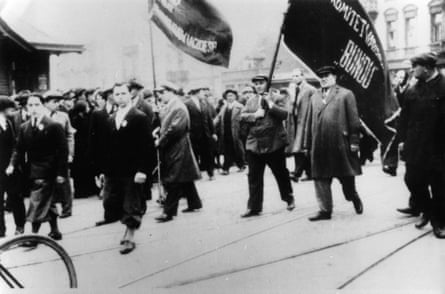
Crabapple disagrees. The Bund didn’t fail; it was defeated. “The difference between failure and defeat is that you fail when your own errors are what lead to your collapse,” she says. “Whereas to lose is just to be overcome by a greater force. And the truth was, there wasn’t a single Jewish group that could have stood up against the Nazis … There was nothing about Palestine that protected the Jews except that it was behind British lines, and the British lines didn’t fall.”
The Zionists, meanwhile, by embracing an ethno-nationalism of their own, have taken their turn on history’s wheel, creating a state strong enough to inflict its own cruelties on the weak and stateless. “Is this the better, more practical thing just to endlessly engage in mass slaughter?” Crabapple says. “What the Zionist model has shown us is that it ends in genocide, too. That’s not acceptable.”
As the Bundists knew, “it’s either solidarity across difference or savagery.” The masses of Jews today denouncing Israel and standing with Palestine, the Minnesotans putting their bodies on the line for their immigrant neighbors, and movements the world over contesting the rise of fortress nationalism, have come to the same conclusion.
-
Molly Crabapple’s book Here Where We Live Is Our Country: The Story of the Jewish Bund is published by One World books on 7 April