.png) 5 hours ago
9
5 hours ago
9
The Carpet Shop nightclub in Peckham, south London, is ordinarily packed with rowdy crowds at the weekend. But Saturday night’s liveliness was not congregated around the DJ on the dancefloor, the crowd was at the sold-out venue for England’s victorious quarter-final game at the 2026 World Cup, and the young spectators were there for the fashion as much as they were for the football.
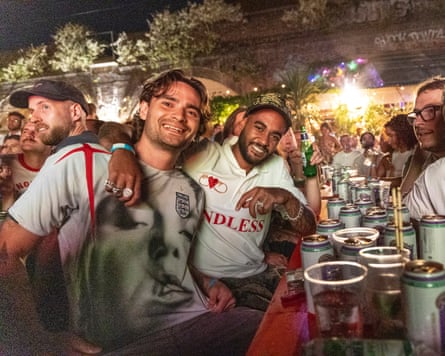
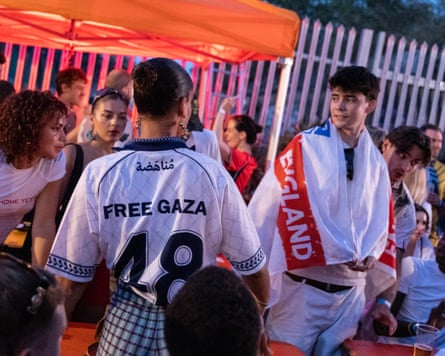
Luke Grandon and Mattia Guarnera, both 27, are “massive” football fans, and their love for the game is expressed in their outfits. “I have a massive collection of vintage football shirts,” said Guarnera, wearing a white polo shirt with “LOVE” printed on the back from a limited-edition World Cup-themed collaboration between Lyle & Scott and the British artist Reuben Dangoor.
“The spectacle is the football, but I’m also interested in the visuals that come alongside it,” said Guarnera, who designed the shirt Grandon was wearing – a white three lions jersey spray-painted with the design of a woman’s face.
Others are even less concerned about football, but have been following the World Cup more for the style and the camaraderie. Sophie Whilby, 27, does not ordinarily follow the sport but tunes into the games “when it makes sense for me”.
“It’s all about the atmosphere for me and the built environment that comes with the culture,” said Whilby, wearing an England jersey from the Palestinian streetwear brand FreePLTN. “It’s just a fun way to rep your country, every England game I try to wear something new.”
During this year’s World Cup, there has been a resurgence of style from the noughties. In particular, the aesthetics of “Wag culture” and the infamous antics in Baden-Baden, Germany, during the 2006 World Cup, have grabbed the attention of an online generation thanks to social media algorithms and the 20-year trend cycle.
“I love it. Victoria Beckham, Coleen Rooney, the little dogs in the big bags, the blow drys and the fake tan,” said Priya Patel, 31, wearing an authentic vintage Michael Owen shirt from the early 2000s that she had made into a crop top. “I remember watching when I was little, this is quite nostalgic.”
Patel said the new generation of wives and girlfriends for this year’s England team had sparked her interest in the tournament. “Tolami Benson [fiancee of Bukayo Saka] is holding a flag for the Wags,” she said.
Martyna Kaczynska and Indiana Meager – both 19 – were not even alive in 2006, but echoed the sentiment that the Wags of old and new had inspired their enthusiasm for the game. “I saw a photo of Declan Rice’s girlfriend on Instagram, and she looked amazing,” said Kaczynska.
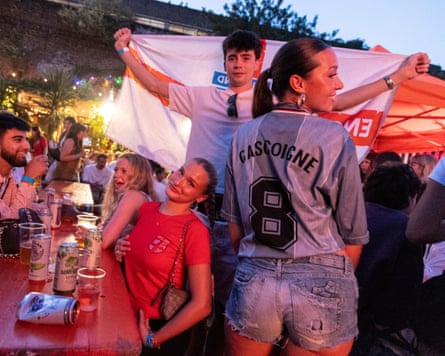
“I feel like sometimes with the World Cup, women don’t get included,” said Meager. “Sometimes if you’re a big supporter, women get laughed at and it’s nice to have a part that’s cool, that is for the women.”
In many ways, the outside courtyard where the quarter-final was being shown on the big screen felt like a portal into 2006. People were snapping selfies using pocket-sized digital cameras, wearing low-rise denim and vintage T-shirts with a faded Pacha cherry logo, cans of Stella flew into the air amid rumbling chants of “En-ger-land”, and a remix of Kylie Minogue’s early noughties hit Can’t Get You Out of My Head blasted through the speakers as everyone danced during half-time.
after newsletter promotion
“It’s just so camp. Pop culture just doesn’t ‘pop culture’ in the way it used to,” said Vanessa Hsiuh, 31, wearing a bodysuit printed with a paparazzi image of Victoria Beckham in the stands at the 2006 World Cup designed by the brand Afta Youth. “I hate the British tabloids, but there was a real theatre to them being kind of lairy that we don’t have anymore.”
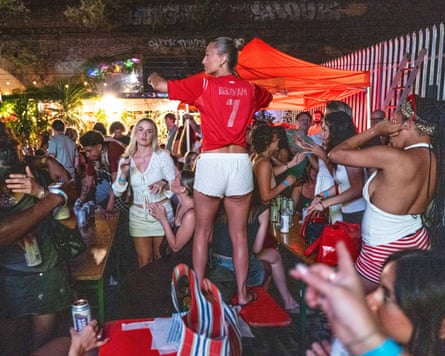
Hsiuh said she became inspired by the TikTok fancams of Cheryl Cole and Victoria Beckham in their heyday. “It really resonated with how I originally accessed football, I’m really interested in the Wags more than the actual players. But then I actually watched the game and now I’m into it,” said Hsiuh, whose favourite player in this year’s team is Jude Bellingham because “he’s beautiful”. “He’s also a really good player so I feel justified in loving him, but really I love him because I love his face,” she said.
While the style of the three lions logo and St George’s cross have captured the nostalgic sensibilities of a fashion-forward football crowd, there was still a recognition of the rightwing, nationalistic connotations the logo also carries. For the young England fans in south London, there was a sense of pride in reclaiming this emblem to represent a national team that is more inclusive.
“There’s so many connotations. It’s been quite a scary time for people of colour, especially with the rise of Reform,” said Megan T, 33, wearing a vintage, pale blue Umbro three lions jersey. “But in times like this, it’s nice to see black and brown people, and people of colour, being proud to wear these tops, and to have a football team that is so diverse.”
Grandon said: “I think we need to reclaim it and be proud of it. We’re in a time where we can bring it back. I’m proud to wear it.”