.png) 3 hours ago
9
3 hours ago
9
For the 21st time in his long and fruitful career, Novak Djokovic arrived at the All England Club on Monday and began his preparations for another Wimbledon in earnest. The 39-year-old worked his way through his tentative first steps on the grass courts of Aorangi Park, movement exercises complementing his sparring on court. He found his rhythm against local hitting partners and tussled with other champions. His training sessions included a catchup with his old friend Marin Cilic and then he broke in the grass on No 1 Court with the world No 1, Jannik Sinner, iron sharpening iron.
The ultimate goal is the same as it has been for some time: Djokovic, the seventh seed, returns to Wimbledon again seeking to become the oldest grand slam singles champion in history by winning an unprecedented 25th grand slam title. At 39 years old, his chances of achieving this goal naturally lessen with each tournament, but he has repeatedly shown that, if fortune favours him for two weeks, he is more than capable of taking advantage.
Djokovic’s 2026 season has perfectly summarised where he stands in his career. In terms of his pure tennis level, his performances are astounding. His run to the Australian Open final, where he toppled Jannik Sinner in five spectacular sets in the semi-finals, will quietly go down as one of his most impressive results ever. He simply did not have enough left in the tank for Carlos Alcaraz in the final.
His five months since the Australian Open have only reinforced how difficult it is to consistently compete at this level. Between February and May, Djokovic could not stay healthy. He played once, losing in the fourth round of Indian Wells to Jack Draper. With Roland Garros moving ever closer, he pushed himself to compete in Rome, losing his opening match to Dino Prizmic, the world No 79. His poor preparation caught up with him in Paris, where he played well for large parts of his third-round match and led by two sets against a brilliant João Fonseca, but he could not withstand the physicality of such a tough five-set match.
Keeping his body in one piece, whether across two gruelling weeks of grand slam tennis or over the course of an entire season, is clearly Djokovic’s greatest challenge at his age and it only gets more difficult. It is no coincidence his run in Australia came at a tournament where he had the benefit of Lorenzo Musetti retiring while leading in their match and Jakub Mensik providing him with a walkover, allowing him to conserve energy.
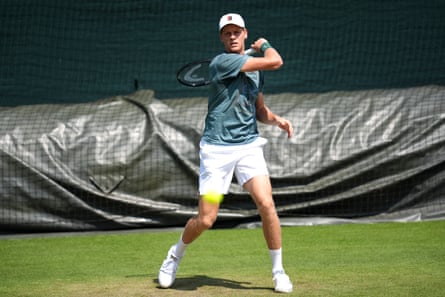
If there is ever a place where Djokovic could win another slam, Wimbledon, which he has won seven times, has always seemed the likeliest venue. Grass courts mean shorter points, allowing Djokovic to rely on his precise serve, close down the net, dictate with his forehand and play a more aggressive brand of first-strike tennis. At his age, the reduced physicality of this type of tennis clearly suits him.
This will be a fascinating tournament for Sinner. Considering the way he dominated the clay-court season, becoming only the second player after Rafael Nadal to sweep the Masters 1000 tournaments in Monte Carlo, Madrid and Rome, any loss at the French Open would have been hard to take. His collapse against Juan Manuel Cerúndolo in the second round, after leading by two sets and 5-1 in set three, was one of the toughest defeats of his career. Sinner insisted at the time that the defeat was not heat-related but he says he spent the weeks after Paris doing tests and trying to get to the bottom of his physical frailties.
Everyone takes big losses, and even the best players in the world lose more tournaments than they win. So much of professional tennis is about showing resilience, learning lessons and recovering. A year after defeating Alcaraz to win his first Wimbledon title, Sinner will try to take that perspective into his title defence.
If Sinner does not bounce back well, Roland Garros showed the anarchy that can follow. The absence of the two-time Wimbledon champion Alcaraz because of his right-wrist injury continues to leave a hole in men’s tennis. As a spectacle, Alcaraz’s talent, athleticism and charisma are desperately missed, but his layoff represents an opportunity for the rest of the field. Djokovic was not in the right physical shape to take advantage of landing in Alexander Zverev’s half of the draw in Paris, a draw that completely collapsed due to the exit of so many seeds in the early rounds. He has been drawn into Sinner’s half in SW19, meaning they could meet in a semi-final.
Along with Djokovic and Sinner, Matteo Berrettini is the only player in the bottom half to have reached a Wimbledon final. Unlike on the clay, there are numerous solid grass-court players at the top of men’s tennis who will be desperate to take advantage. The likes of Taylor Fritz, Ben Shelton, Alex de Minaur, Flavio Cobolli, Mensik and Arthur Fils, if he is healthy, should all start the tournament in that half with high hopes of a breakthrough. Considering how the French Open turned out, every possibility is on the table.