.png) 1 month ago
45
1 month ago
45
If Norway’s highly fancied generation need a warning from history they need only look back 32 years and study the lessons from another searing, suspenseful American summer. They had raced through qualifying at England’s expense to reach their first World Cup since 1938; their top players were starting to make it in the Premier League and through the euphoria shone a confidence that a place in the knockout stage, at least, was there to be seized.
“When we got there we didn’t manage to even get close to the quality of play we had produced in qualification,” remembers Lars Bohinen, one of the silkier elements in a side that, under Egil Olsen, became renowned for an uncompromising and no-frills approach. “That’s the biggest disappointment when I talk now to my old teammates. We never got near to performing at the level we needed.”
In fact Norway were a shade unfortunate. Planted in a strength-sapping group alongside Mexico, Republic of Ireland and Italy, they finished fourth despite the teams finishing level on points and goal difference. Their failure came in attack; Olsen’s side were eliminated because they only scored once, beating Mexico before ultimately running aground in a famously sweltering goalless draw against Jack Charlton’s team at Giants Stadium.
This year’s Group I does not look much easier. But the dynamic of Norwegian football is different now; the not entirely inaccurate picture of burly Vikings replaced by elite, technically supreme talents in the moulds of Martin Ødegaard and Antonio Nusa. There is an Erling Haaland-shaped spearhead to convert chances that flow more frequently in Ståle Solbakken’s fast, flexible setup.
“Back then we played much more direct, physical football,” Bohinen says. “Now we can control the game with the ball and that’s a big difference.
“The players’ technical level has increased and so has the speed. It’s a result of many years professionalising the academies at Norwegian clubs. They have better coaches, better infrastructure, better pitches, more possibilities for more people.”
Artificial turf, in place from the remotest Arctic Circle locations down to the Oslo suburbs, means the harshest conditions can be surmounted. The class of 1994 did not enjoy that luxury although Bohinen points out that their qualifying campaign, in which England were stunningly dispatched in a 2-0 win at Ullevaal, was not simply a route one exhibition. He feels they reverted more to the long ball once they reached the World Cup, where the “Flo Pass” – a crossfield ball generally aimed from the left-back Stig Inge Bjørnebye to the giant centre-forward Jostein Flo, who would pull out to the right – earned renown.
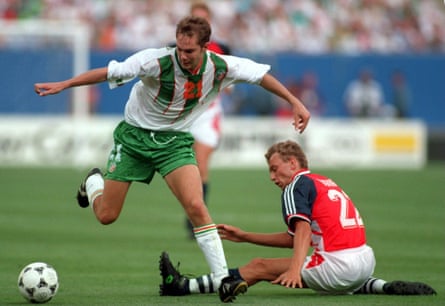
“We had that pass going left to right,” Bohinen says. “Then we had to pick up the second balls from those duels. From then we had to try to get close to goal as soon as possible. That was the whole aim really: get close to goal quickly. And in the heat of the States, it was too much.”
There were a handful of roses among the thorns, including Bohinen, a classy midfielder well remembered for his spells at Nottingham Forest, Blackburn and Derby. “It was easier to stand out because there were not so many who had those qualities at the time,” he says. Even if the ball was frequently sent over his head, he still scored 10 times for the national team. “But now we have a lot of players, some of them really good dribblers, who have a strong technical base and make very few mistakes on that front. It’s a change for the better.”
But if Norway’s ball players can hold their own against France, Senegal and Tuesday’s opponents Iraq, an unintentional corollary may be a less aggressive defensive posture. They only conceded five times in a perfect qualifying campaign but were not seriously tested, a disappointing Italy their closest rivals. Bohinen believes the focus on creating a silkier Norwegian footballer has meant centre-backs with the ruggedness of Erland Johnsen or Henning Berg have become unfashionable.
“We have a fantastic attacking force but we don’t produce defenders any more, everyone wants to be ball players,” he says. “It’s reflected in the national team because that’s our weakest link. We’ve created a lot of offensive, technical players but now we may be paying a price for that.”

Kylian Mbappé will be among those hoping to discover Bohinen is correct. But Norway appear far better prepared for setbacks than in 1994, when the intensity of their approach backfired. “What we all agree on is that we trained too hard,” Bohinen says. “The competition for places was so big and we trained too long in the heat, as if it wasn’t for a tournament but for one game. We didn’t have any energy left when we played. We also spent hours going to the embassy and standing around, meeting the ambassadors and people from different industries. It took too much energy and focus away from what’s important.”
Those mistakes are unlikely to recur in Greensboro, where Solbakken has been tuning them up from the sanctuary of the local University of North Carolina campus. Solbakken took aim last week at the political problems that clouded the tournament’s buildup but controversies within his own camp have been nonexistent. Perhaps the dance moves Haaland exhibited during a training session last Thursday reflected a cooler, calmer, slicker Norway who feel more comfortable in their modern skin.
“The euphoria felt bigger when we qualified in ’94,” Bohinen says. “We had been complete outsiders. Now there’s a little bit more expectation.” Soon Norway will find out if their drastically revamped 2026 model is capable of handling it.