.png) 3 hours ago
4
3 hours ago
4
All hail the wandering glider, a citizen of the globe, an insect for all of us.
Whenever we see a dragonfly zipping through the airspace and devouring tiny insects with aplomb, we can appreciate they are so timelessly effective that they have barely needed to tweak their way of life in 200m years. Odonates are directly descended from some of the earliest winged insects, known as griffin flies, which evolved around 317m years ago.
And if you were a mobile predator who had evolved when the continents were completely different to the world we know today, why would you settle down in a single country?
Wherever we live in the world, we can probably glance up and see one of these sleek, darting dragonflies, which have transparent wings and a yellow or golden-coloured thorax marked with a dark line.
The wandering glider is found on every continent except Antarctica, and from sea level to more than 6,000 metres above it in the Himalayas. It even finds lodgings on the remotest oceanic islands.
Unlike other dragonfly species, whose water-dwelling larvae may slowly grow in ponds over several years, the wandering glider larvae can develop as rapidly as within 38 days, enabling females, which lay up to 2,000 eggs, to take advantage of ephemeral waters and even swimming pools.
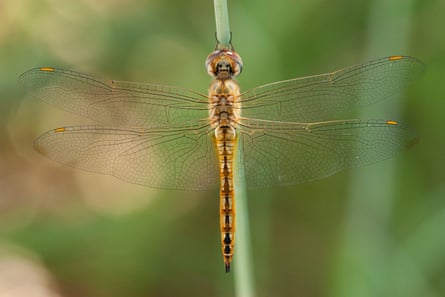
Its ubiquity and ability to quickly produce a new generation point to its truly awesome power: this 4.5cm-long insect weighing a fraction of a gram migrates further than any other known insect. Across generations, it completes a route of up to 18,000km between India and east Africa. Some individuals even cross 3,500km of open water – the Indian Ocean – riding high-altitude monsoon winds.
Ben Price, principal curator of entomology at the Natural History Museum in London, said this miraculous migration had been discovered only this century. It was proposed by the marine biologist Charles Anderson in 2009. Anderson, who lives in the Maldives, observed the dragonflies arriving on the islands with the October monsoons, and then continuing on to Seychelles. Travelling on, they arrive in eastern Africa to take advantage of the monsoon rains there, which enable them to reproduce again, and send the next generation onwards.
This migration was confirmed by isotope evidence in 2012. In 2016, a genetic study discovered that wandering gliders interbreed as one global population.
Price said: “That a common, familiar insect could hide the greatest migration on the planet until our own century is a perfect reminder that the natural world is still full of discoveries. Ubiquitous, fearless, and quietly astonishing. My vote goes to the wandering glider.”
-
It’s invertebrate of the year again! From August 3-12, every day we’ll be profiling one of the thousands of amazing invertebrates that our readers have nominated, and then, when you’ve got to hear about all of them, we’ll open the voting so you can choose your favourites. Don’t hesitate to get in touch with thoughts and ideas: email us at [email protected] with Invertebrate in the subject line.