.png) 1 hour ago
5
1 hour ago
5
A man and a woman are murdered in cold blood inside their Topeka, Kansas bedroom under cover of darkness in 2002. Suspicion quickly falls on the man’s ex-wife, Dana Chandler, with family and forensic evidence painting her as the jealous type. But the county prosecutor at the time declines to pursue charges in large part because nothing places Chandler at the scene of the crime. It’s only after a politically motivated prosecutor is appointed and CBS’s 48 Hours airs a 2009 report rehashing the case that Chandler is arrested on two counts of premeditated first-degree murder in 2011 and condemned to consecutive life sentences the following year.
No doubt: the story is hot copy. And more than likely, Chandler’s conviction marks the conclusion if a husband-and-wife team of true crime enthusiasts hadn’t become convinced that the real killer was still walking free. “There’s a lot of questions that remain,” says film-maker Matthew Galkin. “But when you start to unpack the crime itself, there’s a lot of hoops to jump through and a very high bar to clear in order for her to have pulled this off.”
A Killer Story, HBO’s latest true crime deep dive, takes Galkin and producing partner Josh Levine on a six-year-long steeplechase to answer the burning question of who murdered Mike Sisco and Karen Harkness. It’s a three-part journey driven not just by their collective skepticism of its three bombshell legal outcomes, but led by one of the country’’s foremost cynics.
Joe Sexton doesn’t just look the part of a hardscrabble newsman, with his resplendent gray mane and goatee for doubtful stroking. “We would talk about noir films, a Sam Spade-type character,” Levine says. “But he also had this [flavor] of Capote in In Cold Blood.” Sexton makes himself unmistakable to the ear with his Brooklyn pottymouth and easy enough to spot in his bright North Face windbreaker vests. “At the end of the second trial, we interviewed the foreman in the jury, and one of the things he told us was that they had given nicknames to different people,” Sexton recalls. “The bald 6ft 8in prosecutor with the big beard was the Son of Anarchy. The older defense lawyer with glasses was Mr Magoo. The nickname they gave me, which I’ve kind of leaned into, was Tracksuit Jesus.”
A Pulitzer prize-winning veteran of the New York Times and ProPublica, Sexton has a deep wariness of the juicy lead. In the first episode, Sexton still radiates with contempt as he recalls the 3,000 unsolicited emails he received from Eileen Umbehr, a self-described pyjamas housewife who couldn’t let Chandler’s conviction stand. It wasn’t until Umbehr wrote Sexton to tell him that the Kansas supreme court would hear an appeal of Chandler’s sentence in 2016 that Sexton conceded there was no more avoiding a trip to Topeka, site of the landmark school-segregation case that reached the US supreme court.
It’s at that point the lens widens on Umbehr, who proves to be more than just a concerned citizen. Her husband, Keen, is a lifelong good troublemaker who went from toiling as a garbageman to uncovering local government corruption for the town newspaper with scoops collected along his garbage route. When the county moved to cancel his garbage contract in retaliation for his muckraking, Keen filed a first amendment lawsuit that went all the way to the US supreme court and won a 7-2 decision in 1996. It was all the motivation Keen needed to go to law school and open his own practice. (Fun fact: he also ran for governor as a libertarian, losing in 2014 to Republican former US senator Sam Brownback.) Years later, Keen and Eileen helped assemble the materials and arguments that prompted the Kansas supreme court to review Dana Chandler’s conviction – and overturn it.
That final revelation, of these plucky underdogs winning yet another challenge to the legal system against all discernible odds, marked the first time I pumped my fist watching a documentary. Gaskin and Levine really make viewers fall hard for the Umbehrs – who offload 200 acres of inherited family property to fund the legal defense for Chandler, who goes from crusade cause to actual client. And the doubts they raise about Chandler’s guilt aren’t trivial.
There’s a reason why she wasn’t prosecuted initially, after all. The Sisco-Harkness murder bore the classic hallmarks of a hit job, with the assailant breaking into their home undetected, spraying them at close-range with machine gun fire without hitting anything else even once, and leaving without a trace. Chandler, meanwhile, lived more than 500 miles away in Denver. But because she had recently sent a series of exasperated messages about Sisco, with whom she had a tumultuous marriage and shares two children, and bought two spare fuel canisters at an auto parts store – with her credit card – then, naturally, she had to be the one and only suspect.
Astonishingly, the idea of a frail midwest divorcee hypermiling her Mitsubishi econobox across state lines to go full Tony Montana with a subsonic machine gun that was once reserved for the Israeli military wasn’t enough to stoke reasonable doubt, let alone seed it. “Over the three prosecutions, the basic gameplan was, ‘Let’s make her as ugly and unpleasant as we can,’” Sexton says. “I used to think there were limitations about what could be entered into evidence as prior bad acts. But that’s all it was: ‘well, she showed up and cursed out her husband at a soccer game …’”
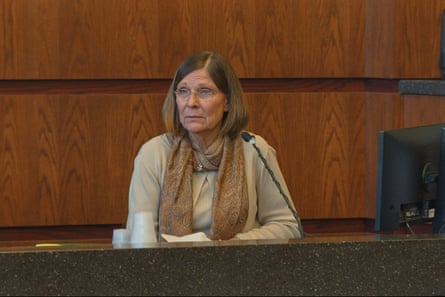
The alternate-killer theory the Umbehrs present, casting suspicion on Harkness’s son-in-law Jeff Sutton, falls apart – ultimately revealing a legal beef between Keen and Sutton dating to the latter’s days as a county attorney and leaving the garrulous Eileen at a notable loss for words. After that second trial in 2022 ends in a hung jury, Chandler is tried a third time, shocks everyone by representing herself and goes down in flames – despite the prosecution manufacturing a witness. (The witness even admits as much on camera!)
“It’s the same evidence in each trial, actually even less because they start throwing things out,” Levine says. “You go from the second trial where there’s a six-day deliberation and they can’t come to a decision in an hour and a half in the third trial. I think it dovetails nicely with our interest in all these people telling their stories for all these years. So it’s like, who do you really believe?”
Once again, you can’t help feeling most for the Umbehrs, who literally bet the farm on Chandler’s exoneration, view her legal Hail Mary as the height of betrayal and cut off all communication and support. That leaves Sexton, Galkin and Levine without a tidy ending for their documentary, but with plenty of observations to offer on the complexities of the criminal justice system, the persuasive effects of true crime mills like 48 Hours and the dangers of confirmation bias – especially when it compounds. “Honestly, I believe she would’ve been free had she not fired her lawyers and represented herself in a massively self-destructive move that almost never turns out well for anyone who chooses it,” Galkin says. “Joe says it well in the series: knowing your case really well and arguing it effectively are two different things.”
In her defense, though, one could also see how failing to win freedom after more than a decade behind bars might make someone with the best counsel act rashly. It’s also difficult to overlook the role a more robust press might have played in, at the very least, underscoring the undeniable reasonable doubt in Chandler’s case. “Certainly local coverage in Topeka at the time of her arrest was in the pocket of prosecutors,” Sexton says. “They’re in bed with 48 Hours, tipped local reporters off to her arrest. Topeka, like many towns its size in America, has had its local press eviscerated. But CBS 48 Hours comes in and does a show and has a bunch of crying family members saying, ‘This woman did it.’ Well, that’s all you need.”
-
A Killer Story starts on HBO on 10 September and will be available on HBO Max