.png) 1 month ago
37
1 month ago
37
“The Conservative party is coming back,” Kemi Badenoch declared at her party’s local election launch last week, surrounded by cheering supporters. And it’s fair to say that many of her MPs are, relative to their mood in recent years, quite cheery.
To others in the Conservative family, though, this optimism appears disconnected from the reality of the situation facing the party. Even the MPs backing Badenoch agree that the Tories face heavy losses on 7 May, not just across English councils, but particularly in votes for the Scottish and Welsh parliaments, where in both they are expected to be reduced to a handful of seats.
This is in part a factor of circumstance. The last time Scotland and Wales elected parliaments was May 2021, when the Conservatives were amid a short-lived vaccine bounce under Boris Johnson, enjoying national poll ratings above 40%.
The equivalent figure for Kemi Badenoch right now, according to YouGov, is 17%, a near extinction level of support that has barely shifted for months. And yet the party consensus is that Badenoch is completely safe in her job.
“I don’t want to say we’re chipper, as that might sound complacent, but we’re quietly chirpy,” said one Tory MP who was not a particular Badenoch acolyte. “Yes, we’re going to do badly, but that’s expected. And more importantly, Labour will do worse.”
Other reasons cited for hope include Reform’s recent mini-dip in the polls, as well as an improvement in Badenoch’s personal ratings and her performances against Keir Starmer at prime minister’s questions, plus a sense that she adeptly handled the potentially destabilising departures of Robert Jenrick and Suella Braverman to Nigel Farage’s party.
“Kemi does come up on the doorstep,” a shadow minister said. “Her party conference speech last year engaged members, and then her response to Rachel Reeves’ budget seemed to tap into the public mood. But there is still frustration that none of this seems to be translating into party polling.”
Not every MP sees it this way. “I’d describe the mood as pretty grim,” one said. “We’re staying dead level at 17% in the polls and we’re going to lose a load of councils. What is there to be happy about?”
But even such fierce critics of Badenoch think there is little chance she will face a challenge to her position, irrespective of how badly the Conservatives lose ground in May, in part because the only MP believed to have been organising such a bid – Jenrick – has gone.
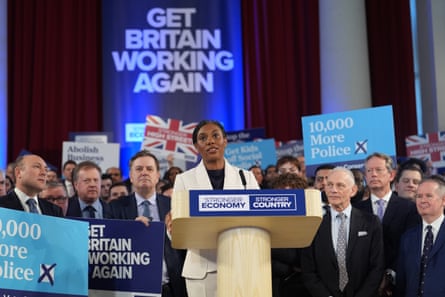
“What pressure there is on Kemi is kind of under the radar for now,” the MP said. “She most likely has another conference speech and maybe another set of local elections before there could be any kind of challenge.”
To an extent, however, talk of Badenoch’s performance at PMQs or how she might have won round her MPs, feels like a distraction. It is not just that polling in third or fourth place is an unprecedented disaster for the Tories, there is also the fact that the party polling in first, Reform, are a direct replacement on the right of British politics.
Some in the party fear that the modern Conservatives resemble a character in a children’s cartoon who has run off the edge of a cliff, but with their feet still scrabbling furiously, they have yet to notice.
“There is mass denial going on in the party,” said one senior regional organiser who has council elections in their area. “If you’re knocking on doors as much as I do, the view from MPs can seem delusional. No one has ever told me: ‘Kemi was good on PMQs, wasn’t she?’ It’s only MPs and nerds like me who watch it.
“We’re not making up ground. The brand has not been repaired. After May, Reform might end up as the party you vote for on the right. They are making inroads everywhere. We’re at risk of reaching that critical mass where a vote for us is seen as a wasted voted. That just wasn’t the case even last year.
“All the party has done is take a tactical decision to go to the right and echo Reform. There is no strategy as to who our voters are. It’s all driven by PMQs and a Westminster comms plan. What is Kemi’s vision for Britain? I don’t know.”
Others wonder whether the party has yet adjusted to the new era of British politics, one in which the Conservative-Labour duopoly has been smashed and voter loyalties feel in permanent flux.
“Their poll position suggests to me that they are in an awful lot of trouble,” said Tim Bale, a professor of politics at Queen Mary University of London, and a chronicler of the Conservatives’ recent history. “Simply pointing to a Labour government that’s doing really badly, and thinking, well, we’re not as bad as them – it’s not enough. They don’t seem to have realised that they are living in their completely different world, one where unpopularity for the government does not necessarily translate into popularity for the official opposition.
“The fact that the shine has come off Reform a little bit is probably encouraging them to think that gradually this thing will come back to normal. But there’s no signs we are going back to life as normal. After Labour won the 1997 election, one Tory said to me: ‘Oh well, it will be like a man running off with his mistress, and when he wants his socks darned and a home-cooked meal he’ll come back.’ I do wonder whether the Conservatives feel there still is a sort of natural order of things.”
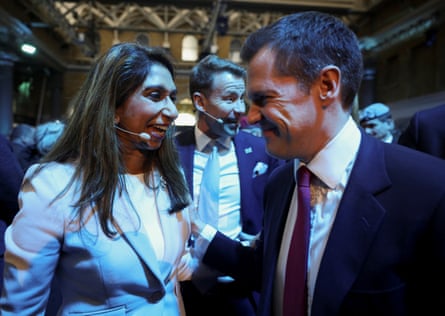
Is there any basis at all for optimism? Perhaps a few flickers. One MP suggests that tactical voting could boost the party’s results. “On the doorsteps I’ve had quite a lot of people say things like: ‘I’m normally a Lib Dem, but it’s you versus Reform here, and I want to keep Reform out at all costs, so I’ll vote for you.’”
Another factor that could protect Badenoch is that some Conservatives are realistic about what is possible in the newly atomised political landscape. “To an extent we might have to adjust our expectations,” another MP said. “It’s a five-party system now. We’re not going to be on 45%. But the truth is that we really don’t know what’s going to happen.”
There is also a more personal reason for the mood of cheeriness, one cited by several MPs – the fact they no longer have to share Commons benches with Jenrick and Braverman, both hugely divisive figures. “It’s hard to overstate how much people breathed a sigh of relief when Robert and Suella left,” one shadow minister said. “Robert was particularly toxic, and that spread. Now he’s gone, even his friends seem to be trying extra hard to be loyal.”
These are, however, crumbs of comfort and in some cases little more than displacement activity to distract from the abyss below the party’s feet. At some point, one party official said, reality has to kick in: “It feels like we’re going through the stages of grief. It’s denial now, but after May there will be the realisation we are doing something very wrong.
“And at some point MPs will decide to take a punt on someone else for leader. If you’re told you have a terminal illness, and there is an unproven operation, which has a 20% chance of success, you’d go for it. If we get smashed in May, I would rather roll the dice and try again. This isn’t about bad results. It’s existential.”