.png) 2 months ago
65
2 months ago
65
Do insects feel pain? Crickets certainly seem to, according to new research which finds they stroke and groom a sore antenna in much the same way as a dog nurses its hurt paw.
Associate Prof Thomas White, an entomologist from the University of Sydney, said the experience of pain was a “longer, drawn-out, ouchy feeling”, that differed from a hardwired nerve response.
But evidence for pain is difficult to establish in other species, he says, so scientists look for behavioural cues. One indicator is “flexible self-protection”, where an animal directs protection to a particular body part over an extended period of time.
“You see a dog, limping, or licking its paw, or holding one particular arm – of course, we’d immediately say, ‘well that’s in pain, it must be sore’.” Scientists search for evidence of similar responses to ascribe pain to other animals, including insects.
So, to test the idea in crickets, researchers first had to give them an “ouchy”.
In the study, published in Proceedings of the Royal Society, dozens of crickets were randomly selected to receive one of three treatments. Some had a heated soldering iron applied to one antenna, while other crickets received the same probe; unheated, and a third acted as a control.
The soldering iron was set to 65C – hot enough to be a “bit unpleasant”, without causing lasting harm, White says.
Crickets that received the hot probe “overwhelmingly” directed their attention to the affected antenna – they groomed it more frequently, and tended to it over a longer period of time, he says. “They weren’t just agitated and flustered. They were directing their attention to the actual antennae that was hit with this hot probe.”
The other crickets? They were a bit perturbed, he says, but resumed normal activity very, very quickly.
White says the behavioural responses would be immediately recognisable to us as pain, if we observed them in our pets or friends. “Which raises the question, why don’t we make the same inference here?” The answer, he says, has to do with human history, culture and insects’ lack of similarity to us.
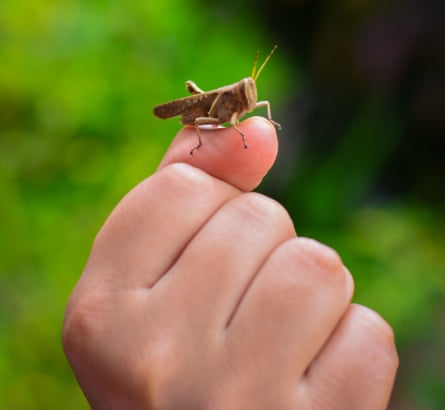
Science is slowly moving the dial, and revealing more and more about insect brains, behaviour and experiences.
“These aren’t just little machines,” says White. “They have rich capabilities to learn, to make complex decisions and trade-offs.”
Studies have shown bumblebees engage in play-like behaviour by rolling coloured wooden balls, while stressed bees show signs of pessimism.
The New York Declaration on Animal Consciousness, signed by more than 500 leading scientists and philosophers, acknowledges a “realistic possibility of conscious experience” in all vertebrates and many invertebrates, including insects.
Animal welfare laws are catching up, with some countries recognising sentience in invertebrates like cephalopods and crustaceans.
Associate Prof Kate Umbers from Western Sydney University, and the managing director of Invertebrates Australia, says it makes sense that insects could be next. “Evolutionarily speaking, insects are a crustacean on land, they share a common ancestor.”
People underestimate insects “all the time”, says Umbers, who was not involved in the study. “Humans are notoriously not very good at appreciating things that are different from them.”
Insects may be tiny and have more legs, but they are capable of remarkable feats and intelligence, she says. Bogong moths, for example, navigate over hundreds of kilometres, at night, to a place they’ve never been before.
“What I hope this study can do is inspire people to look past the differences between humans and insects, and instead embrace empathy, that they naturally feel towards other living things.
“It challenges us to think more carefully about the way we interact with these species – and to not reach for the bug spray.”
To date, most research into insect pain and cognition has concerned bees. But the question of pain is particularly pertinent for crickets – the chickens and cows of the insect world – farmed in their billions and trillions for food, feed and research, White says.
“If they’re capable of having better and worse lives, then we should take that into consideration.”