.png) 6 hours ago
7
6 hours ago
7
‘We have really cool sharks,” says Dr Lucy Hawkes. She is not referring to animals in the rich coastal waters of South Africa or Mexico, but instead talking about the species that live around Britain. Hawkes, an associate professor at the University of Exeter, is co-leading a new three-year project to investigate the lives of three of England’s most vulnerable shark species.
“I like the porbeagle, which looks like a baby great white shark,” she says. “Surfers could see one and absolutely poop their pants, but they’re not dangerous. It’s amazing that we share the water with some pretty exciting animals.”
More sharks swim in British waters than you might expect. From small catsharks and deepwater dogfish to migratory blue sharks and huge filter-feeding basking sharks, there are more than 40 different types in these waters. Yet scientists know surprisingly little about most of them.
Now, the lab that Hawkes and her colleague Dr Matthew Witt run at Exeter has been awarded almost £1m by Natural England to collaborate with the Marine Biological Association, the Angling Trust and the Pat Smith Database, a long-running online record of shark catches dating back to 1953.
Together, they will use a mix of historical records, electronic tags and recreational sightings to find out more about where and when porbeagle, tope or school sharks, and blue sharks are feeding, mating and migrating. The project will also monitor how shark populations are changing in terms of numbers and distribution – helping determine how best to prioritise conservation efforts.
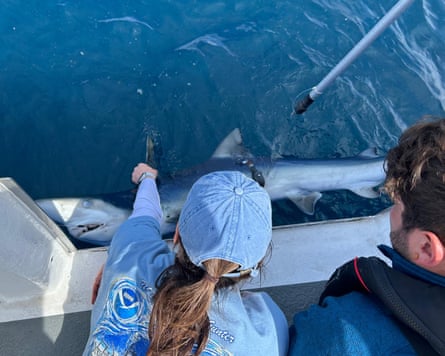
Sightings from some of the nation’s 3 million recreational anglers provide crucial information.
“The UK has a long history of recreational fishing for sharks and big fish like tuna,” says Dr Francesco Garzon, a marine biologist working alongside Hawkes. “It’s one of the best places to see sharks in Europe.”
Recreational shark fishing in the UK is now “catch and release”, he explains. Angling clubs used to keep catch records based on weight once a dead fish was landed onboard the boat. Now, many fishers measure the length of live sharks in the water before releasing them. Tagging should reveal how sharks respond to catch-and-release practices.
“Anglers are conservation-conscious,” says Garzon. “They can sometimes be ostracised but are usually just as passionate about protecting sharks as we are.”
He adds that direct commercial fishing or accidental bycatch are the biggest threats for UK sharks.
Hawkes likens shark anglers to bird ringers. “These people are so passionate about the marine environment; they want to spend thousands of hours just trying to see these amazing animals up close. They’re obsessed with sharks.”
By reporting their catches to the Pat Smith Database, skippers and recreational anglers act as citizen scientists and help researchers find out where these species go.
“Even if all the shark researchers in England got together, we just couldn’t have the same level of records,” says Garzon. “Angler records are an essential tool, helping us understand shark populations.”
The shark scientists will also run in-person workshops and interview hundreds of anglers across the country, from the south-west to the north-east of England.
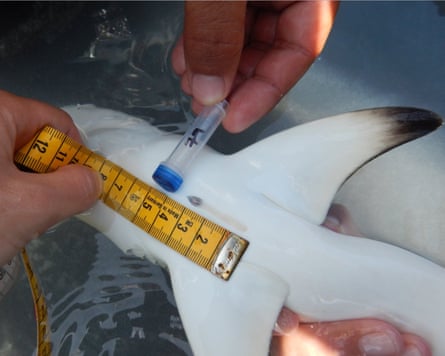
The mutual trust they have developed with the angling community is key to the success of the project. Over the years, the team have spent a lot of time on boats talking to fishers, while tagging pelagic species such as bluefin tuna. And it is entirely possible that porbeagles, for example, could swim halfway across the Atlantic, as bluefin tuna do.
Forty tags, each worth £1,500, will stay on the fish for about 45 days. These tags should reveal how well sharks survive after being caught then released. According to Hawkes, even anglers want to know more about this so they can take measures to avoid harming the fish.
“If tags show that sharks are travelling into waters where a particular fishery is permitted with a high rate of bycatch, that would be relevant to their conservation. It really depends on what the sharks tell us.”
During tagging, the team plan to take DNA samples from the sharks. Usually that involves obtaining a tiny clip of skin from a fin, or swabbing a cotton bud on their skin. By doing this, scientists create a map of genetic connectivity.
“We could work out whether a French blue shark is closely related genetically to an English blue shark,” explains Garzon. “They might be loners then aggregate in big numbers to mate, like tope sharks do in northern Scotland. We don’t yet know.”
The team will also use another 30 more expensive tags, costing about £4,500 each, which last about a year. “These enable us to reconstruct a shark’s path and tell us how deep each shark has been diving and for how long,” says Garzon.
Hawkes says people often recoil when she mentions sharks. “We scientists are the ones who say, ‘Shark! Where? Let me see!’ I’d love to change people’s minds about these beautiful animals. They totally belong here.”
This story was produced in partnership with the Conversation, where Anna Turns is senior environment editor