.png) 4 hours ago
4
4 hours ago
4
Maryam and her best friend were ambling through Magdeburg toward the railway station, talking over the dramatic events of the previous evening and the surge by the far-right Alternative für Deutschland to a historically high vote in the Saxony-Anhalt elections.
“Don’t laugh at me,” she said, “but I wish we could go back to the days of Angela Merkel, when things were OK in Germany”.
The teenagers, from nearby Wolmirstedt, said they were shocked by the AfD’s landslide win. But they felt powerless to do much about it and felt afraid about where it might take their home state.
“We talk about it all the time,” said Maryam, whose name has been changed. “It’s on my mind constantly. My dad came to Germany from Syria in 2015. My mum and I joined him two years later.”
The first clause of the anti-immigrant AfD’s 100-day programme says that – “from the first moment” of being in power – the party will deport people it deems “irregular migrants”. Maryam believes her family could well face deportation.
“We have to renew our residency permits every three years as it is. We’ve always lived in a state of uncertainty. Now after these election results we face going back to Syria which we don’t think is safe, and I can’t even read or write Arabic.”
The AfD won almost 44% of the vote in Sunday’s election, more than even it had hoped for. Doreen, 54, did not immediately admit to having supported the party, but said later in an interview she had put her faith in what she termed “the blues” “out of a sense of desperation”.
When challenged about the human impact the party’s policies could have, for example on immigrant families, she shrugged: “It is what it is.”
“If they [refugees] hadn’t turned up here in such large numbers in the first place, they wouldn’t have to go through such heart-breaking situations now,” she said.
Doreen, a cleaner, said she hoped the pro-Russia AfD would be able to take power and act on promises to end refugee status for Ukrainians (as well as aid to Kyiv). “The winners will hopefully straighten up a few things right away,” she said. “They [Ukrainians] come here in their fancy cars, pretending they’re escaping devastation, but most of them have far more resources and designer clothes than I do.”
Doreen is speaking close to a stolperstein, or stumbling stone – a brass plaque embedded in the concrete – commemorating Ernst Fliess, a Jewish lawyer. Born in 1877, he lived on the spot where a glass-fronted fitness club now stands until he was “humiliated, disenfranchised … (and) took flight in death” (a euphemism for suicide).
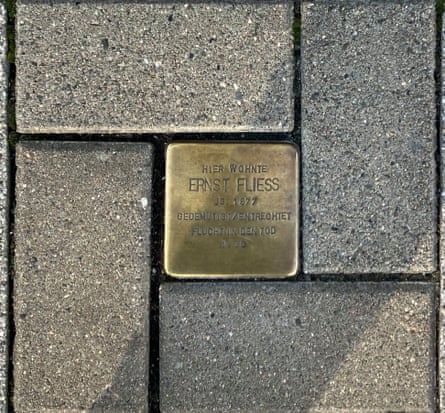
But she angrily rejected any parallel between the AfD’s rise in popularity and the Weimar era rise of the Nazis. “Don’t tar me with that brush,” she said. “We are in a different age, with different problems.”
Returning from their daily stroll to the Elbe river, 88-year-olds Ernst and Judith, a retired boiler maker and a design engineer who have been married for 64 years, said they did not want to talk about the election result. But it soon became clear that they were shattered by the news. Voting data has shown a stark drop-off in support for the far-right party among the over-70s.
“It’s not like we didn’t see it coming,” said Judith. “But we don’t quite know what to do with the information. The reality of it hasn’t quite kicked in.”
The couple said they had voted for the far-left Die Linke. Judith said she was “devastated that a party that has so little regard for refugees” had won, and by such a large margin.
Her own life story – she was forced to flee her home in Silesia in 1945 and spent years in temporary accommodation before settling in Magdeburg – has greatly sensitised her to the plight of refugees, she said.
“I see the look in their eyes, it doesn’t matter where they come from, who they are, and I am so empathetic to their situation,” she said. “It breaks my heart to think that almost half of the population has voted for a party that is so anti-immigrant, particularly after all Germany has gone through as a nation in the last century.”
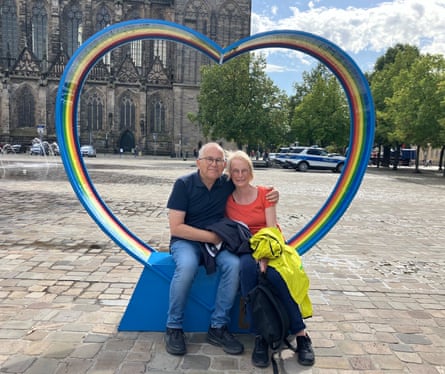
Sitting on a heart-shaped rainbow-coloured bench in front of Magdeburg’s gothic cathedral, Christiane and Franz Josef Jäker, 67 and 71, on holiday from North Rhine-Westphalia, were also digesting the news.
“The populists are ruining everything,” said Franz Josef. “Everything that Germany has built up again after world war two. They promise a lot that they can’t deliver, and they also suppress a lot – such as what is going on in Ukraine – so that they can argue for the resumption of Russian gas imports to Germany.”
Eric, a paramedic cheerily drumming up funds for a hospice, said he was kicking himself for not having voted. The 21-year-old son of a German mother and a Guinean father who spent 10 years applying for a German passport, said: “I try not to think about what the installation of the AfD in government might mean for me as a dark-skinned man.”
Most of all he is worried about “the constitutional changes they might make, and the domino effect that might have across Germany”.
Luisa, a bank teller who says she voted for Die Linke, fears for the image of her state.
“It’s really bad for the reputation of Saxony-Anhalt. A lot of people have said that foreigners here will now choose to leave, but I know enough low-paid foreign workers who won’t be able to afford to do so, and will just have to put up with being badly treated.
“I saw some interviews with Holocaust survivors and they drew parallels with the mood around what’s happening now and the rise of the Nazis. We have to pay attention to this similar sense they say they have – they’re not making it up.”