.png) 5 hours ago
7
5 hours ago
7
A year ago this month, when global talks to end our spiralling plastic crisis collapsed, Emma Hardy, Britain’s then marine minister and the UK’s head of delegation, said she was “hugely disappointed”. The UK is committed to working, at home and abroad, to “protect the environment and pave the way to a circular economy”, she pledged.
But Britain, one of the world’s largest exporters of plastic waste, remains part of a global trade that enables us to send mountains of plastic rubbish to other, mostly poorer countries, fuelling pollution, health impacts and waste crime.
Over the last few months, I have been looking at exports to Turkey, which is now the primary destination for EU and UK plastic waste. A Turkish researcher told me he found high levels of microplastic and other plastic pollution in an irrigation canal next to Kemal Deniz, a major recycling site in Adana, southern Turkey. And an analysis of export/import data, carried out for the Guardian by the Environmental Investigation Agency (EIA), identified 13 British companies who sent plastic to this site between 2021 and 2024.
Residents in Adana say plastic waste from the UK and the EU is driving the operations responsible for water and air pollution, leaving them to pay the price.
More of what happened when the Guardian spoke to farmers and residents near Kemal Deniz, after this week’s headlines.
Essential reads
-
El Niño could push 50 million people into acute hunger before end of next year
-
‘We stared into an abyss’: the men and women battling France’s megafire
In focus
Ayhan*, an aubergine farmer in Adana whose fields are metres from a canal found to be contaminated with microplastics, told us: “We get pollution from all sides here,” referring to the plastic recycling zone upstream, as well as a nearby textile plant that he suspects is making the water acidic. “The plastics are all there, by the bank, and the fumes come this way.”
Between May 2021 and July 2024, 13 British companies sent 545 shipments of household and supermarket plastic waste, totalling 52,000 tonnes, to the Kemal Deniz recycling zone, according to data analysed for the Guardian by the EIA, an international NGO. The zone is under a mile from Ayhan’s aubergine fields.
New research also shared with the Guardian that shows high levels of microplastics, as well as plastic debris, were found in the waterway alongside Ayhan’s fields.
Sedat Gündoğdu, a Turkish marine biologist at Sabancı University’s Istanbul Policy Center, says many of the recycling facilities discharge wastewater directly into canals and channels used for irrigation.
“The discharge of microplastic-laden wastewater into irrigation canals raises critical concerns about agricultural contamination and food safety,” he said.
There is no suggestion that the UK companies exporting plastic waste are acting illegally. British exporters of plastic waste do, however, have a regulatory duty to ensure that the plastic they export is recycled in an environmentally sound manner.
When Ayhan’s fields flooded in January after heavy rain, it destroyed 7 hectares (17 acres) of his crops, he said.
“We had to plant new ones,” said Ayhan. “But what can we do? Nothing. Nowhere to file a complaint – nobody cares.”
Environmental campaigners say plastic waste exports to Turkey are driving the operations responsible for the pollution, leaving the city’s poorer residents to pay the price.
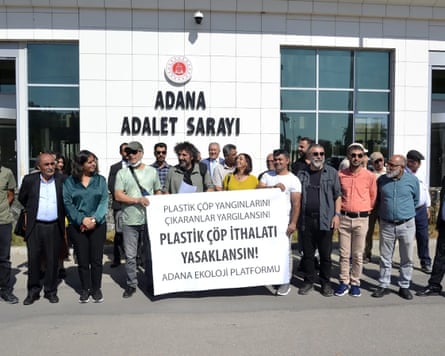
Last year, residents held a protest outside the city law courts after a blaze at a recycling facility near the Küçükdikili neighbourhood burned for 36 hours, creating a plume of thick toxic smoke over their homes and nearby fields. Unlike the facilities at Kemal Deniz – which, the Guardian established, are supplied by British companies – we could not determine whether the plastic waste entering the facility was imported or domestic.
after newsletter promotion
However, a pile of waste that included British packaging was dumped on the roadside nearby. Fires have also happened at Kemal Deniz, according to local news reports.
The city of Adana is divided along socioeconomic lines: the north, where the wealthy live, and the south, made up of poorer residents and migrants, where the recycling facilities are located, according to Yaşar Gökoğlu, a spokesperson for the environmental group Adana Ecology Platform.
“Even under normal working conditions, chemical pollution, water, air and soil pollution negatively affect their lives,” he told the Guardian.
The UK and the EU are the largest exporters of plastic waste to Turkey. But the EU has recently imposed strict controls on plastic exports. From November, exports other than to mostly rich Organisation for Economic Cooperation and Development (OECD) countries will be banned, and there will be tighter controls on exports to OECD member countries such as Turkey.
Lauren Weir, of EIA, said the UK government is lagging behind the EU and should take responsibility for its own plastic waste.
“People don’t take the time to clean out their yoghurt pots for recycling expecting the plastic to end up polluting another country’s environment,” she said. “They are acting in good faith, taking responsibility for their role in creating a circular economy. It’s time the government does the same by banning plastic waste exports and putting an end to waste colonialism.”
A spokesperson for the UK’s Department for Environment, Food and Rural Affairs said: “There are already strict controls in place on the export of waste set out in UK legislation. Businesses involved in the export of waste from the UK are required to ensure that the waste they ship is managed in an environmentally sound manner, and we have already taken action to further reduce our need to export plastic waste.”
The Turkish government was approached for comment but did not respond.
*Name has been changed to protect identity
Read more:
UK plastic ‘waste colonialism’ found to be polluting Turkey’s farming heartland
‘Nobody cares’: Turkish farmers bear the burden of UK’s plastic waste problem
Germany was largest exporter of plastic waste in 2025, sending 810,000 tonnes overseas, analysis finds