.png) 3 months ago
71
3 months ago
71
‘National emergency to repel invaders,” is the fictional Daily Mail headline as London becomes a smouldering wasteland. There are crumbling buildings, food shortages and corpses. But the invaders on the newspaper’s mind might not be from Mars: images of an Enoch Powell rally suggest fears about a different kind of alien. There is talk of rivers of blood.
With this heavy-handed metaphor, the Lancaster-based Imitating the Dog shoves HG Wells into a time when the threat of annihilation comes from within: from lack of trust, suspicion of foreigners and selfish lust for survival. Yes, there is the occasional glimpse of an extraterrestrial tripod and some squid-like tentacles, but this War of the Worlds is so unconcerned about that, you wonder what attracted the creators to the book in the first place.
The political message is not merely shoehorned in, it is also confusing: is London dealing with Martian invaders or not?
The production describes what could be the fever dream of William Travers (Gareth Cassidy), not the worldly narrator of the original but a rightwing acolyte of Powell who has suffered a heart attack after being knocked over by a horse at his rally. Still in his hospital pyjamas, he wakes up to an apocalypse and wanders through a charred landscape of empty corridors, deserted underground stations and crazed survivors. He has a perpetual look of panic.
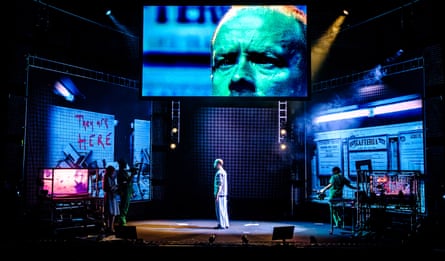
And a look is all he can give: there is so little dialogue in the visually based adaptation by directors Pete Brooks, Andrew Quick and Simon Wainwright that the four actors can only imply what they are thinking. What motivates their curt interactions we can only guess. When Travers stops being frightened and bewildered, he becomes unaccountably angry, his psychology always a mystery.
For all the dramaturgical flaws, however, it is impressively told. With handheld cameras, back projections and miniature props, the precisely choreographed actors provide the live feed for a filmic odyssey projected above their heads. Abby Clarke’s sets stick to a claustrophobic palette of dirty greens and fiery ochres, while James Hamilton’s ever-present score swells in symphonic waves and electronic pulses. Technically, it is a triumph; emotionally, it is on another planet.