.png) 9 hours ago
10
9 hours ago
10
UK mortgage approvals hit two and a half-year low
UK mortgage approvals have fallen to their lowest level in two and a half years, as the recent jump in borrowing costs hit demand for home purchases.
The Bank of England has reported that lenders approved 56,205 mortgages in May, down from 66,034 in April, and also below the average of 63,300 over the previous six months.
That’s the lowest total for mortgage approvals for any month since December 2023.
Approvals for remortgaging also decreased, to 33,300 in May, from 51,200 in April.
Potential homebuyers were hit by a rise in mortgage costs after the Iran war began, as the jump in the oil price pushed up bond yields as investors anticipated a surge in inflation.
Simon Gammon, managing partner at Knight Frank Finance, said:
“The uncertain economic outlook and mounting pressure on household finances caused a sizeable drop in mortgage lending to homebuyers during May. Leading fixed mortgage rates sat just above 4.5% during the month, up from around 3.5% before the conflict in the Middle East began.
“The property market remained fairly resilient through March and April, with mortgage lending running in line with long-run averages, but May’s data provided the first signs that a larger number of borrowers were beginning to sit on their hands. That’s unsurprising given the uncertain outlook for inflation, the rising cost of living and weaker consumer confidence. The property market is particularly vulnerable during periods of uncertainty because of high transaction costs – buyers often find it difficult to justify paying stamp duty.
“Conditions have improved since. The agreement between the US and Iran announced in mid-June prompted oil prices to fall sharply, easing inflation expectations and prompting a series of rate cuts by the major high street lenders. Should that agreement hold, mortgage rates could ease further through the summer, setting the stage for a recovery in the autumn. However, domestic political uncertainty around the incoming prime minister’s policy agenda remains a clear risk.”
Key events
“UK mortgage approvals - eek they’re weak!”
So says Anthony Codling, managing director of RBC Capital Markets, after mortgage approvals for house purchase fell to 56,205 in May.
He adds:
The sharp monthly decline is likely to negatively impact the UK housebuilders who had been enjoying a steady improvement through the first quarter of the year.
April’s print of 66,034 was the strongest since late 2024, making May’s fall all the more jarring. Year-to-date the picture remains broadly supportive: the January-to-May average of 61,972 is holding up, but momentum has stalled.
Chart: how UK mortgage approvals fell in May
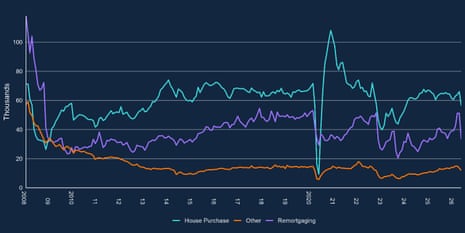
The total value of new mortgage approvals also fell in May.
Net borrowing of mortgage debt by individuals decreased to £2.9bn in May, down from £4.4bn in April, the Bank of England reports.
That’s the lowest since April 2025.
Damien Burke, head of regulatory practice at banking and credit advisory consultancy Broadstone, says:
“The sharp slowdown in mortgage borrowing and approvals suggests the surge in activity earlier this year has now faded, with buyers and homeowners taking a more cautious approach. While borrowing costs have eased from their recent highs, affordability remains stretched and many prospective buyers continue to contend with elevated house prices and wider cost-of-living pressures.
“For lenders, the changing outlook highlights the importance of integrating forward-looking affordability assessments that better reflect real borrower behaviour and lifetime income patterns. As caution rises, these more personalised models can help to sustain housing demand over the coming months.
UK mortgage approvals hit two and a half-year low
UK mortgage approvals have fallen to their lowest level in two and a half years, as the recent jump in borrowing costs hit demand for home purchases.
The Bank of England has reported that lenders approved 56,205 mortgages in May, down from 66,034 in April, and also below the average of 63,300 over the previous six months.
That’s the lowest total for mortgage approvals for any month since December 2023.
Approvals for remortgaging also decreased, to 33,300 in May, from 51,200 in April.
Potential homebuyers were hit by a rise in mortgage costs after the Iran war began, as the jump in the oil price pushed up bond yields as investors anticipated a surge in inflation.
Simon Gammon, managing partner at Knight Frank Finance, said:
“The uncertain economic outlook and mounting pressure on household finances caused a sizeable drop in mortgage lending to homebuyers during May. Leading fixed mortgage rates sat just above 4.5% during the month, up from around 3.5% before the conflict in the Middle East began.
“The property market remained fairly resilient through March and April, with mortgage lending running in line with long-run averages, but May’s data provided the first signs that a larger number of borrowers were beginning to sit on their hands. That’s unsurprising given the uncertain outlook for inflation, the rising cost of living and weaker consumer confidence. The property market is particularly vulnerable during periods of uncertainty because of high transaction costs – buyers often find it difficult to justify paying stamp duty.
“Conditions have improved since. The agreement between the US and Iran announced in mid-June prompted oil prices to fall sharply, easing inflation expectations and prompting a series of rate cuts by the major high street lenders. Should that agreement hold, mortgage rates could ease further through the summer, setting the stage for a recovery in the autumn. However, domestic political uncertainty around the incoming prime minister’s policy agenda remains a clear risk.”
Hopes of taming inflation could be undermined by a surge in freight shipping costs.
The cost of freight shipping has risen to its highest since summer 2024, when the Red Sea was effectively closed by Houthi rebel attacks, the Financial Times is reporting today.
They report:
The price of a 40ft container (FEU) — an industry-standard measure — between China and the US east coast rose to $7,880 last week, up 62 per cent from a month earlier, according to shipping platform Freightos. Rates between China and the Mediterranean jumped 47 per cent to $6,431.
These increases appear to be driven by companies trying to avoid a new round of US tariffs, expected next month.
UK’s Bridgepoint buys US real estate unit
Shares in UK private equity firm Bridgepoint have jumped by over 9% in early trading after announcing a foray into the US property world.
Bridgepoint are buying Florida-based Kayne Anderson Real Estate in a cash-and-share deal worth $1.393bn.
Although “Kayne Anderson” sounds like an exciting combination for England at the World Cup, they’re actually an investment management firm. As well as the real estate arm which Bridgepoint are buying, the group also operates in energy and infrastructure, private credit and wealth management.
Raoul Hughes, chief executive of Bridgepoint, says:
“This marks another major step forward in our strategy to strengthen our position as a leading global middle-market private markets platform. Real estate is a growing private markets asset class and Kayne Anderson Real Estate has built a leading position as a scaled specialist with an exceptional track record and strong fundraising momentum.
The Transaction is highly complementary and immediately accretive. Bridgepoint’s and Kayne Anderson Real Estate’s investor networks have limited overlap, creating attractive opportunities to broaden relationships and enhance fundraising.
Adding Kayne Anderson Real Estate creates a more balanced and diversified platform, with around half of our AUM invested in real assets and around half of our management fees generated in the US.”
BT and Verizon to create joint global business in $625m deal

Lauren Almeida
BT and the US mobile company Verizon are to combine their international businesses, ending the British telecom group’s more than 18-month search for a buyer.
Verizon will pay a $625m (£473m) “equalisation” fee to BT to guarantee equal voting rights in the new 50/50 joint venture, the companies announced on Monday. The deal is expected to create a company with more than 3,000 customers across about 180 countries and $4bn in combined annual revenue.
It marks the end of BT’s long search for a buyer of its international business, as its chief executive, Allison Kirkby, works to refocus the company on the UK market.
She said the deal marked an “important step forward for BT as a whole, as we deliver on our UK-focused strategy”.
BAT cutting 5,500 jobs in cost-saving drive
British American Tobacco has just become the latest company to cut jobs as it uses AI to boost productivity.
BAT has announced it will cut 5,500 jobs globally by the end of this year, through its Fit2Win transformation programme.
Fit2Win is expected to cut costs by £600m by the end of 2028, by reducing complexity, building closer partnerships with technology and business services companies, and streamlining the business.
Those partnerships include a tie-up with Accenture, to give access to “advanced AI solutions”.
Tadeu Marroco, chief executive of BAT, said:
“We are building a future-ready organisation that is more agile, cost disciplined and technology enabled.
“Fit2Win is central to this ambition, strengthening how we operate and our ability to compete in a rapidly evolving environment.
“These changes affect many of our colleagues, and we are focused on supporting them through this transition with care and respect, as we position the business for the future.
In addition, around BAT 3,500 roles have been moved to “strategic partners”.
South Korea announces $590bn chipmaking expansion
Over in Korea, two of the country’s chipmaking giants and the Seoul government have announced a massive manufacturing expansion costing more than half a trillion dollars, to address the shortages of AI chips.
President Lee Jae Myung pledged to cement South Korea’s leadership in the industry with investments worth more than $576bn over several years covering semiconductors, AI data centres and robotics.
Under the plan, Samsung Electronic and SK Hynix will build a total of four fabrication plants in South Korea’s southwest region.
Lee said:
“We must secure the core elements of AI faster than any other country.
Semiconductors, physical AI, and AI data centres are the triple axis for our great leap forward.”
South Korea’s stock market has more than doubled in value so far this year, thanks to the surge in demand for chips to power AI systems.
At the end of last week, Samsung’s share price has jumped 183% so far this year, while SK Hynix had risen 310% since the start of January.
Oil price rising after US-Iran attacks
The oil price is nudging higher, after the latest tit-for-tat military strikes between the US and Iran.
Brent crude is up almost 1% at $72.61 a barrel, having fallen to its lowest level since just before the confict began on Friday.
Oil prices are pushing. up after Tehran launched drone and missile attacks against Bahrain and Kuwait on Sunday after new US strikes on sites in southern Iran.
Last night, a US official said both sides had agreed to “stand down”, which is probably helping the oil price from rising more sharply.
Introduction: BoE chief economist warns against 'complacency' on inflation
Good morning, and welcome to our rolling coverage of business, the financial markets and the world economy.
The Bank of England’s chief economist is warning against complacency in the fight against inflation, after finding himself in a minority at this month’s BoE interest rate vote.
Huw Pill has told the Press Association that policymakers “should not be complacent” about the current rate of inflation, after the Consumer Prices Index (CPI) remained over the Bank’s 2% in May, at 2.8%.
Pill argued that in the past, inflation running around one percentage point above target would have been seen as “problematic”, adding:
“I think it should be seen as problematic, because our mandate is very clear; inflation at 2% at all times.”
“I do fear a little bit that, because we saw inflation go to 11%, policy discussion becomes, ‘oh inflation at 3% is not so bad’.”
Two week’s ago, the Bank’s monetary policy committee split 7-2 when it voted to leave borrowing costs on hold, with Pill and Megan Greene the lone voices for a hike in Bank rate.
Pill also appeared to criticise the six cuts in interest rate since August 2024, arguing that on balance monetary policy “hasn’t been restrictive enough over the last few years.”
City economists have been cutting their forecasts for UK interest rate rises in recent weeks, as tensions in the Middle East have cooled somewhat, and the oil price has fallen.
The City money markets are now only fully pricing in a rise in interest rates by next February – earlier this year, as many as three rises this year were priced in.
But the latest round of escalating strikes between Iran and the US last weekend has shown that the peace deal will not be easy to secure.
As Pill puts it:
“The world is becoming more uncertain and becoming more complex,” Mr Pill concluded.
“What we can guarantee is that monetary policy is not adding to uncertainty, and I think that is where we should keep the focus.”
The agenda
-
9.30am BoE mortgage approvals and consumer credit data
-
18.30pm BST: Christine Lagarde, president of the European Central Bank, gives speech at the ECB Forum on Central Banking 2026