.png) 5 hours ago
7
5 hours ago
7
So shocked were the worthies of the venerable Three Choirs festival by the eunuchs and concubines littering William Walton’s Belshazzar’s Feast that they banned the work for 26 years (the powers that be finally unpursed their lips sufficiently to allow it to be performed in 1957). These days it’s a hot ticket judging by the enthusiastic crowd packing out Gloucester Cathedral for this opening concert. It’s also a significant test of any group of singers, and one that this year’s Festival Chorus passed with flying colours.
The UK premiere of Gavin Higgins’ Fanfare Americana opened proceedings, a likable work celebrating the can do attitude prevalent in the US. Whooping brass and tubular bells propelled vast wodges of sound into the resonant cathedral acoustic that exploded like exuberant fireworks. Adrian Partington led the Philharmonia Orchestra in a delightfully Tiggerish account.
The noble tread of Elgar’s First Symphony brought matters down to earth, though the music took a little time to settle. The opening movement might have benefited from greater elasticity, and tempo changes needed more time to breathe. It was exhilarating nonetheless, as was the scherzo, which ran the gamut from elfin filigree to Darth Vader-ish menace. A warm, yet unsentimental Adagio preceded a brisk finale with plenty of Edwardian fire in its belly.
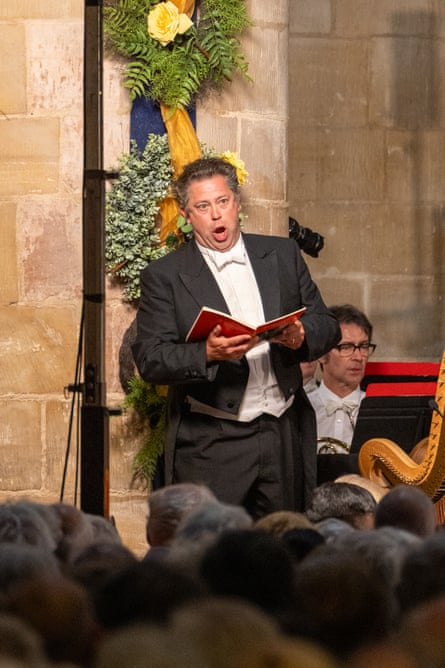
The evening, however, belonged to the 141-strong Festival Chorus who delivered Walton’s cantata with discipline, diction and considerable clarity of intent. Blend and balance were highly impressive for what is essentially three choirs thrown together as one with inner parts and intricate intertwining lines invariably distinct. The male voices aced it in their forceful opening salvo, with female voices joining to pour their hearts out by the waters of Babylon.
David Stout injected theatricality and a rare humanity into the baritone solos, his stentorian tones leading choir and orchestra into a “Praise ye the Gods” section that built to a terrific percussion-riddled hullabaloo. Partington adopted an ideally flexible approach here, drawing out the grinding dissonances in “Thou, O King, art King of Kings” and bringing a crackling energy to the concluding hymn of praise. As noises go, this one was joyful indeed.