.png) 4 hours ago
9
4 hours ago
9
A deadly van ramming and knife rampage near Berlin’s Pride festival was an Islamist terrorist attack, German authorities have said as the hunt for the main suspect continues.
One person was killed and 29 others were injured after a man drove a minivan into a crowd of pedestrians, then attacked people with what appeared to be a machete. The attack took place in the Tiergarten park near the Brandenburg Gate at about 10pm local time on Saturday, close to one of Europe’s biggest LGBTQ+ celebrations.
The German interior minister, Alexander Dobrindt, named the chief suspect as 21-year-old Abdul Ballout, and said Ballout was thought to have used a machete to attack people, leaving some victims with life-threatening injuries. “Everything we see here indicates that we are dealing with an Islamist terrorist attack,” Dobrindt said.
“We are dealing here with a suspected perpetrator, who had previously drawn attention to himself through a high volume of criminal offences, radicalisation and affiliation with the Islamist scene,” Dobrindt told a press conference near the site of the attack. He said Ballout had a criminal conviction and had been sentenced to a year and 10 months in prison, but that the sentence had been suspended.
German media reported that Ballout, a German national with Lebanese roots, was a supporter of Islamic State and last year travelled to the Middle East in a failed attempt to join the group. He was then convicted in Germany of “preparing a serious act of subversive violence”, the news outlets Bild and Der Spiegel reported.
Police and prosecutors have asked for help in finding Ballout, but warned the public to avoid “direct contact” with him, saying he may be armed and dangerous.
Ballout is described as thin, about 1.90 metres (6ft 3in) tall with black hair, and dressed in a black hoodie and white trousers.
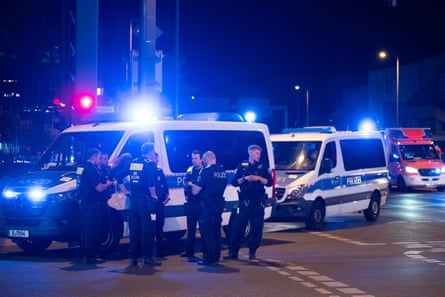
Police searched an apartment in the Schöneberg district of Berlin in the early hours of Sunday, but said they had found no one there.
The chancellor, Friedrich Merz, urged Germany to avoid division and intimidation in the aftermath of the attack. “We will think about consequences, we will defend our freedom,” he said in a news conference.
Earlier, Merz vowed to punish those responsible, describing the “heinous act” as an “attack on our society” in a social media post. The flag at the German Bundestag was ordered to be lowered to half mast.
The attack forced organisers to cut short one of Europe’s largest Pride events and came as Germany remained on edge after a series of deadly vehicle and knife attacks.
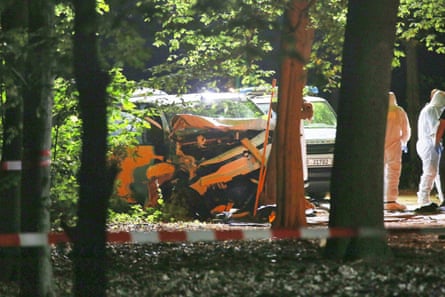
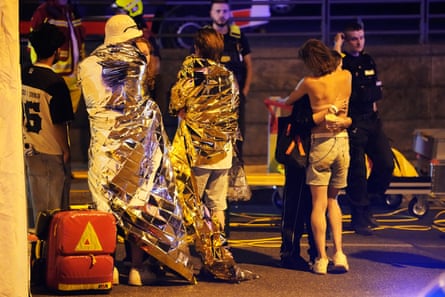
Hours after the attack many details remained unclear, but police said the vehicle had struck multiple people after being driven into the Tiergarten close to the Brandenburg Gate. Police said those hurt “included several with life-threatening injuries”.
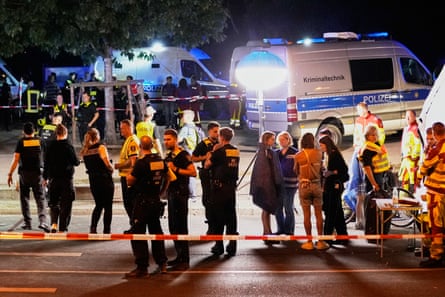
The driver of the white minivan had swerved shortly before 10pm into the park, close to where the route of the Pride march had been earlier in the day, hitting people on a path and crashing into a tree, police said.
“[The vehicle] was empty, which is why we are currently working intensively to track down the perpetrator or perpetrators,” police said. Bild cited a witness as saying that a man had emerged from the vehicle and fled on foot.
A hunt involving helicopters and officers from several German states was under way across the capital on Sunday.
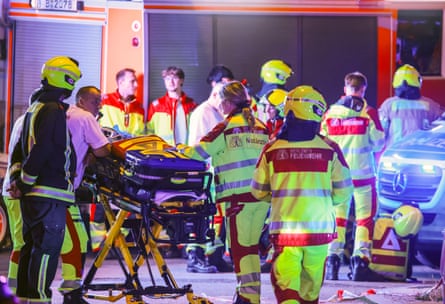
Emergency workers set up a helicopter landing pad near the Reichstag parliament building to transport the injured to hospitals.
Julian Methig, who attended the event, described it as a terrible day. “It’s one of the worst days for the queer community and a day I personally hoped I’d never have to experience … I’m shocked,” he said.
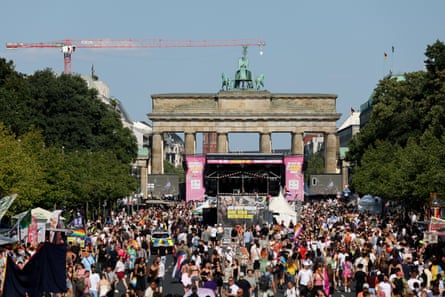
Hundreds of thousands of people had gathered in Berlin in warm summer sunshine to celebrate the Pride parade.
It is known in Germany as Christopher Street Day (CSD), named after the site of the Stonewall Inn in New York City where riots against police raids touched off the modern LGBTQ+ rights movement. CSD was first held in West Berlin in 1979.
Berlin’s mayor, Kai Wegner, called the deadly assault “an attack on our free and cosmopolitan society”.
“Following a peaceful and colourful CSD, the rally for a tolerant and peaceful Berlin was attacked in the most brutal manner,” he said on X. “Berlin is the city of freedom – and our freedom has today been attacked in the most appalling way. My thoughts are with the victims, their families and friends.”
For the first time in its history, CSD began on Friday night this year with a pro-democracy political rally. Berlin will hold a state election in September.
The parade on Saturday ran under the motto “taking a stand is hot”, which organisers said was “in response to increasing hostility” to LGBTQ+ people in Germany.
More than 80 floats and 50 groups on foot joined the procession through the city centre past Potsdamer Platz and the Victory Column monument in the Tiergarten, culminating in a rally at the Brandenburg Gate.
Earlier in the day one person was arrested for resisting police orders at a far-right counterprotest.
Before last year’s parade, Berlin LGBTQ+ organisations sounded the alarm that attacks had become more frequent while hard-won rights were under threat. Campaigners said a rise in hostility had accompanied the surge in support for the far-right Alternative für Deutschland (AfD), now the most popular party in national opinion polls, as well as an increase in Islamist-inspired attacks.
European leaders offered solidarity, including heads of government in Belgium, the Netherlands and Sweden. “Italy firmly condemns and opposes all forms of hate and extremism,” the Italian prime minister, Giorgia Meloni, wrote on X, adding: “We stand with Germany and the German people.” The French president, Emmanuel Macron, said: “Faced with hatred and violence, our response will always be unity, freedom, and resolve.”
The European Commission president, Ursula von der Leyen, a German centre-right politician allied with Merz, sent her deepest sympathy to the victims of the attack, describing the CSD parade as standing for “freedom, dignity and equality – the fundamental values of the EU”.
Britain’s foreign secretary, Ed Miliband, said he was “horrified by the appalling attack in Berlin” and had spoken to his counterpart, Johann Wadephul, “to convey the UK’s solidarity: we stand with Germany”.
Far-right leaders were also quick to comment on the attacks. The co-leader of the AfD Tino Chrupalla wrote on X: “We will not allow religious extremists to divide our country with violence and intolerance!”
The president of France’s far-right National Rally, Jordan Bardella, wrote: “The Islamist threat remains a major issue in Europe and continues to target what they hate most about our civilisation – and what we cherish so much – freedom.”