.png) 3 months ago
42
3 months ago
42
Abraham Rodríguez stares at the corn furrows he must plough before the end of the day. It is not even noon in Artemisa, Cuba, but the sun beats down hard and he’s already tired: working the land is a tough job. He has done it for almost half his life, since he was 13 and his mother got a divorce. He is turning 26 this year.
Farming has always been hard, he says, but now it is almost impossible to sustain. “I make 1,200 pesos (£1.80) a day, so I have to work two days to buy a bottle of oil.”
It has been weeks since he ate meat. His last meal, last night, was a dish of white rice and fried banana. “Breakfast? What’s that?” he says.
Not so long ago, he could spend part of his salary on eating out once a week, but after Covid, he says, everything changed for the worse. Now, he wouldn’t mind a US intervention, “as long as it’s for the better”.
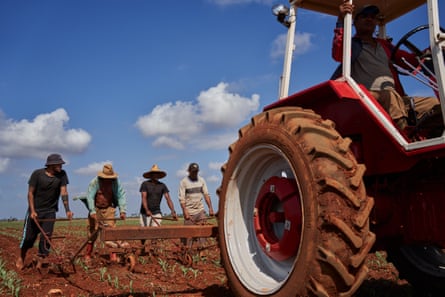
In Artemisa, Cuba’s rural heartland just south of Havana, many farmers survive on scarce meals, unable to afford essentials, while cuts to the state procurement system – under which the government buys farmers’ products – leave crops to rot in the fields. The crisis, worsened by post-Covid inflation and US sanctions, drives some towards illegal charcoal trading or migration, as families split to survive.
Rodríguez’s situation is not exceptional. Yomar Matos, originally from Guantánamo, worked in construction in Havana for years until three months ago, when unemployment forced him to turn to farming for a living.
He relocated to Artemisa to join his brother and stepfather, who have been working in agriculture since leaving Guantánamo seven years earlier. The three of them share a small plastic bottle with a little black coffee and a couple of cigarettes – their breakfast for the day.
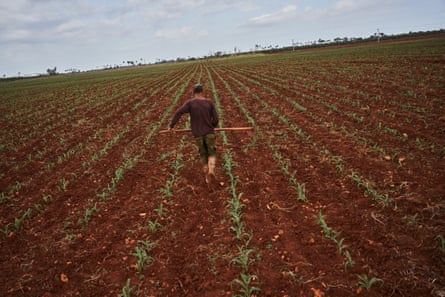
“I have two kids,” Matos says, his voice shaking slightly. He says one of his daughters is living in Curitiba, in southern Brazil. “The girl is nine; she’s in Brazil with her mother, who works as a supermarket cashier. They are better off than here.”
He adds, smiling: “My girl left skinny, and now she’s grown up just like me.” His other daughter is five months old and lives with her mother in Cuba.
Once known as “Havana’s granary”, Artemisa supplies about 40% of the capital’s fresh produce. Its fertile soils and warm climate have made it a key region for producing grains, vegetables and fruit, and its diversified farming – including sugarcane and livestock – have reinforced its reputation as a heartland of Cuban agriculture.
“Proud to be farmers” reads a Communist party sign by the road. But the farmers say working the land is becoming increasingly difficult. Fuel shortages are driving up costs, and many say agriculture is no longer economically sustainable.
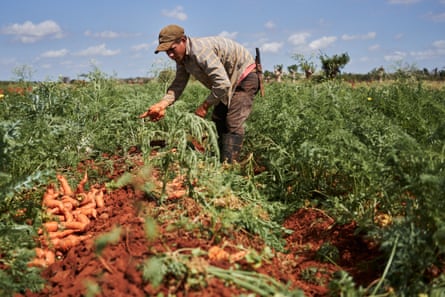
Edián and Maykel Romero Álvarez are siblings who inherited a small plot of land from their father and grandfather. They have lived off the land their whole lives, but now worry about the future. The US intervention in Venezuela in January, in which military troops captured the socialist president, Nicolás Maduro, only exacerbated Cuba’s energy crisis.
“Since Trump took Maduro, everything changed,” Maykel says as he watches a couple of his workers harvest carrots. “Now we don’t have a drop of fuel, so we can’t sell our produce.”
He hates to see food go to waste in a time of such need. “It’s very sad to harvest a good crop and not be able to sell it.”
Although land in Cuba has been mainly state-owned since the revolution in 1959, its management has changed over the years. For decades, Cuban agriculture was focused on large-scale industrial monoculture, particularly sugar. This production system contributed to soil degradation and was highly dependent on exports to the USSR.
After the collapse of the socialist bloc, the government promoted crop diversification, the creation of cooperatives and the redistribution of state land in usufruct to farmers, who were required to sell a share of their produce to the state and allowed to market the rest.
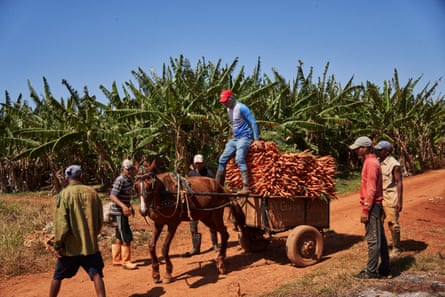
This approach avoided a food system collapse, but it never became efficient or viable for farmers, leaving some agricultural land abandoned. In 2008, the then president, Raúl Castro, loosened regulations in a bid to attract new farmers to cultivate idle state-owned land.
“The only thing you had to prove was that you had a minimum of equipment and machinery to work the land, and they gave you up to 13 hectares [32 acres],” says Marie Aureille, an anthropologist researching Cuban agriculture at the Laboratory of Political Anthropology in Paris.
Yet these small producers receive little investment, as the government has prioritised cooperatives and state farms, while still encouraging them to keep producing despite the energy crisis, under a revolutionary rhetoric of “feeding the nation”.
Maykel shakes his head: “We work so people can eat – we need solutions urgently.”
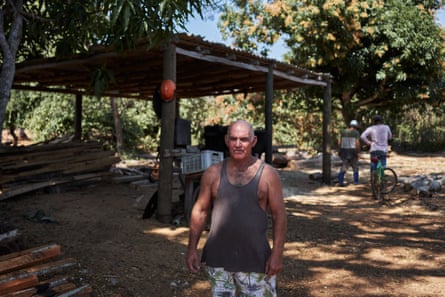
Charcoal is another business evolving in Cuba’s rural regions, driven by increased demand due to repeated blackouts. Luis Torres García, 63, has been producing it in his back yard near the town of Güira de Melena for as long as he can remember. “We’re used to cooking with it,” he says. “It’s in the towns and cities where people are having a hard time.”
Each morning, he heads into the forest to cut marabú wood, hauls it home by tractor and burns it in a homemade open-air oven for 10 days until it turns to charcoal. His main client is the state, which pays 900 pesos for a sack of about 20lbs (9kg). Like the farmers, he is allowed to sell any surplus privately to cover costs.
He charges the market rate – about $2.40 (£1.80) a sack – though prices have climbed as high as $4 a sack. “I remember what it was like to be poor, to be hungry and in need,” he says. “Why should I take advantage?”
On the porch, his wife, Milagros Moreno, carefully sorts rice, picking out impurities grain by grain. She worked as a nurse in Güira de Melena, but transport has deteriorated to the point that she can no longer make it in. Both are critical of Trump’s “maximum pressure” campaign.
“That crazy old man should leave Cuba alone so we can trade with other countries,” Torres García says, clicking his tongue. “They want to suffocate us, to provoke war against the state.”
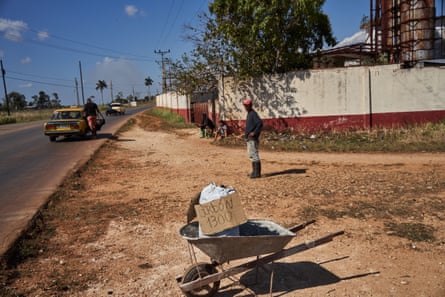
A few kilometres down the road from Torres García and Moreno’s farm, Ángel Reyes, 42, sells charcoal sacks for 1,300 pesos. Unlike Torres García, he entered the trade only a few weeks ago. He used to work as a taxi driver in San Antonio de los Baños, but fuel shortages forced him to find an alternative. Charcoal offered a way “to fight the money”.
His hands are covered in blisters from the spines of marabú trees; he has no gloves nor intentions of looking for any. “Where would I find them, anyway?” he asks.
Reyes knows he could face state inspections, as it usually oversees production, but has not encountered any so far and does not seem concerned. “It’s simple: I need to feed my children,” he says, “I can buy them a pair of shoes once a year – but food, you need to eat every day.”