.png) 4 hours ago
3
4 hours ago
3
Summer is at an end, and suddenly spiders seem to be everywhere – in your house, in your garden, in your hair. Fresh webs hang from doorways, walls, shrubs and fence posts, creating invisible obstacle courses. Where do all these spiders come from, what kind are they and what, if anything, should we do about them?
The short answer to the question “Why are there so many more spiders at this time of year?” is: there aren’t. They are just more obvious. Dave Clarke, an ectotherm (“cold-blooded” animal) specialist at the Zoological Society of London, says: “There are more spiders around in the spring, because that’s when they hatch from their egg sacs, and there are hundreds of babies in each egg sac. But they’re small and not very obvious. They grow up during the summer and, at this time of year, they reach their maximum size.” Their webs are also correspondingly larger.
The other reason they are more apparent is that they are finding their way indoors in the desperate search for a mate. Dr Sara Goodacre, professor of evolutionary biology and genetics at the University of Nottingham, says: “The ones you see in your home at the minute, the really big, fat, hairy ones, they’re usually teenage males that are lost – emotionally, geographically – and are just hoping they might find a female so they can continue the life cycle.”
The spider season can be a difficult time for people who don’t like spiders, but a little knowledge about these fascinating creatures can go a long way to promote understanding. Here, then, are the 10 spiders you’re most likely to run into this autumn.
1. House spider (Tegenaria domestica)
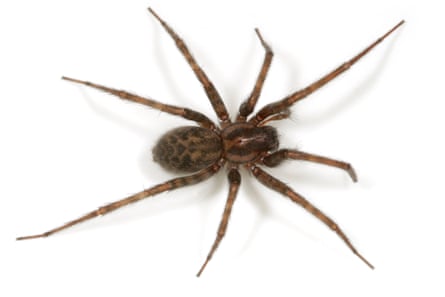
One of the species you are likely to find in your home, the house spider ranges from pale to dark brown, with black markings and banded, hairy legs. While the name seems to imply that it thrives only within four walls, that is not the case. “They’re not called house spiders because they have to live in your house,” says Clarke. “It’s just because it’s the commonest species you would see inside the house.” Centrally heated homes are generally too dry and too short of food for most species of spider so you don’t have to feel bad about gently relocating one. “It’s your home,” says Goodacre. “You decide who you share it with.”
If you wish to evict a house spider, trap it gently in an upturned glass and slide a piece of card underneath the glass. At this time of year, it’s probably best to release it somewhere with a bit of shelter – a porch, shed or garage.
2. Cardinal spider (Tegenaria parietina)
The cardinal is the largest spider native to the UK, one of a range of hard-to-distinguish species in the genus Tegenaria that also go by the name giant house spider. The term “giant” is in some cases an exaggeration, but not here: adult cardinal spiders can reach a total leg span of 14cm.
They are allegedly called cardinal spiders because Cardinal Wolsey was terrified of them, or because he was protective towards them, or he thought they were lucky, or something. They are found in the south of England, but not the extreme southwest.
3. Cellar spider (Pholcus phalangioides)
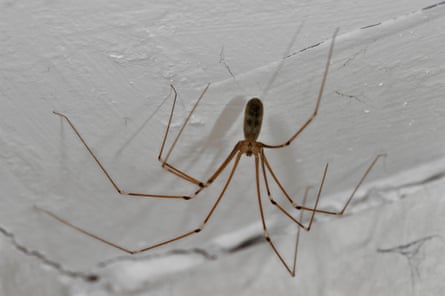
It is also known as the daddy-longlegs spider (its legs are about five times the length of its body), but this can be confusing because the name daddy longlegs is also used for a type of crane fly and for harvestmen, the latter of which are arachnids but not spiders.
Cellar spiders are originally subtropical, but they have spread around the world thanks to indoor living. They spin quite untidy webs and generally hang out in the corners where walls meet ceilings. When disturbed they can gyrate rapidly, turning themselves into a blur which, in theory, is supposed to convince predators that they have vanished.
4. Garden spider (Araneus diadematus)
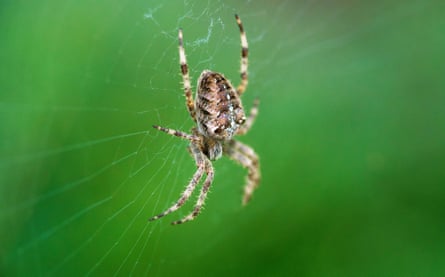
If you have ever stepped out your back door and walked face first into a spiral spider’s web, chances are it belonged to a garden spider. “They’re one of the most obvious because they tend to sit in the middle of the web,” says Clarke. “I’ve been blundering into loads of their webs in my garden over the last few weeks because they are very good at building them right across the path.”
Garden spiders range in colour from grey-brown to reddish-brown, with a white cross – made up of speckles – on the abdomen. Females are twice the size of males, with a body length of up to 1.8cm.
5. False Widows (Steatoda nobilis, Steatoda bipunctata, Steatoda grossa)
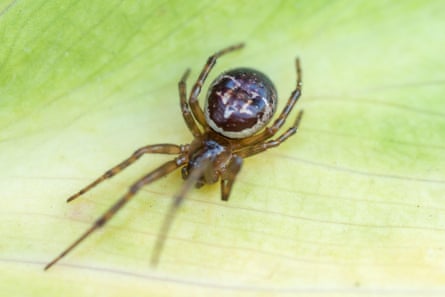
Of the three false widows, two – the cupboard false widow (Steatoda grossa) and the rabbit hutch false widow (Steatoda bipunctata) – are native to Britain. The other, the noble false widow (Steatoda nobilis), turned up here some time in the late 19th century from the Canary Islands. The noble false widow is the one that gets all the bad press: it’s often referred to as “Britain’s most dangerous spider”, a construction roughly as misleading as “Britain’s most earthquake-prone region”. It’s not a competition that is hard to come top in. Medium-sized with a glossy black abdomen, the spider is, in fact, solitary and not in the least aggressive.
False widows can bite, although confirmed cases of them biting humans are rare, and while they are venomous, the common reaction to the bite is similar in severity to a nettle or wasp sting. “But it doesn’t fly like a wasp,” says Goodacre, “so you’d have to try really hard [to get bitten]. The level of hysteria is the worst bit – people feel ill because they’re so worried about the concept of a spider bite.”
You may regard all other spiders commonly found in Britain as essentially harmless. And Britain’s most earthquake-prone region is Perth and Kinross, by the way.
6. Missing sector orb weaver (Zygiella x-notata)
Often found in and around windows, this spider is usually silver-grey with an oak-leaf mark on its back, but it’s easiest to identify by its web: a classic circular pattern with one pie slice missing. This gap is bisected by a single thread, running from the outer edge to the centre, from which the spider can pick up the vibrations of anything landing. “They don’t sit in the middle of their web; they sit hidden on your windowsill,” says Goodacre. “They always sit with one foot casually out, but there’s nothing casual about it – it’s sensing.”
7. Tube web spider (Segestria florentina)
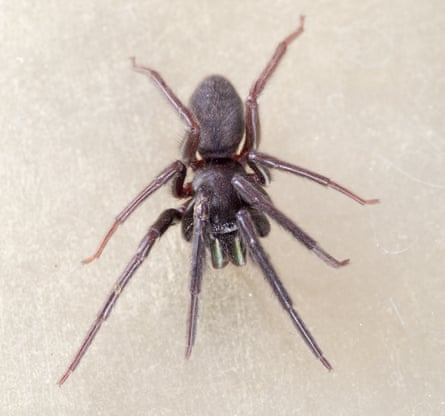
One of the biggest spiders found in the UK – mostly in the south – its body can reach 2.2cm in length. It’s easily identifiable by its iridescent green mouth parts, but only if you can see them: tube web spiders spend most of their time tucked into holes in brick walls or fences, at the centre of their vortex-shaped web, waiting to pounce on any prey disturbing the silken tripwires. “If you’re very careful, you can often get them to come out of their retreat with a grass stem or something like that,” says Clarke. But it won’t work if you just touch it with your finger – they can sense the difference. This spider does have a venomous bite, which is said to be painful but not dangerous, but it’s a very reclusive creature, so you’d have to really bother it to get bitten.
8. Zebra jumping spider (Salticus scenicus)
These little spiders are between 5mm and 9mm long, can jump about 10 times their length, and have been observed taking on prey up to three times their size. Despite their predatory nature, they are among the most adorable of all spiders, thanks to their zebra-stripe markings and their two big, front-facing SpongeBob eyes. “If you see a jumping spider and you look at it, it will look up at you, which is very cute,” says Clarke. For what it’s worth they also have six smaller eyes, distributed down their flanks and in the rear.
9. False wolf spider (Zoropsis spinimana)
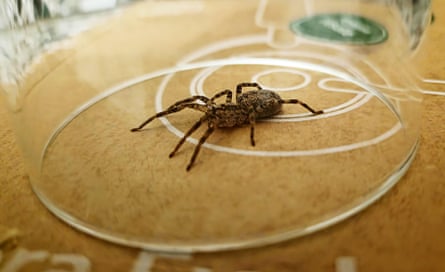
This gets its name because of its outward resemblance to wolf spiders. Like wolf spiders, they don’t trap their prey in webs – they go out and hunt it down. It’s also known as a Nosferatu spider, because the markings on its back look like a little vampire face. Normally found in the Mediterranean, the false wolf has only recently arrived in the UK, and is increasingly likely to be spotted in and around London. “This is a species that really wouldn’t survive our harsh winters outside,” says Clarke, “so they do rely on human structures.”
10. Woodlouse spider (Dysdera crocata)
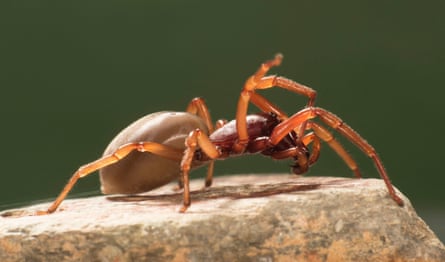
They get their name not because they resemble woodlice, but because they eat them. Their look, in fact, is quite distinctive: reddish orange with a peanut-shaped abdomen, and large enough fangs to penetrate the protective armour of a woodlouse. “People are often quite surprised when they see one because they look quite exotic,” says Clarke. But they’re not rare; just quite demure. “I think they prefer to be hidden away underneath things a lot of the time, rather than running about in the open.”